06/06/2015
By Uri Avnery*
6 June 2015
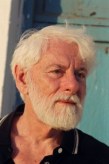
Uri Avnery
THREE WEEKS ago was Naqba Day – the day on which Palestinians inside and outside Israel commemorate their “catastrophe” – the exodus of more than half of the Palestinian people from the territories occupied by Israel in the 1948 war.
Each side has its own version of this momentous event.
According to the Arab version, the Jews came from nowhere, attacked a peace-loving people and drove them out of their country.
According to the Zionist version, the Jews had accepted the United Nations compromise plan, but the Arabs had rejected it and started a bloody war, during which they were convinced by the Arab states to leave their homes in order to return with the victorious Arab armies.
Both these versions are utter nonsense – a mixture of propaganda, legend and hidden guilt feelings.
During the war I was a member of a mobile commando unit that was active all over the southern front. I was an eye-witness to what happened.
I wrote a book during the war (“In the fields of the Philistines”) and another one immediately afterwards (“The Other Side of the Coin”).
read more »
Posted in Middle East, Others-USA-Europe-etc., The Peoples, War Lords |
Leave a Comment »
06/06/2015
Milan 5 June, 2015 – “We need to change the way we produce food,” FAO Director-General Jose Graziano da Silva said today in a World Environment Day speech advocating creating positive connections between food, agriculture and the environment.
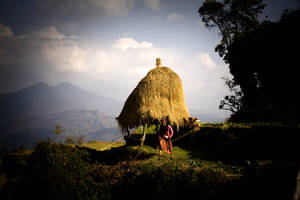
A Nepali woman returns from her fields. The straw will be used to make rugs and feed livestock. | FAO
Governments, citizens, producers and investors must forge a “new and holistic way of thinking and, of course, acting” to face down climate change and feed a growing population, he said at the Expo 2015 in Milan.
He cited two guiding principles – ensuring everyone has access to food, and making our food systems sustainable – as critical to the effort to feed the world’s growing population while conserving the the health of soils and other natural resources that human life needs to flourish.
read more »
Posted in Africa, Asia, Latin America & Caribbean, Market Lords, Middle East, Mother Earth, Others-USA-Europe-etc., The Peoples |
Leave a Comment »
06/06/2015
5 June 2015 – With many of the earth’s ecosystems nearing “critical tipping points,” the United Nations invited each of the seven billion people on the planet to mark this year’s World Environment Day by making one change towards a more responsible consumption of resources – “be it refusing to buy single-use plastic bags or riding a bike to work.”

Sugar cane and soybean plantations have replaced hectare after hectare of jungle as the Amazon has been exploited in the name of agriculture, with little regard for the environmental impacts. Photo: UNEP GRID Arendal/Riccardo Pravettoni
“Humanity continues to consume far more natural resources than the planet can sustainably provide,” Secretary-General Ban Ki-moon said in this year’s message for the Day, observed annually on 5 June. “It is time for us to change.”
read more »
Posted in Africa, Asia, Latin America & Caribbean, Market Lords, Middle East, Mother Earth, Others-USA-Europe-etc., The Peoples |
Leave a Comment »
05/06/2015
‘From Wasted Economy to Wasted Planet: Why Changing Our Consumption Patterns is a Choice We Must Make!’

UNEP
Editorial by Achim Steiner, UN Under-Secretary-General and Executive Director of the UN Environment Programme*
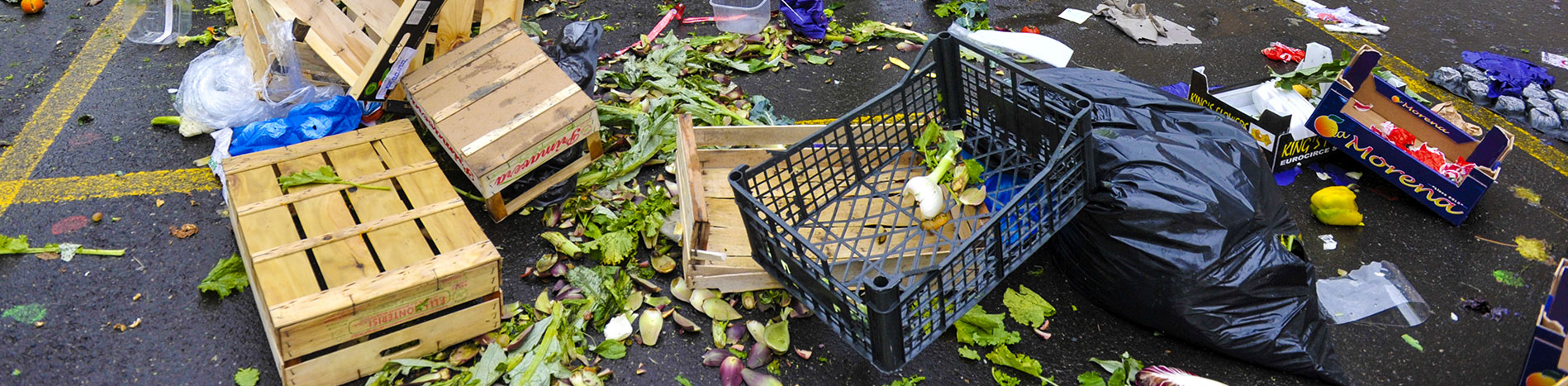
As we sit down to lunch or dinner on this World Environment Day, it is important to consider this: one-third of all food produced globally each year – 300 million tonnes – is wasted. This waste costs the global economy a staggering one trillion dollars a year.
Industrialized regions account for almost half of the total. The food we discard is still fit for human consumption and could feed more than 800 million people in the world today.
This is just the tip of the waste iceberg, and serves as a proxy for the ‘ecological footprint’ of our entire global economy. Our global food system is responsible for 80 per cent of deforestation and is the largest single cause of species and biodiversity loss.
read more »
Posted in Africa, Asia, Latin America & Caribbean, Market Lords, Middle East, Mother Earth, Others-USA-Europe-etc., The Peoples |
Leave a Comment »
05/06/2015
5 June 2015, Stockholm International Water Institute (SIWI)* – Today, on World Environment Day, we launch the movie One Water – For Sustainable Development.“Water is a precondition for human existence”, says UN Deputy Secretary-General, Jan Eliasson. Water is health, water is energy, water is food, water is climate, and water is equality.

This year, we also celebrate the 25th Jubilee of Stockholm Water Prize. Hear from previous recipients of the Prize, Rita Colwell, Sunita Narain and Tony Allan about water’s centrality to sustainable development.
Watch, share and help us spread the message through hashtag #WaterIs!
read more »
Posted in Africa, Asia, Latin America & Caribbean, Market Lords, Mother Earth, Others-USA-Europe-etc., The Peoples |
Leave a Comment »
05/06/2015
The UN estimates that more than 3.8 million people, representing a third of South Sudan’s population of 11 million, do not have sufficient food.
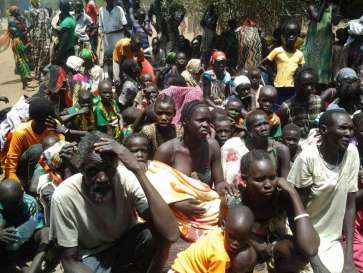
© UNHCR/R.Riek | South Sudanese refugees wait to be registered at a crossing into Ethiopia earlier this year.
The UN refugee agency on 2 June 2015 reported that heavy fighting over the last two months in South Sudan’s Unity and Upper Nile states has displaced more than 100,000 people and blocked humanitarian aid deliveries for some 650,000 people.
“Refugees cite the upsurge in fighting, but also growing food insecurity as the main reasons for fleeing their homes. It’s estimated that more than 3.8 million people, representing a third of South Sudan’s population of 11 million, do not have sufficient food,” UNHCR spokesman Adrian Edwards told journalists in Geneva.
read more »
Posted in Africa, Market Lords, The Peoples, War Lords |
Leave a Comment »
05/06/2015
Critical aid operations supporting millions of people affected by the conflict in Iraq are at risk of shutting down unless funds are made available immediately, senior United Nations on 4 June 2015 warned as they joined an international appeal for nearly $500 million to cover the immediate needs of 5.6 million Iraqis for the next six months.

Baharka IDP camp for displaced Iraqis on the outskirts of Erbil, northern Iraq. Photo: © UNICEF/Philip Hazou
“Humanitarian partners have been doing everything they can to help. But more than 50 per cent of the operation will be shut down or cut back if money is not received immediately,” Lise Grande, the UN Humanitarian Coordinator for the war-torn country said at an appeal launch at the European Parliament in Brussels.*
The implications of this, Grande said, would be “catastrophic” in what is already one of the most complex and volatile crisis anywhere in the world. Humanitarian needs in Iraq are huge and growing. More than 8 million people require immediate life-saving support, a number that could reach 10 million by the end of 2015.
read more »
Posted in Middle East, Others-USA-Europe-etc., The Peoples, War Lords |
Leave a Comment »
04/06/2015
By Johan Galtung and Naakow Hayford*
3 June 2015 (TRANSCEND Media Service) — There is much to agree with Robert D. Kaplan’s 25 May 2015 publication in Foreign Policy in his well-informed analysis. And very much to disagree with, especially his wrong remedy.

Source: Arab League | Wikimedia Commons
Kaplan ascribes the present “chaos” –as if major changes can be orderly or take place under old much praised “order” and “stability”– to the break-down of imperialisms, in plural, starting with the collapse of the Ottoman Empire in 1918.
And he manages the incredible: not a single word about who gave them that death blow: Sykes-Picot, UK-France, helped by czarist Russia. Analysis?
read more »
Posted in Middle East, Others-USA-Europe-etc., The Peoples, War Lords |
Leave a Comment »
04/06/2015
Nearly eight months after the ceasefire that ended the most recent hostilities in the Gaza Strip, not a single destroyed home has been rebuilt in the enclave, the United Nations agency mandated with ensuring the well-being of Palestine refugees reported six weeks ago. Now the United Nations has announced that a UN-backed project is to provide hundreds of new housing units to Palestine refugees in Gaza.

UNRWA says almost eight months after the announcement of the ceasefire, not a single totally destroyed home has been rebuilt in Gaza. Photo: UNRWA Archives
“To date 9,161 Palestine refugee houses have been considered totally destroyed and 5,066 have suffered severe, 4,085 major and 124,782 minor damages,” on 23 April 2015 said Chris Gunness, spokesperson for the UN Relief and Works Agency for Palestine Refugees in the Near East (UNRWA).*
read more »
Posted in Middle East, Others-USA-Europe-etc., The Peoples, War Lords |
Leave a Comment »
04/06/2015
By Rene Wadlow*
2 June 2015 (TRANSCEND Media Service) – As Winston Churchill once quipped “God so loved the world that he did not send a committee”.

The Drafting Committee of the Review Conference on the Treaty on the Non-proliferation of Nuclear Weapons (NPT) was unable to draft an “outcome document” or as it is sometimes called “a final statement”.
Even with the last-days efforts of the President, Ambassador Taous Feroukhi of Algeria and the UN Disarmament Secretariat to smooth over the rough edges of the document by weakening all the controversial wording, there was no possible meeting of minds.
In the end, the USA, UK, and Canada refused to accept the final document citing the paragraph proposing a nuclear-weapon free zone in the Middle East.
Since there has been no visible progress on the reduction of nuclear weapons through negotiations among the nuclear-weapon States − the USA and the Russian Federation hold some 95% of them − efforts have been made to make legally-binding nuclear-weapon free zones.
read more »
Posted in Asia, Middle East, Mother Earth, Others-USA-Europe-etc., The Peoples, War Lords |
Leave a Comment »



 HUMAN WRONGS WATCH