08/02/2016
By Teddy Leposky*
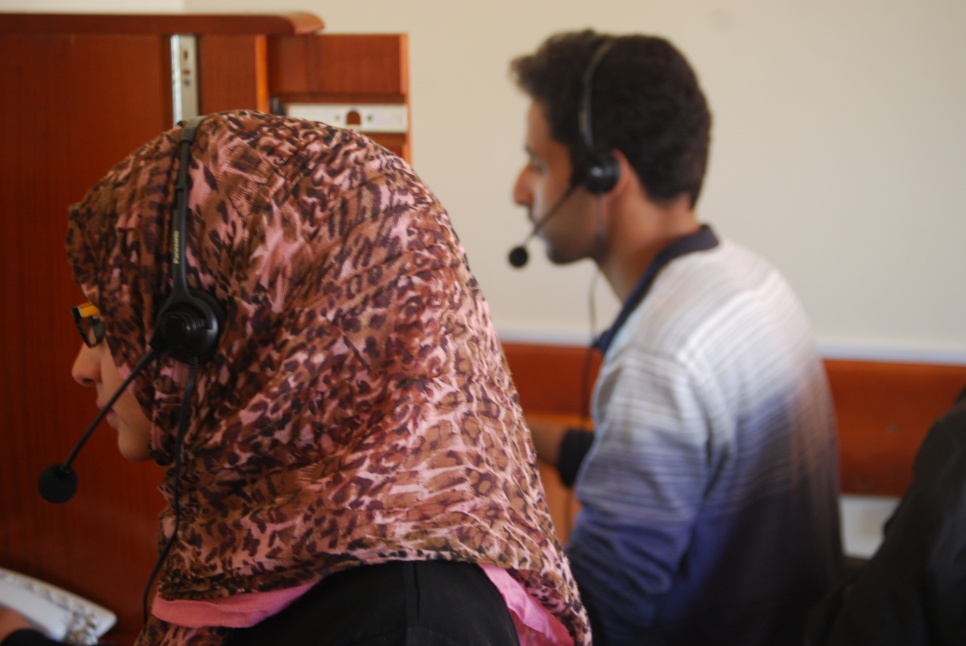
SANA’A, Yemen, 5 February 2016 (UNHCR) – Fleeing airstrikes near his home in Haradh, near the border with Saudi Arabia, Yemeni father of 10 Ahmed* sought shelter in the capital Sana’a – where he found help was only a phone call away.

© UNHCR/A.Alsayaghi | A new call centre in Sana’a provides an essential bridge between Yemenis and the humanitarian community.
“We lost everything and wherever I go I am humiliated,” he told an operator he called at Tawasul, an innovative new call centre set up to link Yemenis in need with those in those in the humanitarian community who are there to assist.
read more »
Posted in Climate Crisis |
Leave a Comment »
08/02/2016
By Mohamed Omar Mulla*
GARDO, 5 February 2016 (IRIN) – Somalia is the new home for 30,560 people who have fled the fighting in Yemen and are trying to adjust to life in a country that – while no longer written off as a “failed state” – certainly has its challenges.
.
Many who once left Somalia, fleeing war, are now returning, fleeing a different war.
The majority of those who have landed by boat in the autonomous regions of Puntland and Somaliland since March last year are Somalis, embarking from Yemen’s southern ports.
read more »
Posted in Africa, Asia, Middle East, Others-USA-Europe-etc., The Peoples, War Lords |
Leave a Comment »
08/02/2016
Chad becomes 30th AU Member State to ratify the Protocol on the establishment of the African Court on Human and Peoples’ Rights.
Source: The African Union
Arusha, 5 February, 2016 (African Union)* – The Republic of Chad has deposited its instrument of ratification of the Protocol to the African Charter on Human and Peoples’ Rights on the establishment of the African Court on Human and Peoples’ Right, bringing the number of African Union (AU) Member States to have ratified it to 30.
The instrument was signed on 27 January, 2016 by Chad’s President Idriss Deby Itno and immediately deposited at the AU Headquarters in Addis Ababa, Ethiopia.
The President of Chad assumed the AU annual rotating Chairmanship last week in Addis Ababa from President Robert Mugabe of Zimbabwe.
read more »
Posted in Africa, Middle East, The Peoples |
Leave a Comment »
08/02/2016
.

According to the Italian Ministry of Labour and Social Policy estimates, three out of four Bangladeshi workers in Italy work in the tertiary sector. 23,3% of them are employed in the hotel, restaurant and catering sector. Credit: Simba Shani Kamaria Russeau/IPS
His father, a public servant and his mother a home maker, Roni had to sell umbrellas on the streets of Rome for more than a year before finding a summer job by the sea at a coffee shop, popularly known as a ‘bar’ in Italy.
read more »
Posted in Africa, Asia, Latin America & Caribbean, Market Lords, Middle East, Others-USA-Europe-etc., The Peoples, War Lords |
Leave a Comment »
08/02/2016
.

Adelescent girls in Shinyanga dancing as part of the altenative learning programme by UNESCO aimed at equiping them with life skills. Credit: Kizito Makoye/IPS
“I didn’t want to get married, I wanted to study and become a doctor, but all my dreams seem to have been crushed,” she told IPS.
Distraught, Maria who is now 18, repeatedly pleaded with her father to let her finish her education but he completely refused. “If you don’t want to get married get out of my house, my father told me angrily,” she said.
read more »
Posted in Africa, Asia, Latin America & Caribbean, Market Lords, Middle East, The Peoples |
Leave a Comment »
07/02/2016
Addis Ababa, 5 February 2016 (African Union)* – Female Genital Mutilation (FGM) has been recognized as a human rights violation, torture and an extreme form of violence against women and girls.
.

Image: African Union
.
It is an excruciatingly painful practice that denies girls their basic human rights.
Its impact on young girls and women is multi-faceted and touches various aspects of their lives, including their physical, psychological and social well-being, with scars lingering on for the rest of their lives.
The African Union has adopted legally binding instruments that promote the prohibition of traditional practices that are prejudicial to the health and welfare of young girls and women.
Among others, Article 21 of the African Charter on the Rights and Welfare of the Child obliges States Parties to eliminate harmful social and cultural practices, such as FGM, that affect the welfare, dignity, normal growth and development of the child.
read more »
Posted in Africa, Asia, Middle East, The Peoples |
Leave a Comment »
07/02/2016
UN Women* – With 6 February marking International Day of Zero Tolerance for Female Genital Mutilation (FGM), UN Women unveils the story of Assétou Touré, a survivor of FGM from Mali who is working to eradicate the harmful practice in her country. Touré’s story is part of our new series “From where I stand”, which captures the unique and powerful experiences of women across the globe.
From where I stand: Assétou Touré, Mali

Assétou Touré is a 49-year-old woman from Mali and a survivor of FGM. Photo: UN Women/Coumba Bah
“I was 6-years-old when I was cut. For me, the most traumatic experience was seeing what my older sister went through. She wasn’t as lucky as me. She suffered terrible injuries and almost died. The scars will remain with us for life. Where we live, more than 80 per cent of girls go under the knife.
read more »
Posted in Africa, Asia, Middle East, The Peoples |
Leave a Comment »
07/02/2016
The world is facing a political, economic, moral and social crisis as governments and communities struggle to provide effective solutions for the unprecedented numbers of people fleeing war, instability or persecution, the top United Nations migration official on 5 February 2016 said, calling for deceive multilateral action to tackle “the global issues lurking behind today’s vast movement of people.”

Local volunteer groups help provide hot meals for the increasing numbers of refugees and migrants arriving in Calais, France. Photo: UNHCR/ V. Cochetel
The UN Special Representative of the Secretary-General for International Migration, Peter Sutherland, said today in Geneva that 2016 “is the year of migration and multilateralism,” and that series of comprehensive initiatives is needed to drive home – and effectively address – the global nature of the issue.
read more »
Posted in Africa, Asia, Latin America & Caribbean, Market Lords, Middle East, Mother Earth, Others-USA-Europe-etc., The Peoples, War Lords |
Leave a Comment »
07/02/2016
5 February 2016 – The most senior United Nations officials are urging the world to eliminate female genital mutilation (FGM) by 2030, calling it a “violent practice” that scars girls for life, endangering their health, depriving them of their rights, and denying them the chance to reach their full potential.

Women chat together in the village of Halajay Gawra, northern Iraq, one of the villages UNICEF is working with to become “FGM-free.” © UNICEF/UN09330/Mackenzie
“Never before has it been more urgent – or more possible – to end the practice of female genital mutilation, preventing immeasurable human suffering and boosting the power of women and girls to have a positive impact on our world,” said United Nations Secretary-General Ban Ki-moon in a message ahead of the International Day of Zero Tolerance for Female Genital Mutilation marked annually on 6 February.
read more »
Posted in Africa, Asia, Middle East, The Peoples |
Leave a Comment »
07/02/2016
5 February 2016 (openDemocracy) – Arms deals with Saudi Arabia say a lot about British political culture and foreign policy. And not in a good way.
.

Flickr/airwolfhound, CC BY-SA 2.0 | Source: openDemocracy
.
In December 1965, the government of Saudi Arabia signed a ‘Letter of Intent’, confirming its desire to buy arms from UK companies as part of the Saudi Arabian Air Defence Scheme.
The letter paved the way for the purchase of “Forty Lightning fighter jets and twenty-five Jet Provost training aircraft from BAC [the British Aircraft Corporation]; nine radar stations from Associated Electrical Industries (AEI) and training, logistics and other support services from Airwork.”
read more »
Posted in Market Lords, Middle East, Mother Earth, Others-USA-Europe-etc., The Peoples, War Lords |
Leave a Comment »




 HUMAN WRONGS WATCH