30/07/2016
Some 77 million of the world’s newborns – or 1 in 2 – are not breastfed within the first hour of birth, depriving them of essential nutrients and antibodies and thus exposing them to an increased risk of death, The United Nations Children’s Fund (UNICEF) on 29 July 2016 warned.

Sumi Madhi a volunteer on child feeding, nutrition and care interacts with mothers in Kudada, India. Photo: UNICEF/Prashanth Vishwanathan
According to the agency, delaying breastfeeding by two to 23 hours after birth increases the risk of dying in the first 28 days of life by 40 per cent. Delaying it by 24 hours or more increases that risk to 80 per cent.
“Early breastfeeding can make the difference between life and death,” France Bégin, UNICEF Senior Nutrition Adviser, said in a press release.
“If all babies are fed nothing but breastmilk from the moment they are born until they are six months old, over 800,000 lives would be saved every year,” she added.
read more »
Posted in Africa, Asia, Latin America & Caribbean, Market Lords, Middle East, Mother Earth, Others-USA-Europe-etc., The Peoples |
Leave a Comment »
30/07/2016
The international community must do more to end the inhumane practice of human trafficking and protect migrants and refugees – particularly young people, women and children – from those who attempt to exploit their opportunity for a better future, the United Nations Secretary-General Ban Ki-moon on 29 July 2016 said, urging all nations to recognize their responsibility in combating the global scourge.

Young girls attending a school at the Shagarab Refugee camp in eastern Sudan where thousands of asylum-seekers, refugees and migrants are at risk of being trafficked every year. Photo: UNHCR
“All over the world, tens of millions of people are desperately seeking refuge, many of them far from home and even farther from safety. Migrants and refugees face imposing physical obstacles and bureaucratic barriers. Sadly, they are also vulnerable to human rights violations and exploitation by human traffickers,” said Ban in a message to mark the World Day against Trafficking in Persons.*
read more »
Posted in Africa, Asia, Latin America & Caribbean, Market Lords, Middle East, Others-USA-Europe-etc., The Peoples, War Lords |
Leave a Comment »
29/07/2016

Despite being one of the biggest grain producers of the world, India lags behind on food security with nearly 25 percent of its population going to bed hungry. Credit: Neeta Lal/IPS
The World Health Organization defines food security as a situation when all people at all times have physical and economic access to sufficient and nutritious food that meets their dietary needs and food preference for an active and healthy life. The lack of a balanced diet minus essential nutrients results in chronic malnutrition.
read more »
Posted in Asia, Market Lords, Middle East, Others-USA-Europe-etc., The Peoples |
Leave a Comment »
29/07/2016
28 July 2016 – Some 23 million people in southern Africa are in need of urgent support to be able to produce enough food to feed themselves and avoid being dependent on humanitarian assistance until mid-2018, the United Nations agricultural agency has warned.

Widespread crop failure has exarcerbated chronic malnutrition in the Southern Africa region. Photo: FAO/Desmond Kwande
According to the Food and Agricultural Organization (FAO), if farmers are not able to plant by October, the result will be another reduced harvest early next year, severely affecting food and nutrition security as well as livelihoods in the region.
“The main way people are able to access food is through what they themselves produce. Assisting them to do this will provide lifesaving support in a region where at least 70 percent of people rely on agriculture for their livelihoods,” David Phiri, FAO Subregional Coordinator for Southern Africa, said in a news release issued by the agency.
read more »
Posted in Africa, Asia, Latin America & Caribbean, Market Lords, Middle East, Mother Earth, Others-USA-Europe-etc., The Peoples |
Leave a Comment »
29/07/2016
Many African elephants continued to face serious threats to their survival in 2015 from the illegal trade in ivory and unacceptably high levels of poaching, although the sharp upward trends in poaching since 2006 have started to level off, according to the Secretariat of the United Nations-backed treaty regulating wildlife trade.
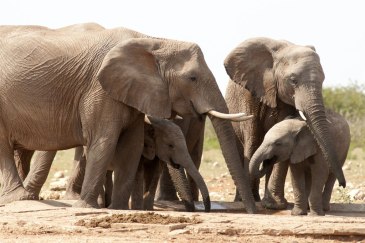
Between 2010 and 2012, 100,000 elephants were killed for their ivory in Africa. Photo: UNEP GRID Arendal/Peter Prokosch
“There are some encouraging signs” but “much more remains to be done,” 28 July 2016 said John E. Scanlon, the Secretary-General of the Convention on International Trade in Endangered Species of Wild Fauna and Flora (CITES) in a press release.
“The momentum generated over the past five years is translating into deeper and stronger efforts to fight poaching and illicit trafficking on the front-lines, where it is needed most – from the rangers in the field, to police and customs at ports of entry and exit and across illicit markets,” he added.
read more »
Posted in Africa, Market Lords, Mother Earth, Others-USA-Europe-etc., The Peoples |
Leave a Comment »
29/07/2016
Warning of a possible rise in heatwave deaths due to climate change, the United Nations Office for Disaster Risk Reduction (UNISDR) on 28 July 2016 called for measures to reduce mortality from this natural hazard.

In Sindh province, Pakistan, a mother tries to shield her four-year-old daughter from scorching heat. Photo: UNDP/Hira Hashmey
The warning came days after the World Meteorological Organization (WMO) announced that global temperatures for the first six months of this year reached new highs, setting 2016 on track to be the hottest-ever on record, and the temperature hit 54 degrees Celsius in Kuwait last week.
read more »
Posted in Africa, Asia, Latin America & Caribbean, Market Lords, Middle East, Mother Earth, Others-USA-Europe-etc., The Peoples |
Leave a Comment »
28/07/2016

Tapantí National Park lies east from the capital San José covering more than 50.000 hectares of forest, which in turn provides valuable watershed protection. Picture: Diego Arguedas Ortiz / IPS
The UN Food and Agriculture Organization (FAO) flagship publication The State of the World’s Forests revealed that commercial agriculture was responsible for 70 percent of forest conversion in Latin America between 2000 and 2010.
read more »
Posted in Africa, Asia, Latin America & Caribbean, Market Lords, Middle East, Mother Earth, Others-USA-Europe-etc., The Peoples |
Leave a Comment »
28/07/2016
UNITED NATIONS, 26 July 2016 – The United Nations has a “zero tolerance” policy towards sexual abuse by anyone working under the blue flag.
.

Jane Holl Lute, Special Coordinator on improving the United Nations response to sexual exploitation and abuse, gives an interview for the UN News and Media Division’s news outlets. UN Photo/Mark Garten
The matter is one of such weight for the Organization that earlier this year, Secretary-General Ban Ki-moon appointed Jane Holl Lute as the Special Coordinator on improving the UN response to sexual exploitation and abuse.
Posted in Africa, Asia, Latin America & Caribbean, Market Lords, Middle East, Others-USA-Europe-etc., The Peoples, War Lords |
Leave a Comment »
28/07/2016
To bring an end to the Boko Haram threat in the Lake Chad Basin region, affected countries must address the root causes that contributed to the emergence of the group, including the social, economic and political grievances of marginalized communities, the top United Nations political affairs official on 27 July 2016 said.

In Tagal, Chad, an IDP community meets under a tree. More than 100 persons had to flee from one of the small islands in Lake Chad after Boko Haram insurgents attacked their village. Photo: OCHA/Ivo Brandau
“A military approach, while essential, will not bring end to the Boko Haram threat,” Jeffrey Feltman, the Under-Secretary-General for Political Affairs, told the Security Council in his briefing on peace and security in Africa.*
read more »
Posted in Africa, Market Lords, Middle East, Others-USA-Europe-etc., The Peoples, War Lords |
Leave a Comment »
27/07/2016

Land degradation – Sustainable land management: do nothing and you will be poorer. Credit: UNEP
“Every second, one person is displaced by disaster,” the Oslo-based Norwegian Refugee Council (NRC) reports. “In 2015 only, more than 19.2 million people fled disasters in 113 countries. “Disasters displace three to ten times more people than conflict and war worldwide.”
read more »
Posted in Africa, Asia, Climate Crisis, Latin America & Caribbean, Market Lords, Middle East, Mother Earth, Others-USA-Europe-etc. |
Leave a Comment »


 HUMAN WRONGS WATCH