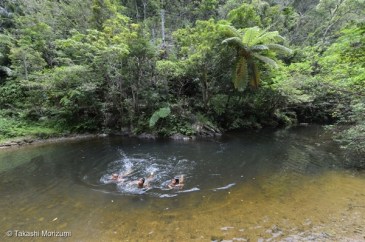
(Greenpeace) – For 20 years, the people of Okinawa, Japan have opposed the construction of a US military base that will damage the marine environment and endangered sea creatures like the Japanese dugong. Now the construction threatens to take over their forest.
Children swimming in the lake in the Yambaru forest | Takashi Morizumi/Greenpeace
Japanese photojournalist, Takashi Morizumi has been documenting the Okinawa people’s movement for nine years. Read his journey and meet the people who are fighting to keep their home.
Driving north along the highway towards Higashi village, Okinawa I’m immediately struck by the lush, green Yamburu Forest.
KUALA LUMPUR, Malaysia, Oct 20 2016 (IPS)– Privatization has been one of the pillars of the counter-revolution against development economics and government activism from the 1980s. Many developing countries were forced to accept privatization as a condition for support from the World Bank while many other countries have embraced privatization, often on the pretext of fiscal and debt constraints.
Privatization generally refers to changing the status of a business, service or industry from state, government or public ownership to private control.
It sometimes also refers to the use of private contractors to provide services previously delivered by the public sector.
(RT)*Afghanistan, it has been said, is the place where empires come to die. And while we might still fail to grasp all the geopolitical entanglements of this Afghan War, it is clear America overestimated its ability to project power in Central Asia.
**Topographic map of Afghanistan | The map has been created with the Generic Mapping Tools | Creative Commons Attribution-Share Alike 3.0 Unported license. | Wikimedia Commons
The question might sound rather silly, but does anyone actually remember why America declared war on Afghanistan? Maybe the solution is right there in the question, because the United States never really declared war on Afghanistan … not really anyway, and not in keeping with its own rules of engagement.
UNITED NATIONS, Oct 19 2016 (IPS) – Farmers are already experiencing the effects of climate change but can also help to fight it, according to a new report released by the UN Food and Agriculture Organization (FAO).
More extreme weather from climate change is threatening food producers. Credit: Mauricio Ramos/IPS
“All farmers have to both adapt to climate change and will have to make a contributions to mitigate the emissions coming from agriculture,” Rob Vos, Director of Agricultural Development Economics at FAO told IPS.
“The good news,” he added, is that a lot of the techniques farmers can use to adapt to climate change will also help to reduce their emissions, and vice versa.
20 October 2016 – Sezano (Verona) – (Pressenza) – We have met and interviewed the prominent German peace activist Jürgen Grässlin during the Conference about Utopia at the Monastero del Bene Comune in Sezano (Verona), Italy.
In his opinion we all must achieve a world without arms, military and violence step by step, starting by forming a network of all people who are working for a better future.
21 October, 2016 (Greenpeace)Last week, in Kigali, Rwanda, governments across the world agreed on a landmark deal to phase down HFCs (hydrofluorocarbons). HFCs are greenhouse gases that are up to a thousand times more powerful than CO2. They are used as refrigerants in things like air conditioners, and contribute the rapid warming of our planet..
The phase down is a move in the right direction, but progress is simply not happening fast enough. We need to stay below 1.5ºC of global warming to alleviate its worst effects and we only have a few more years to take action before damage to the planet becomes irreversible.
QUITO, Oct 21 2016 (IPS) – The Third United Nations Conference on Housing and Sustainable Urban Development and the alternative forums held by social organisations ended in the Ecuadorean capital with opposing visions regarding the future of cities and the fulfillment of rights in urban areas.
Activists protest during the Resistance to Habitat III social forum held at the Central University of Ecuador, which hosted the gathering held parallel to Habitat III, bringing together 100 NGOs from 35 countries, to debate on how to create cities for all. Credit: Emilio Godoy/IPS
On Thursday Oct. 20, the representatives of 195 countries taking part in the Habitat III conference adopted the Quito Declaration on Sustainable Cities and Human Settlements for All, after four days of deliberations.
19 October 2016 (UN News Centre)*– On 13 October 2016, the UN General Assembly appointed, by acclamation António Guterres, as the next United Nations Secretary-General, to succeed Ban Ki-moon when he steps down on 31 December.
António Guterres, Secretary-General-designate, speaks to journalists at the General Assembly stakeout following his appointment by acclamation to serve as the next Secretary-General of the United Nations. UN Photo/Kim Haughton
Mr. Guterres, aged 67, was Prime Minister of Portugal from 1995 to 2002, and the UN High Commissioner for Refugees from June 2005 to December 2015.
Adopting a consensus resolution put forward by its President, Peter Thomson, the Assembly acted on the recommendation of the UN Security Council, which on 6 October forwarded Mr. Guterres’ name to the 193-member body as its nominee for UN Secretary-General for a five-year period, ending 31 December 2021.
Rome – The pledge to eradicate hunger and poverty must go hand in hand with rapid transformations of farming and food systems to cope with a warmer world, FAO on 17 October 2016 said in a new report.
17 October 2016 – TRANSCEND Media Service – Democracy is rule with consent of the ruled; of all by dialogue, of majority by voting. Parliamentarism is government with parliament consent by all or by majority; and voter consent by proportionality.
Johan Galtung
In one week the Spanish illegitimacy crisis–caretaker government voted into power by parliament 2-3 elections ago–is 10 months old.
Martin Caparrós in “Spain, without government” (INYT 29 Aug 2016): Spain, reconquered from Moros 2 January 1492 by the Reyes Católicos, has always had a government, sometimes two, but never none.
By the end of October, a Rajoy-PP government may be confirmed–using political tricks and arithmetics with abstentions more important than No or Yes–meeting a budget deadline. (An anti-corruption Big Coalition against Rajoy-PP–the problem, not the solution–might have been better; or at least a PP without the key responsible, Rajoy).


 HUMAN WRONGS WATCH