06/07/2017
MPUMALANGA, South Africa, Jul 6 2017 (IPS) – The United States and Europe’s preference for white meat is hurting Africa’s poultry industry, says Luc Smalle, manager at the agro firm Rossgro in South Africa’s Mpumalanga area.

Bags of feed at the Rossgro agribusiness firm in South Africa. Credit: Friday Phiri/IPS
.
.
With 3000 Ha of maize and 1000 Ha of soya, as well as 1,500 heads of beef cattle, Rossgro mills its own feed, which also caters for millions of chickens housed in 40 environmentally controlled houses.
read more »
Posted in Africa, Market Lords, Middle East, Others-USA-Europe-etc., The Peoples |
Leave a Comment »
05/07/2017
4 July 2017 – Access, funding and security are urgently needed to ensure humanitarians can reach hundreds of thousands of children suffering from cholera and diarrhoea across Yemen, South Sudan, Somalia and Sudan, the United Nations Children’s Fund (UNICEF) has said.

Two boys, one 16 years old and the other 12, collect water from a damaged pipe on the outskirts of Juba, South Sudan. The water is pumped from the White Nile River, but is untreated, risking the health of those who consume it. Photo: UNICEF/Hatcher-Moore
On top of these diseases, rising rates of malnutrition in these countries “could be deadly for children,” Christophe Boulierac, a spokesperson for the UN agency, said at a regular news briefing in Geneva.
read more »
Posted in Africa, Asia, Market Lords, Middle East, Mother Earth, Others-USA-Europe-etc., The Peoples, War Lords |
Leave a Comment »
05/07/2017
UNITED NATIONS, Jul 4 2017 (IPS) – A decade ago, it was difficult to get Western policy makers in governments to be interested in the role of religious organizations in human development. The secular mind-set was such that religion was perceived, at best, as a private affair. At worst, religion was deemed the cause of harmful social practices, an obstacle to the “sacred” nature of universal human rights, and/or the root cause of terrorism. In short, religion belonged in the ‘basket of deplorables’.
Yet, starting in the mid-1990s with then President of the World Bank, James Wolfenson, and celebrated in 2000 under then UN Secretary-General Kofi Anan when the Millenium Development Goals were agreed to, a number of religiously-inspired initiatives coalesced, all trying to move ‘religion’ to international development’s ‘basket of desirables’.
The arguments used to begin to generate positive interest in the role of religious NGOs in international multilateral fora were relatively straightforward.
read more »
Posted in Climate Crisis |
Leave a Comment »
05/07/2017
By Robert J. Burrowes*
DAYLESFORD, Australia, 5 June, 2017 – In 1932, Sigmund Freud and Albert Einstein conducted a correspondence subsequently published under the title ‘Why War?’ See ‘Why War: Einstein and Freud’s Little-Known Correspondence on Violence, Peace, and Human Nature’.
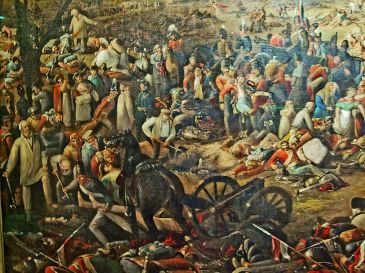
**Morning after the Battle of Waterloo, by John Heaviside Clark, 1816 | Wuselig – Own work | This is a faithful photographic reproduction of a two-dimensional, public domain work of art. The work of art itself is in the public domain for the following reason: The author died in 1863, so this work is in the public domain in its country of origin and other countries and areas where the copyright term is the author’s life plus 100.
read more »
Posted in Africa, Asia, Latin America & Caribbean, Market Lords, Middle East, Mother Earth, Others-USA-Europe-etc., The Peoples, War Lords |
Leave a Comment »
05/07/2017
By Johan Galtung*
3 July 2017 – TRANSCEND Media Service – There are many of them–of different kinds–in world geography. We can try to identify the characteristics of their peacefulness.

Johan Galtung
Or we can start by identifying belligerent societies and then see peaceful societies as their negations. Let us try this one first.
Belligerent societies have a track record of violence across border, on the territory of others, often invoking “defense”– preventive, pre-emptive, proactive.
For that they need weapons, arms, as an army or not. And the weapons, with their carriers, must be long range, offensive, to work across borders, inside another society.
By negating, we get three characteristics of peaceful societies:
- having only short range defensive weapons for defensive defense;
- having no weapons, arms, at all, nor the capacity to make them;
- having a track record of no war, no attack across borders.
read more »
Posted in Africa, Asia, Latin America & Caribbean, Market Lords, Middle East, Others-USA-Europe-etc., The Peoples, War Lords |
Leave a Comment »
05/07/2017
3 July 2017 – Movements by sea from Libya to Europe, despite being the most dangerous route for reaching the continent, have increased and there are indications that it will likely continue to do so, a new study by the United Nations refugee agency has revealed.
.

A boat carrying asylum seekers and migrants in the Mediterranean Sea. Photo: UNHCR/L.Boldrini
Posted in Africa, Asia, Market Lords, Middle East, Mother Earth, Others-USA-Europe-etc., The Peoples, War Lords |
Leave a Comment »
03/07/2017
By Marianna Hoszowska*
30 June, 2017 (Greenpeace)* – Would you put your body on the line to stop some of Europe’s oldest trees from being cut down? That’s what hundreds of activists are doing to protect the Białowieża Forest in Poland.

Fifth blockade of the Białowieża Ancient Forest Photo Rafał Wojczal, 2017
read more »
Posted in Market Lords, Mother Earth, Others-USA-Europe-etc., The Peoples |
Leave a Comment »
03/07/2017
Italy needs more international support to assist the waves of migrants and refugees crossing the Mediterranean, the United Nations refugee chief on 1 July 2017 urged.

Some 275 refugees and migrants waiting to disembark from a tug in the Port of Pozzalo, Italy, after being rescued a few days earlier. Photo: UNHCR/F. Malavolta (file)
“What is happening in front of our eyes in Italy is an unfolding tragedy,” said Filippo Grandi, UN High Commissioner for Refugees.
He stressed that “this cannot be an Italian problem alone. It is, first and foremost, a matter of international concern, requiring a joined-up, comprehensive regional approach.”
read more »
Posted in Africa, Asia, Latin America & Caribbean, Market Lords, Middle East, Others-USA-Europe-etc., The Peoples, War Lords |
Leave a Comment »
03/07/2017

CTO Secretary-General Hugh Riley (left) and CDB President Dr. Warren Smith share a light moment during the signing of a partnership agreement at CDB headquarters. Credit: Desmond Brown/IPS
Visitor expenditures also hit a new high, growing by an estimated 3.5 per cent to reach 35.5 billion dollars.
read more »
Posted in Latin America & Caribbean, Market Lords, Mother Earth, Others-USA-Europe-etc., The Peoples |
Leave a Comment »
02/07/2017
By John Scales Avery*
John Scales Avery, author of this book: We Need Their Voices Today! has generously granted Human Wrongs Watch permission to publish it in a series of chapters. This is Chapter 5: William Godwin. The others will follow successively.

Figure 6.1: William Godwin in a painting by James Northcote (Wikipedia).
Political Justice
In 1793 the English novelist and philosopher William Godwin published an enormously optimistic book, “Political Justice”.
As the eighteenth century neared its end, this book became the focus of hopes for political reform and the center of the debate on human progress.
Godwin was lifted briefly to enormous heights of fame and adulation, from which he plunged, a few years later, into relative obscurity.
In “Political Justice”, Godwin predicted a future society where scientific progress would liberate humans from material want.
read more »
Posted in Africa, Asia, Latin America & Caribbean, Market Lords, Middle East, Mother Earth, Others-USA-Europe-etc., The Peoples, War Lords |
Leave a Comment »


 HUMAN WRONGS WATCH