11 September 2017 – Nearly one-in-five children across the Middle East and North Africa – over 90 per cent of whom live in conflict-affected countries – need immediate humanitarian assistance, according to new analysis by the United Nations Children’s Fund (UNICEF).
At the Al Sab’een Hospital in Sana’a, Yemen, a doctor checks on a girl suffering from cholera. Photo: UNICEF/UN066510/Fuad
“Conflict continues to rob millions of girls and boys of their childhood,” said Geert Cappelaere, UNICEF Regional Director, in a press statement.
“Decades of progress are at risk of being reversed across the Middle East and North Africa,” he added.
The United Nations human rights chief on 11 September 2017 lashed out at the treatment of the Rohingya in Myanmar which has led to more than 300,000 people fleeing to Bangladesh in the past three weeks, as security forces and local militia reportedly burn villages and shoot civilians.
Rohingya refugee children from Myanmar stand outside Kutupalong camp in Bangladesh (July 2017). Photo: Poppy McPherson/IRIN| Source: UN News Centre
“The situation seems a textbook example of ethnic cleansing,” Zeid Ra‘ad al-Hussein told the UN Human Rights Council in Geneva, noting that the current situation cannot yet be fully assessed since Myanmar has refused access to human rights investigators.
ROME, Sep 11 2017 (IPS) – When officials and experts from all over the world started the first-ever environmental summit hosted by China, they were already aware that climate and weather-related disasters were already seriously beginning to set the international agenda – unprecedented floods in South Asia, strongest ever hurricanes Harvey and Irma, and catastrophic droughts striking the Horn of Africa, among the most impacting recent events.
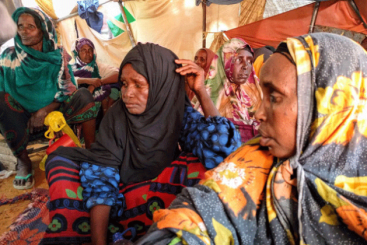
A group of women in Mogadishu, Somalia, after leaving Toro-Toro, 100 kilometres away, because of a lack of water and food. Credit: OCHA
Ordos, September 11, 2017 (UNCCD)* – Up to 2 billion hectares of land are degraded. On average, 12 million hectares are lost every year and 169 countries are affected by land degradation, desertification and drought.
In an unprecedented global campaign to save productive land, 112 countries, as of today, have agreed to make the Sustainable Development Goal target of achieving land degradation neutrality by 2030 a national target for action.
For those of us committed to systematically reducing and, one day, ending human violence, it is vital to understand what is causing and driving it so that effective strategies can be developed for dealing with violence in its myriad contexts. For an understanding of the fundamental cause of violence, see ‘Why Violence?’
Robert J. Burrowes
However, while we can tackle violence at its source by each of us making and implementing ‘My Promise to Children’, the widespread violence in our world is driven by just one factor: fear or, more accurately, terror.
And I am not talking about jihadist terror or even the terror caused by US warmaking.
Let me explain, starting from the beginning.
The person who is fearless has no use for violence and has no trouble achieving their goals, including their own defence, without it. But fearlessness is a state that few humans would claim. Hence violence is rampant.
Hurricane Irma continues to wreak havoc in the Caribbean, leaving a trail of destruction in its wake, the United Nations humanitarian wing on 8 September 2017 said, warning that areas along its path continue to remain at risk of significant damage.
A seven-year old boy stands in front of debris as Hurricane Irma moves off from the northern coast of the Dominican Republic. Photo: UNICEF/UN0119399
“There is continued risk of catastrophic damage from hurricane-force winds, storm surge and flooding in areas on Irma’s trajectory,” read an update issued by the UN Office for the Coordination of Humanitarian Affairs (OCHA).
Today is the last day of the 93rd year of my life. Ridiculous.
Uri Avnery
Am I moderately satisfied with my life until now? Yes. I am.
If by a miracle I could be returned to, say, 14, and travel all this long way again, would I like that? No, I would not.
Enough is enough.
IN THESE 93 years, the world has changed completely.
A few days after my birth in Germany, a ridiculous little demagogue called Adolf Hitler attempted a putsch in Munich. He was put in prison, where he wrote a tedious book called Mein Kampf. Nobody took any notice.
The World War (no one called it World War I yet) was still a recent memory. Almost every family had lost at least one member. I was told that a remote uncle of mine had frozen to death on the Austrian-Italian front.
Deprivation, marginalization and perceived state violence or abuse of power are pushing young Africans into the clutches of violent extremism, a groundbreaking study by the United Nations Development Programme (UNDP) reveals.
The United Nations migration agency on 8 September 2017 confirmed that 270,000 people have fled violence in Myanmar for safety in Bangladesh over the past two weeks, and the number of new arrivals continues to increase.
.
After fleeing violence in Myanmar in October 2016, Rohingya refugees live in overcrowded makeshift sites in Cox’s Bazar, Bangladesh. Photo: UNHCR/Saiful Huq Omi
ROME, Sep 5 2017 (IPS) – With the highest temperatures on record and unprecedented heat waves hitting Europe this year, Africa’s ‘Great Desert’, the Sahara, is set continue its relentless march on the Southern European countries until it occupies more than 30 per cent of Spain just three decades from now.
Land Degradation Neutrality – UNCCD
The Sahara is the largest hot desert on Earth, covering more than 9,000 square kilometres, comparable to the surface of China or the United States.




 HUMAN WRONGS WATCH