“Fake news” is nothing new. In less glamorous times, perhaps, it was known as subterfuge, lying, deceit, deception, advertising or public relations. One of the advantages of aging is that one may look back and, in so looking back, events which, at the time of perception, seemed perfectly plausible, can be peered at more closely and, can, in fact, be seen for what they really were.
Thus Pearl Harbor, the dropping of the atomic bombs on Hiroshima and Nagasaki, the Gulf of Tonkin ‘incident’ that launched the Vietnamese debacle, and, more recently, the ostensible discover of Iraq’s ‘weapons of mass destruction’ — all of these events, considered in the reflective hindsight of reason, have been exposed.
President Trump wants the others to cough up more dough for the “protection”provided to them by the United States.
The American leader berated European heads of state as if they were naughty children, accusing them of “freeloading” on US military power for their defense over many decades, and of giving nothing back.
Indigenous women of Guatemala’s Polochic valley are feeding their families, growing their businesses and saving more money than ever before, with the help of a joint UN programme that’s empowering rural women.
Women of Puente Viejo, a small indigenous community across the Polochic and Malazas rivers. Photo: UN Women/Ryan Brown
10 July 2018 (UN Women)* — The women of Puente Viejo, a small indigenous community across the Polochic and Malazas rivers in the Polochic valley of Guatemala are happy. For once, they have plenty of crops to feed themselves and their families, and they have saved more money than ever before from their organic shampoo sales.
11 July 2018 (Wall Street International)*— It is reported that there are roughly 20,000 empty homes in London and several times more across the UK. While in some cases inheritance issues or huge damages might keep properties out of the market, quite often they stay empty just because their owners are waiting for a rise in their values before selling them.
HERAT, Afghanistan, 10 July 2018 (UNFPA)* — By midnight, Khurshid, 35, was in serious trouble. Five months pregnant and bleeding heavily, she had passed out at home. Her family carried her unconscious body to the nearest – and only – health station in Afghanistan’s remote, mountainous Chesht-e Sharif District.
“Her state shocked me, but I knew quickly that it was a miscarriage,” recalled Amena, 22, the midwife on duty at the clinic, known locally as a ‘family health house’.
A reckoning on the importance of maximising the world’s resources is taking place across the world, and achieving the 17 Sustainable Development Goals (SDGs) by 2030 depends heavily on reeling in our global consumption and production patterns, a key UN forum heard on 12 July 2018.
Saeed Rashid | Plastic pollution in the world’s oceans is threatening marine life | UN News Centre.
.
That was one focus on the fourth day of the High-level Political Forum on Sustainable Development (HLPF), currently taking place at UN Headquarters in New York, when delegates debated the best way to make SDG 12 a reality, highlighting what countries consume and produce.
12 July 2018 — International migration “has been with us forever,” and a safe and orderly means of facilitating it is “in everybody’s interest”, said a UN envoy.
UNHCR/A. D’Amato Risking their lives to reach Europe from North Africa, a boatload of people, some of them likely in need of international protection, are rescued in the Mediterranean Sea by the Italian Navy.
Speaking to UN News during the final round of negotiations on a global compact for safe, orderly and regular migration, Louise Arbour said that migration should not be seen in terms of good or bad, but as “a phenomenon that’s been part of human history”, with immense benefits if well handled.
With the UN General Assembly set to agree a new global compact on migration, the United Nations chief on 12 July 2018 highlighted its “immense potential” to harness the benefits of orderly migration and lower the risks facing millions on the move without documentation.
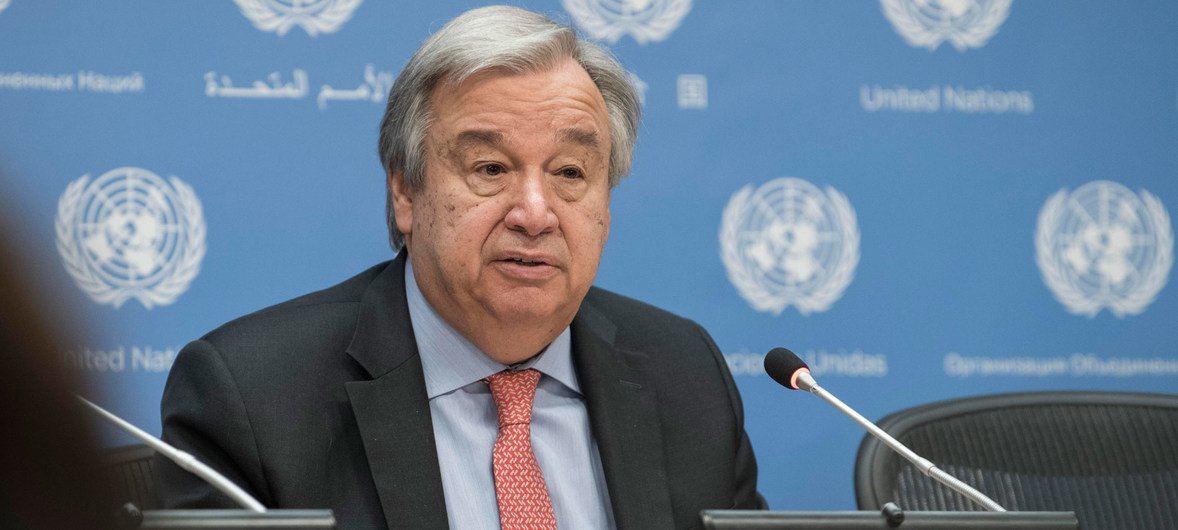
UN Photo/Mark Garten | Secretary-General António Guterres briefs press
“Migration is a positive global phenomenon,” Secretary-General António Guterres told a press conference at UN Headquarters, with negotiations on the Global Compact for Safe, Orderly and Regular Migration expected to conclude on Friday [13 July 2018] in New York, for formal adoption in December in Marrakesh.
“Migrants are a remarkable engine for growth,” Guterres stressed, noting that they number more than 250 million around the world, making up 3 per cent of the global population and contributing 10 per cent of the overall global gross domestic product.
12 July 2018 (UN Environment)* — Every year, people all over the world tune in to see which cities make it onto the Economist Intelligence Unit’s (EIU) list of the world’s most liveable cities. And every year, a number of surveys look at the best and worst living conditions in the world’s major cities. For the EIU, each city is ranked across 30 factors – from acceptable to intolerable – and across quantitative and qualitative criteria.
The annual report, which measures quality of life, fires up the aspirations of many of the world’s greatest cities. Beijing is one city that is tackling its ranking, and its environment.
But what goes into these rankings and how much do environmental factors really matter to quality of life? And can a city grow in population and at the same time improve the quality of its air, water and public transportation?






 HUMAN WRONGS WATCH