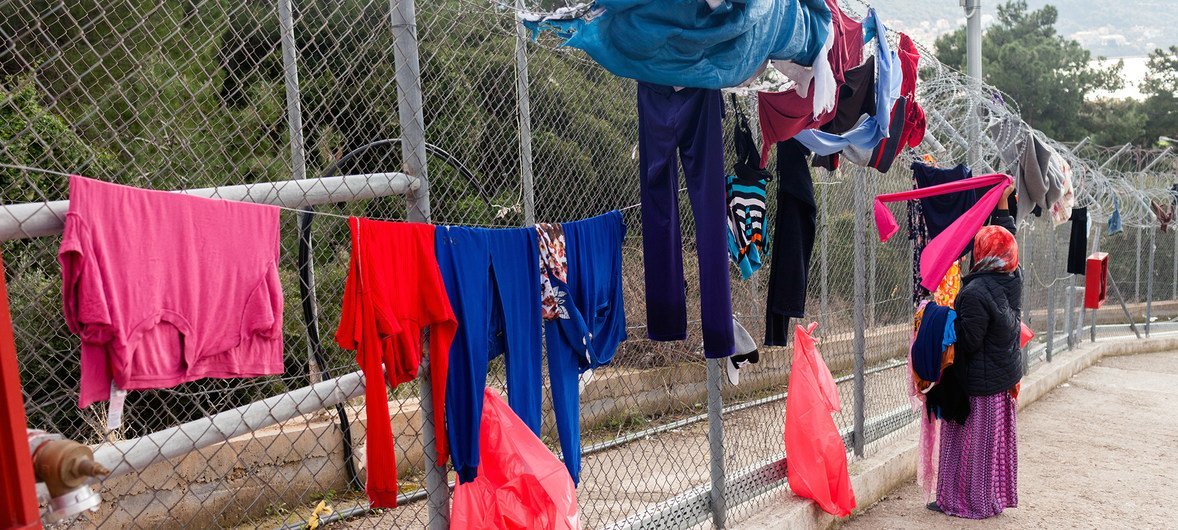
The Government of Greece has been urged by the United Nations to do more to help thousands of asylum-seekers and migrants who have been “crammed” into island reception centres, amid reports that children have tried to take their own lives there.
UNHCR/Markel Redondo | A woman hangs washing out to dry at the Vathy Reception and Identification Centre (RIC) on the island of Samos, Greece. Refugee families are struggling at the reception centres on the island of Samos due to overcrowding, leading to deteriorating conditions.
29 August, 2018 (UN Women)* – After 10 years of advocacy, ethnic Sulaliyyate women of Morocco finally have equal land rights. On 23 July, a State-run lottery distributed some 860 plots of land equally among men and women, as part of ongoing efforts to privatize land throughout the country.
Mahjouba Mhamda and Cherkauia Mhamda. Photo: UN Women/Hassan Chabbi
Mahjouba Mhamda is one of the 1,460 women who received a 70 square metre plot of land. It was an arduous process.
She had just failed the national exam, barring her from pursuing the education she longed for. As the first-born girl in her family, Salia was now consigned to household chores – and even this, she knew, would not last long enough.
Salia’s parents did not have the financial means to support her. Like many young girls in Ethiopia, it was only a matter of time before she would need to leave her family for a husband.
30 August 2018 (FAO)* – The Middle East and North Africa is the world’s most water-scarce region and the situation is worsening due to the impacts of conflict, climate change and economic downturn.
The water crisis threatens the region’s stability as well as its human development and sustainable growth.
What is the agreement that has been reached and why does it matter?
About 60 per cent of the world’s refugee population lives in around 10 countries, all in the global south. Refugees often live in the poorest parts of these countries.
At the time, misinformation about immigration, sensationalised by tabloids, was rife. In a population still reeling from decades of civil conflict, mistrust of minorities remained close to the surface.
29 August 2018 (IOM)* – “When an acquaintance told me there might be work for me in Austria, I jumped at the opportunity. She told me how good Austria was so I figured I would just get there, find work and settle in. They told me the journey was easy so I decided to give it a go.”
These are the recollections of Sara, one of thousands of Nigerian women who have been fooled by traffickers and sent to Europe, West and Central Africa and the Middle East for domestic labour or sexual exploitation.
DAYLESFORD, Australia, 30 August 2018 –Developing the tradition charted by C. Wright Mills in his 1956 classic The Power Elite, in his latest book, Professor Peter Phillips starts by reviewing the transition from the nation state power elites described by authors such as Mills to a transnational power elite centralized on the control of global capital.
Thus, in his just-released study Giants: The Global Power Elite, Phillips, a professor of political sociology at Sonoma State University in the USA, identifies the world’s top seventeen asset management firms, such as BlackRock and J.P Morgan Chase, each with more than one trillion dollars of investment capital under management, as the ‘Giants’ of world capitalism.
The seventeen firms collectively manage more than $US41.1 trillion in a self-invested network of interlocking capital that spans the globe.
This $41 trillion represents the wealth invested for profit by thousands of millionaires, billionaires and corporations.
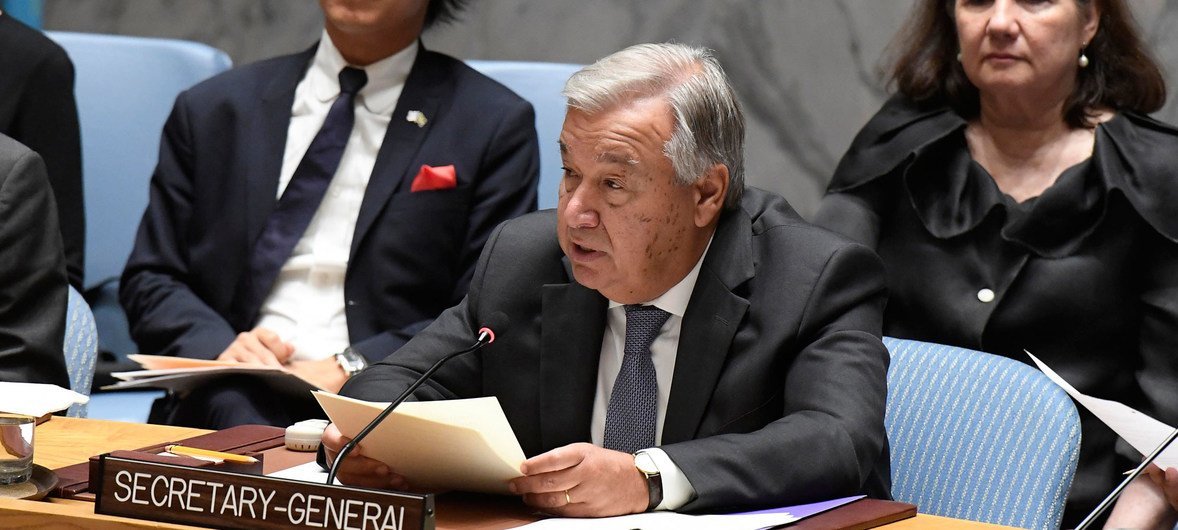
As war and the mediation of peace have become increasingly complex, innovative thinking is needed to save and improve the lives of millions, United Nations Secretary-General António Guterres on 29 August 2018 told the Security Council.
.
UN Photo/Evan Schneider | UN Secretary-General António Guterres addresses the Security Council meeting on the maintenance of international peace and security, with a focus on mediation and settlement of disputes.
.
Speaking alongside the UN chief were the Archbishop of Canterbury, Justin Welby, a member of his High-Level Advisory Board on Mediation, and Mossarat Qadeem, the co-founder of PAIMAN Alumni Trust, a civil society group working to prevent violent extremism in Pakistan.
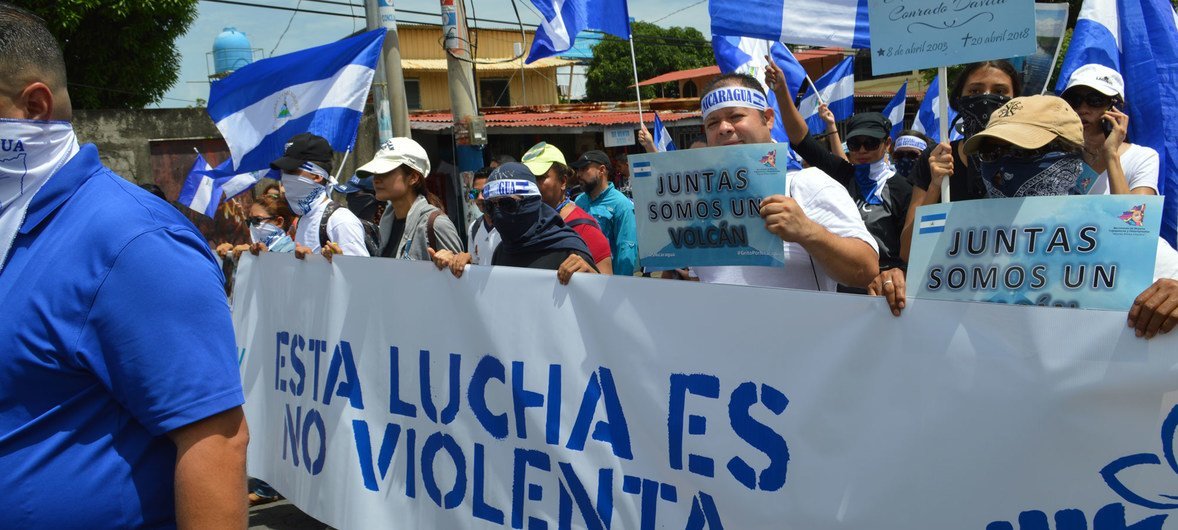
The United Nations on 29 August 2018 called for urgent action to address the human rights crisis in Nicaragua, where “repression and retaliation against demonstrators continue … as the world looks away.”
Artículo 66 | Protesters in Managua take part in a march to demand an end to violence in Nicaragua. The banner reads “This struggle is non-violent” in Spanish. | Photo from UN News
A new report from the UN human rights office has detailed what it describes as numerous violations carried out by the Nicaraguan Government after mass protests erupted in mid-April over planned social security reforms.


 HUMAN WRONGS WATCH