Cox’s Bazar, 10 August 2018 (IOM)* – UN Migration Agency medical staff in Cox’s Bazar, Bangladesh, have now carried out over half a million consultations since the Rohingya refugee crisis began nearly a year ago, as monsoon conditions sparked the busiest week of the year for doctors and nurses working in the camps.
Families wait for treatment at an IOM medical clinic in the Kutupalong Rohingya refugee camp, Cox’s Bazar, Bangladesh. Photo: Lydia Moore / IOM 2018
12 August 2018 – After seeing first-hand the complexities of the Ebola response in the conflict-affected region of North Kivu in the Democratic Republic of the Congo (DRC), the Head of the World Health Organization (WHO) called for “free and secure” access to the disease-affected people.
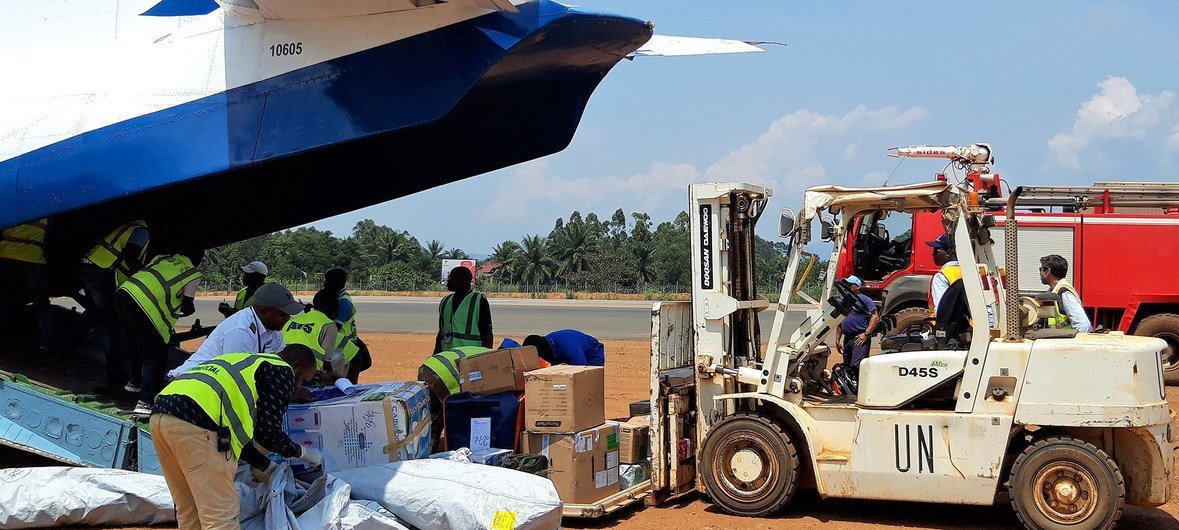
MONUSCO-AVIATION | Medical supplies to fight the Ebola disease outbreak in the Democratic Republic of the Congo are unloaded in Mavivi in North Kivu province in August 2018.
.
“All of those participating in the response must be able to move freely and safely in conflict areas to do the work that is needed to bring the outbreak under control,” said Dr. Tedros Ghebreyesus, WHO’s Director-General.
10 August, 2018 (UN Women)* — 1.3 million refugees are currently hosted by Jordan, a country that continues to demonstrate humanitarian leadership in the Syrian refugee crisis. In 2012, UN Women opened its first Oasis— a centre for refugee women and girls to access emergency aid and specialized gender-based violence services at Za’atari refugee camp in northern Jordan.
Intesar Hassan, 20, Syrian refugee woman learned to be a hairdresser through aworkshop at the Oasis Center for Resilience and Empowerment of Women and Girls in the Azraq refugee camp. Photo: UN Women/Lauren Rooney
UN Environment* – Today, 9 August, is the International Day of the World’s Indigenous Peoples. This year’s theme is “Indigenous Peoples’ Migrationand Movement.” We spoke to thirty-four-year old Hindou Oumarou Ibrahim, an indigenous woman from the Mbororo pastoralist community of Chad, to ask whether she believes there is a future for nomadic communities?
.
Association for Indigenous Women and Peoples of Chad
With a background in indigenous peoples’ rights and environmental protection, Ibrahim was recently nominated a National Geographic Emerging Explorer.
She is the coordinator of the Peul Indigenous Women and Peoples Association of Chad and co-chairs the International Indigenous Peoples Forum on Climate Change.
When she was only 15, her husband brought her to an island near the border of Nigeria. They were going on a fishing trip, he said.
Instead, he took her to a Boko Haram training camp where she was ordered to become a suicide bomber. When she refused, she was threatened with immediate execution.
New Jersey’s first Sikh attorney general, Gurbir Singh Grewal, was a target of disparaging remarks recently. Two radio hosts commented on Grewal’s Sikh identity and repeatedly referred to him as “turban man.”
New Jersey Attorney General Gurbir Grewal. AP Photo/Julio Cortez | Photo from The Conversation.
When called out on the offensiveness of their comments, one of them stated, “Listen, and if that offends you, then don’t wear the turban and maybe I’ll remember your name.”
Listeners, activists and Sikhs around the country acted immediately by contacting the station to express their concerns. News outlets quickly picked up the story and the radio hosts were suspended.
Europe’s prolonged extreme drought has caused the most severe problems to the EU vegetable sector in the last 40 years, according to the European Association of Fruit and Vegetable Processors (PROFEL).
Significant reductions in field yields are reported for peas and beans ranging from 20% up to 50%. [Shutterstock] | Photo from EurActiv.
“With the hot and dry weather continuing throughout July across most parts of the continent, vegetables have continued to suffer and crop yields have fallen sharply. Today the situation for vegetable growers and processors is the most serious that has been experienced in the last forty years,” the association said in a statement.
A firefighter runs after trying to save a home in Lakeport, California, suffering its biggest fires ever. AP Photo/Noah Berger | Photo from The Conversation.
These burn forests, houses and other structures, displace thousands of people and animals, and cause major disruptions in people’s lives.
Africa was once home to more than 200,000 lions just over a century ago. Now, the continent has just over 20,000.
Cecil the lion is seen at Hwange National Parks in Zimbabwe. | Photo: Reuters | Photo from teleSUR.
.
10 August 2018 (teleSUR)* – Today, World Lion Day, comes amid the unforgiving hands of modernity.
.
Habitat loss, prey base depletion, people killing lions in the name of defending livestock or protecting human life and the insidious canned lion and lion bone trade have dramatically decreased the species’ population.
.
Other illegal activities involving lions include captive breeding; cub petting; volunteering and lion walks; and canned hunting.





 HUMAN WRONGS WATCH