07/08/2018
The two atomic bombs dropped on Japan in 1945 killed and maimed hundreds of thousands of people, and their effects are still being felt today.
.
.
The uranium bomb detonated over Hiroshima on 6 August 1945 had an explosive yield equal to 15,000 tonnes of TNT.
.
It razed and burnt around 70 per cent of all buildings and caused an estimated 140,000 deaths by the end of 1945, along with increased rates of cancer and chronic disease among the survivors.
Posted in Climate Crisis |
Leave a Comment »
07/08/2018
The world needs the continued moral leadership of the people of Hiroshima, the top United Nations disarmament official on 6 August 2018 said, commemorating the 73rd anniversary of the atomic bombing that devastated the city while lamenting that after decades of momentum towards a nuclear-free world, “progress has stalled.”
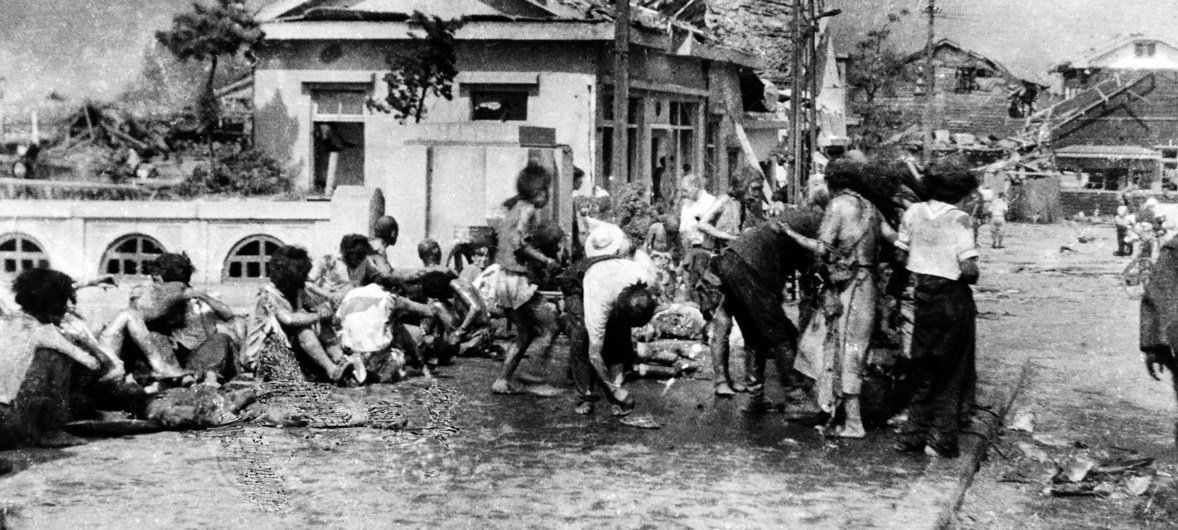
UN Photo/Yoshito Matsushige | Injured civilians, having escaped the raging inferno, gathered on a pavement west of Miyuki-bashi in Hiroshima, Japan, about 11 a.m. on 6 August 1945.
“Tensions between nuclear-armed States are rising. Nuclear arsenals are being modernized and, in some cases, expanded,” said
Izumi Nakamitsu, High Representative for Disarmament Affairs, speaking on behalf of
Secretary-General António Guterresat the Hiroshima Peace Memorial Ceremony.
Posted in Africa, Asia, Latin America & Caribbean, Market Lords, Middle East, Others-USA-Europe-etc., The Peoples, War Lords |
Leave a Comment »
06/08/2018
6 August 2018 – Calling 2017 “the first year in human history” that more electricity was generated globally from the sun, than oil, gas and coal combined, Erik Solheim, Executive Director of the UN Environment Programme (UNEP) has told UN News that “we are on track” but “we really need to speed up”.
World Bank/Arne Hoel | An elephant and a bird in the wilderness of Ghana, 28 November 2006. | Photo from UN News Centre.
Southern India, for example, now has “the first all-solar airport in the world”, he said, pointing out that some of India’s southern states are experiencing “the most rapid economic development anywhere in the world — based on solar energy”.
Moreover, he said that in the United States, “there are five times more jobs in solar, than in coal”.
read more »
Posted in Africa, Asia, Latin America & Caribbean, Market Lords, Middle East, Migrants and Refugees, Mother Earth, Others-USA-Europe-etc., The Peoples, War Lords |
1 Comment »
06/08/2018
6 August 2018
[The United States detonated two nuclear weapons over the Japanese cities of Hiroshima and Nagasaki on August 6 and 9, 1945, respectively.]
An Interview with Mrs. Koko Kondo, The Tanimoto Peace Foundation, Conducted in Kobe, Japan on 27 Jul 2018

Mrs. Koko Kondo showing the manuscript written by her father, Reverend Kiyoshi Tanimoto, that inspired John Hersey’s classic, Hiroshima.
Do you think the Hibakusha are still important?
read more »
Posted in Africa, Asia, Latin America & Caribbean, Market Lords, Middle East, Migrants and Refugees, Mother Earth, Others-USA-Europe-etc., The Peoples, War Lords |
Leave a Comment »
06/08/2018
6 August 2018 – The state of the world is right now going from bad to worse, with more violence or threats thereof; an epidemic, even pandemic, of violence. And more inequality within and between countries and money buying votes in fake elections and politicians in fake democracies turning plutocracies run by money.

Johan Galtung
.
And nature insulted; less diversity and less symbiosis with CFCs in the ozone layer. But not all over.
There are regions low on violence, often headed by a state or nation as a “pole”, and a multi-polar world with passive peaceful coexistence. Disputes, not war.
Which are these regions headed by a “pole”?
Anglo-America is one, headed by USA.
Latin-America/Caribbean is one, with Cuba, Nicaragua, Venezuela, Argentina, Brazil playing leading roles, but no single leader. Comunidad de Estados Latinoamericanos y Caribeños (CELAC) is a coordinating forum for all 35.
read more »
Posted in Africa, Asia, Latin America & Caribbean, Market Lords, Middle East, Migrants and Refugees, Mother Earth, Others-USA-Europe-etc., The Peoples, War Lords |
Leave a Comment »
06/08/2018
By Pascal Reyntjens*
Algiers, 6 August 2018 (IOM)* – The buses left Algiers almost a day ago. Although the buses are comfortable, it has been a long day on the road for everyone.
Pascal Reyntjens, IOM Chief of Mission in Algeria (far left), meets Bintu, a young Nigerien child. Photo: IOM 2018
It is late June, and the convoy has arrived in Ghardaïa, northern-central Algeria – the door to the desert.
read more »
Posted in Africa, Market Lords, Middle East, Migrants and Refugees, Mother Earth, Others-USA-Europe-etc., The Peoples, War Lords |
Leave a Comment »
06/08/2018
By Anne Althaus and Amanda Brown*
Geneva, 3 August 2018 (IOM)* –
With the recent debate in Europe surrounding the Aquarius, NGO rescues at sea, and the steep increase in tragic deaths of migrants at sea in the past weeks, there has been a resurgence of discussion in the media and political arena about the so-called “migration crisis” and feelings about “invasions” of migrants. It is about time to restate the facts, recall the actual numbers, and reconsider the situation.
Migrants and refugees on the Greek island of Lesbos. File Photo: IOM/Amanda Nero
It is perfectly understandable that people in Europe and elsewhere would react to alarming messages. Yet, looking at the actual numbers regarding migration and labour forces in Europe and other global economies reveals a much less alarming situation.
One way to address public worries about migration is to present the actual numbers.
Posted in Africa, Asia, Latin America & Caribbean, Market Lords, Middle East, Migrants and Refugees, Mother Earth, Others-USA-Europe-etc., The Peoples, War Lords |
Leave a Comment »
06/08/2018
Most countries’ guidelines recommend that people have at least 3-5 servings of fruits and vegetables a day. For a sweet tooth, fruit is a good alternative to processed sugars. ©FAO/Ezequiel Becerra
Societal changes, however, are making these choices more complicated. While many countries are still dealing with undernutrition, more and more people around the world are eating energy-dense, high-fat, high-sugar and high-salt foods.
Urbanization, more sedentary types of work and changing modes of transportation are decreasing people’s levels of physical activity, creating entire populations at risk of obesity, overweight and related diseases.
read more »
Posted in Africa, Asia, Latin America & Caribbean, Middle East, Mother Earth, Others-USA-Europe-etc., The Peoples |
Leave a Comment »
06/08/2018
Indigenous peoples are among the most vulnerable populations in the world. This International Day is an opportunity to raise public awareness of their precarious situation, particularly in relation to migration, which is the Day’s theme in 2018.

Audrey Azoulay, Director-General of UNESCO
Migration influences the way of life of many indigenous peoples, whether these be nomadic pastoral societies who follow the transhumance calendar, such as the Red Fulani cattle herders in West Africa whose seasonal migration covers several thousand kilometres, or hunter-gatherer peoples who travel several hundred square kilometres, in the Kalahari Desert and the Congo Basin, for example, in order to benefit from the unique resources of their ecosystem and to preserve a delicate balance.
read more »
Posted in Africa, Asia, Latin America & Caribbean, Market Lords, Middle East, Migrants and Refugees, Mother Earth, Others-USA-Europe-etc., The Peoples, War Lords |
Leave a Comment »
06/08/2018

These indigenous Tule women in Colombia’s Choco region prepare cotton to be used in making traditional clothes and material. They have only recently been able to return to their land, but damage to the environment and the presence of armed groups makes their future uncertain. The land and their connection to it is very important in Tule culture. Photo UNHCR/B. Heger.
.
Posted in Africa, Asia, Latin America & Caribbean, Market Lords, Middle East, Migrants and Refugees, Mother Earth, Others-USA-Europe-etc., The Peoples, War Lords |
Leave a Comment »




 HUMAN WRONGS WATCH