18 November 2019 (UN News)* — Ending the practice of defecating in the open, rather than in a toilet, will have “transformational benefits” for some of the world’s most vulnerable people, says the UN’s partner sanitation body, the WSSCC (Water Supply and Sanitation Collaborative Council).
19 November 2019 (United Nations)* — Toilets save lives, because human waste spreads killer diseases. World Toilet Day is about inspiring action to tackle the global sanitation crisis.
World Toilet Day is celebrated on 19th November every year. It’s all about inspiring action to tackle the global sanitation crisis and help achieve Sustainable Development Goal 6 (SDG 6), which promises sanitation for all by 2030.
NAIROBI, Kenya, 14 November 2019 (UNFPA)* – “If I had known about safe sex in my teens, my life would never have turned out this way,” said 21-year-old Sithu* from Myanmar. He contracted HIV two years ago, despite being intimate only twice with his partner at the time.
Durban, 14 November 2019 (UN Environment)* – The United Nations Environment Programme (UNEP) today launched the Global Environment Outlook-6 (GEO-6) for Youth in Africa report on the margins of the 17th session of the African Ministerial Conference on the Environment (AMCEN).
The report analyses the economic opportunities that Africa’s natural resources can provide for job creation and sustainable development. It also provides a package of solutions to tackle Africa’s youth unemployment through the Green Economy.
17 November 2019 — Saving lives by improving road safety is “one of the many objectives of the 2030 Agenda for Sustainable Development”, the United Nations chief said in his message for the global day set aside for remembering the victims of traffick accidents. (*).
Noting that more than 1.3 million people die in road accidents every year, Secretary-General António Guterres pointed out that more young people between the ages of 15 and 29 die from road crashes annually than from HIV/AIDS, malaria, tuberculosis or homicide.
Stockholm (SIPRI)* — Climate change poses serious challenges to current and future peacebuilding missions, according to a new report by the Stockholm International Peace Research Institute (SIPRI) which studies the UN Assistance Mission in Somalia (UNSOM). Climate change amplifies existing challenges and strengthens radical groups. At the same time, climate change forces missions to think out of the box with UNSOM proving to be an encouraging example.
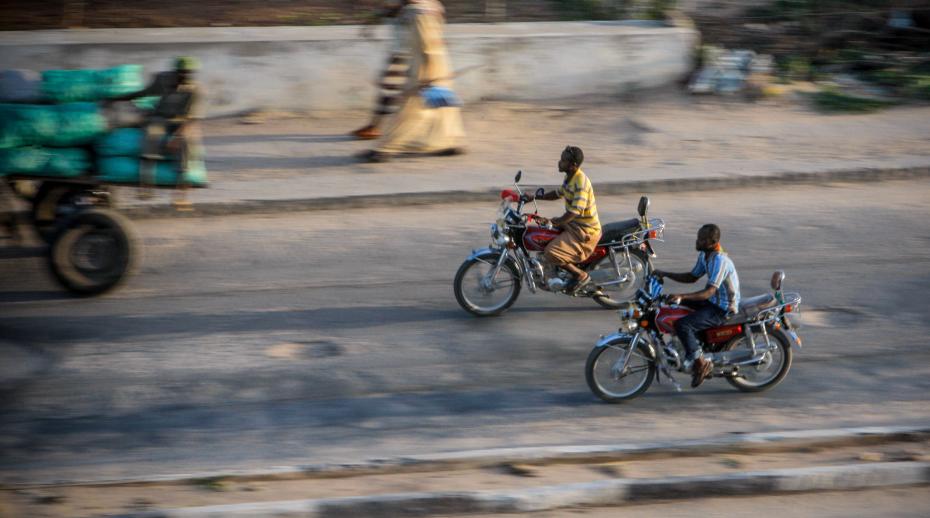
Somali men on motorcycles ride along a road 6 August 2012, opposite the parliament building in the Somali capital, Mogadishu.Photo posted here from SIPRI).
Durban (UN Environment)* – A new UN Environment Programme (UNEP) desk study launched today [15 November 2019] at the 17th African Ministerial Conference on the Environment in Durban, South Africa, calls for urgent action to address the production and consumption of biomass as a source of energy in Africa.
The study presents the current status of biomass energy in Africa and explores ways to mitigate its negative impacts until a transition to cleaner and modern energy sources takes place.
14 November 2019 (Norwegian Refugee Council)*— Millions in Somalia need humanitarian aid because of extreme weather conditions and conflict. However, relief work is difficult and dangerous in a country that has been ravaged by armed conflict for almost 30 years.
Ifrah Ahmed works with the Norwegian Refugee Council’s shelter projects in Garowe. The area has received a large number of internally displaced people due to extreme weather conditions and conflict. The majority live in temporary camps, but the Norwegian Refugee Council (NRC) also builds permanent housing for vulnerable groups who are unable to return home. Photo: Ingrid Prestetun/NRC
11 August 2019 (Wall Street International)*— This is the fourth of a series of articles on the I Ching, or Yijing, the Book of Changes, an ancient oracle, a divinatory book that played a key role in Chinese culture and became for the Chinese a map of ‘heaven and earth’, of the totality of existence. Much of this material is contained in the Introduction to the Eranos Yijing1. To that book the reader is referred for a deeper discussion of the concepts here presented.
 © WSSCC/Jason Florio | As the population in Nigeria increases, efforts are underway to ensure that open defecation does not increase.





 HUMAN WRONGS WATCH