Further inaction on climate change is “simply not an option”, United Nations Secretary-General António Guterres said on Wednesday [29 May 2019] in an opinion piece where he called for “rapid and deep change in how we do business, generate power, build cities and feed the world.”
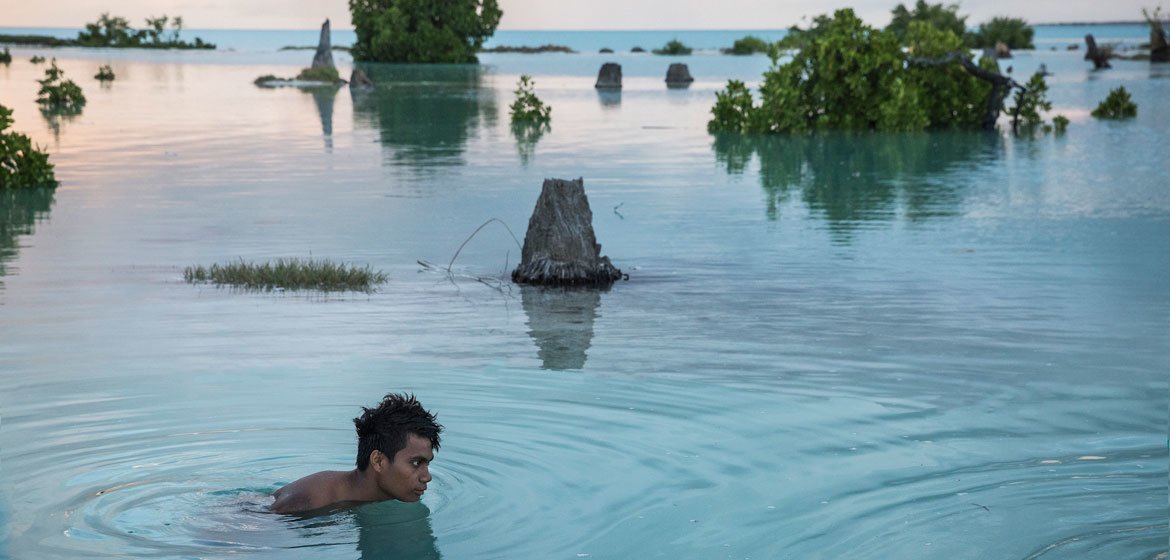
UNICEF/Sokhin | A 16-year-old child swims in the flooded area of Aberao village in Kiribati. The Pacific island is one of the countries worst affected by sea-level rise.
29 May 2019 (UN Environment)* — Public transit passengers in Indonesia’s capital may soon notice a new green addition to their commute.
Photo by Unsplash/Azka Rayhansyah
In line with Governor Anies Baswedan’s vision to make Jakarta one of the greenest cities in the world, the Transjakarta Bus Rapid Transit System is rolling out a trial programme of electric buses on certain routes in the city.
KUALA LUMPUR and PENANG, May 28 2019 (IPS)– Over recent decades, the scope, size, concentration, power and even the purpose and role of finance have changed so significantly that a new term, financialization, was coined to name this phenomenon.
Financialization refers to a process that has not only transformed finance itself, but also, the real economy and society.
The transformation goes beyond the quantitative to involve qualitative change as finance becomes dominant, instead of serving the needs of the real economy.
Financialization involves the growth and transformation of finance such that with its hugely expanded size, scope and concentration, finance now overshadows, dominates and destabilizes the productive economy.
The role and purpose of finance has been qualitatively transformed. Finance used to profit from serving production and trade. Traditionally, financing production involved providing funds for manufacturers to finance production, and for traders to buy and sell.
Through a social security reform, the Brazilian far-right seeks to reduce protections for pregnant women and shorten maternity leave period.
President Jair Bolsonaro (C) and his staff at Alvorada Palace in Brasilia, Brazil, May 28, 2019. | Photo: Reuters | Photo fromteleSUR..
29 May 2019 (teleSUR)* — Brazil’s President Jair Bolsonaro proposed an amendment that alters Article 201 of the Constitution, which guarantees protection to pregnant women and breastfeeding mothers, the Worker’s Party (PT) Congressman Alexandre Padilha said during public hearing on the impact of the social security reform bill which was held in Sao Paulo.
29 May 2019 (WHO)* — The focus of World No Tobacco Day 2019, marked in 31 May, is on “tobacco and lung health.” The campaign will increase awareness on the negative impact that tobacco has on people’s lung health, from cancer to chronic respiratory disease, and the fundamental role lungs play for the health and well-being of all people.
Tobacco kills more than 8 million people each year. More than 7 million of those deaths are the result of direct tobacco use while around 1.2 million are the result of non-smokers being exposed to second-hand smoke.
Around 80% of the world’s 1.1 billion smokers live in low- and middle-income countries.
UNITED NATIONS, May 29 2019 (IPS)* – When the UN Security Council met last week to discuss the deaths and devastation caused to civilians in ongoing military conflicts and civil wars, the killings in Yemen and the air attacks on hospitals, schools, mosques, and market places—whether deliberate or otherwise– were singled out as the worst ever.
Children walk through a damaged part of downtown Craiter in Aden, Yemen. The area was badly damaged by airstrikes in 2015 as the Houthi’s were driven out of the city by coalition forces. Credit: UN OCHA/Giles Clarke
(Geenpeace)*— Imagine a world 100% powered by renewables. A sustainable world where development does not take an irreversible toll on our planet’s natural resources. A world where there is funding to support a just recovery for the communities most impacted by climate change and a just transition for those economically dependent on the fossil fuel industry. A world where there is support for those on the frontlines suffering the worst impacts of extreme weather events now, and no one is left behind. That world is possible.
“The culture of peace is universal. It is shared by people and nations Worldwide. Today’s “culture of war” is a US hegemonic project predicated on the creation of conflict and divisions within and between countries. It is this (unilateral) project of global warfare which is intent upon destroying civilization.” — Prof. Michel Chossudovsky, “Towards a Culture of World Peace”
Warmongering Is Anti-Human Impulse
Dr. Mahboob A. Khawaja
The draconian ferocity of aggressive wars continues as we watch the unwarranted aggressive events unfolding against Iran in the Persian Gulf Region. One sees a contrast between a real issue and an imaginative problem.
The motivating factor signals one thing that American ruling elite thinks: “we are the most powerful nation on earth” and nobody else should challenge our supremacy – the naïve malignity mindset of the American current leadership.
28 May 2019 (UN Environment)* — As a global movement to tackle air pollution gathers pace, innovators are rising to the challenge, unveiling products and technologies that remove some of the dangerous toxins that are seeping into our lungs and accelerating climate change.
Photo by NIERIKA/Guadalajara, México | Photo from UN Environment.
According to the World Health Organization (WHO), every year around 7 million premature deaths are caused by air pollution. That’s 800 people dying every hour. But the good news is that there is a growing public understanding that action must be taken.
Here are four innovative businesses and their cutting-edge technologies to beat air pollution:
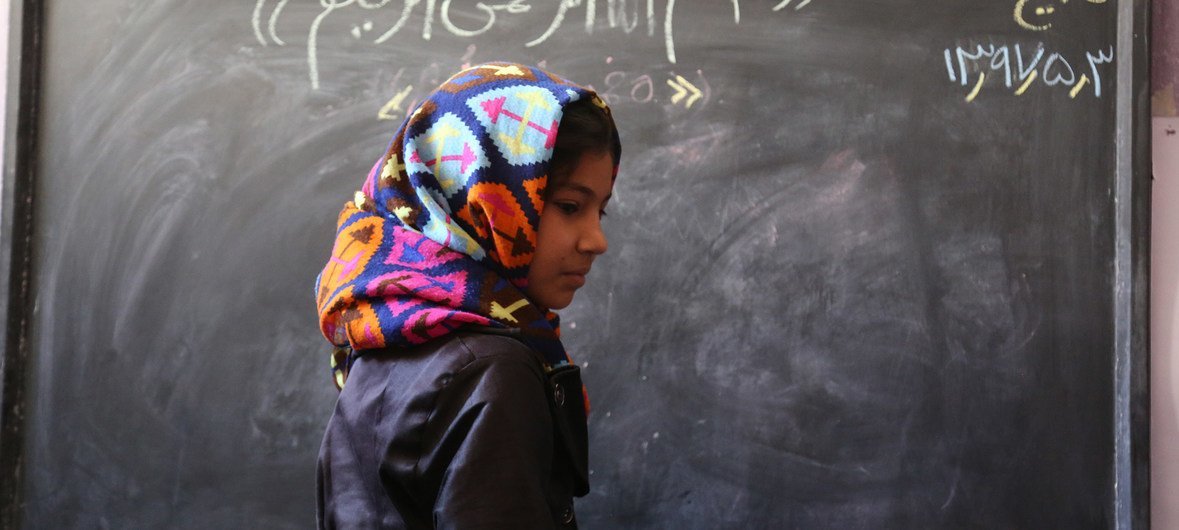
The UN Children’s Fund (UNICEF) said on 28 May 2019 that much greater protection for educational facilities was needed across Afghanistan where attacks against schools have increased three-fold in just one year. The call coincides with the third International Conference on Safe Schools, taking place this week in Mallorca, Spain.
If you are a pupil in Afghanistan, then you were three times more likely to be affected by an attack in 2018 than you were the previous year. Attacks on schools in the country surged from 68 in 2017 to 192 in 2018, according to UNICEF. This is the first time that the number of school attacks has increased, since 2015.




 HUMAN WRONGS WATCH