(UN News)* —Newborns and infants in Gaza have reportedly died of hypothermia, deaths described by the UN Children’s Fund (UNICEF) as preventable. The news comes amid continued Israeli bombardments and an expected further drop in temperatures.
In Gaza, where hundreds of thousands of people displaced from their homes are sheltering in tents, the temperatures are expected to drop further in the coming days.
Edouard Beigbeder, UNICEF Regional Director for the Middle East and North Africa, reported in a statement on Friday [] that, according to the Palestinian Ministry of Health, four newborns and infants died in recent days from hypothermia.
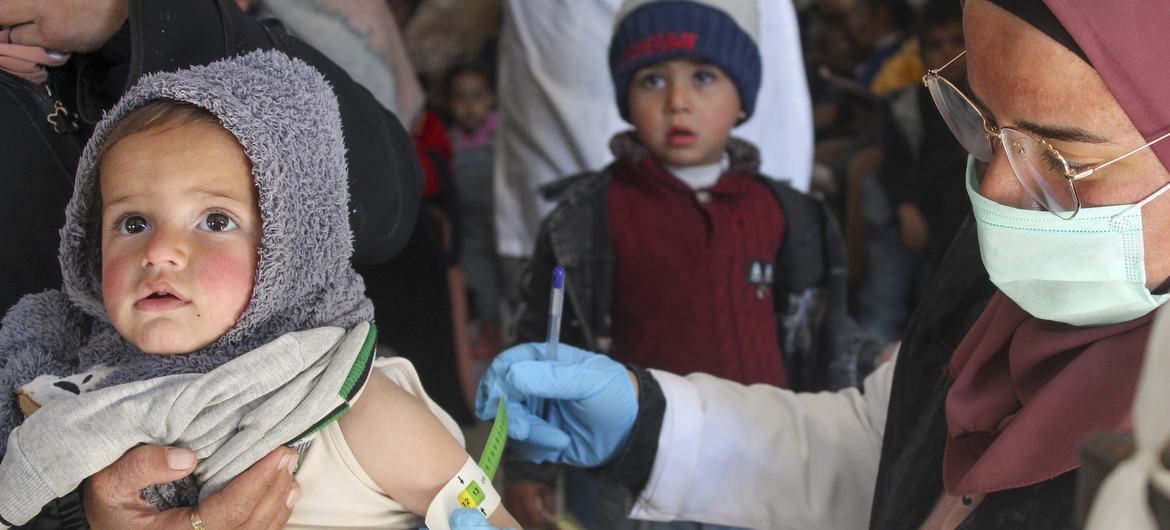
(UN News)* — Health challenges in northwest Syria have escalated due to harsh winter conditions, exacerbating the vulnerability of displaced populations, the UN World Health Organization (WHO)-led Health Cluster reported on Friday [].
It also cited rising cases of respiratory illnesses, compounded by inadequate heating, overcrowded camps and damaged infrastructure.
“There is continuous significant rise in influenza-like illnesses (ILI) and severe acute respiratory infections (SARI), since the beginning of winter with subsequent rise in hospital visits and heightened public health concerns,” the Health Cluster said.
(UN News)* — Fresh details of the Israeli airstrike on Sana’a airport, which occurred as Tedros Ghebreyesus, the Director-General of the World Health Organization (WHO) was preparing to fly out of the country, have been provided by Julien Harneis, the UN Resident and Humanitarian Coordinator in Yemen.
On 26 December, Israeli forces struck Sana’a International Airport, Red Sea ports and power stations. Tedros was at the airport when it was hit, along with Mr. Harneis and other members of a UN party negotiating the release of several UN workers held hostage by Ansar Allah, the de facto authorities in Sana’a.
Tedros and his colleagues were finally able to leave Yemen on Friday [].


 HUMAN WRONGS WATCH