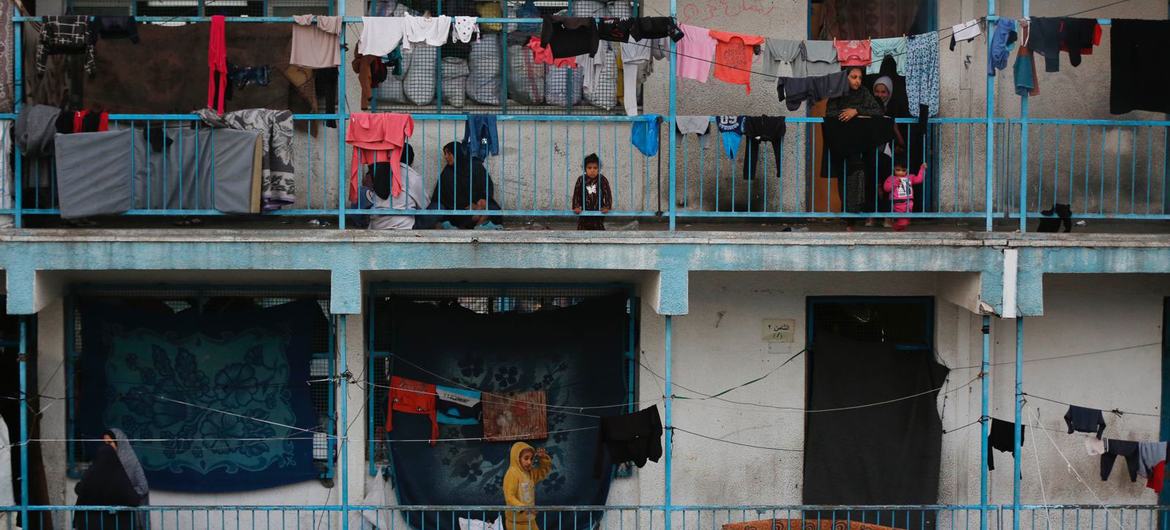
(UN News)* — Attacks on schools in conflict zones around the world have increased by a “staggering 44 per cent” over the past year according to the United Nations, resulting in the death, abduction and trauma of thousands of teachers and students.
Over 41,000 incidents of violence against school-age children were reported by the UN in 2024.
.
Countries with the highest levels of violations in were Israel and the Occupied Palestinian Territory, notably the Gaza Strip, the Democratic Republic of the Congo (DRC), Somalia, Nigeria, and Haiti.
(UN News)* — UN rights chief Volker Türk on Monday [] condemned what he called a worldwide “glorification of violence” which is underway, as well as “coordinated efforts” to undermine fundamental birthrights. “It is time for States to wake up and to act,” he insisted.
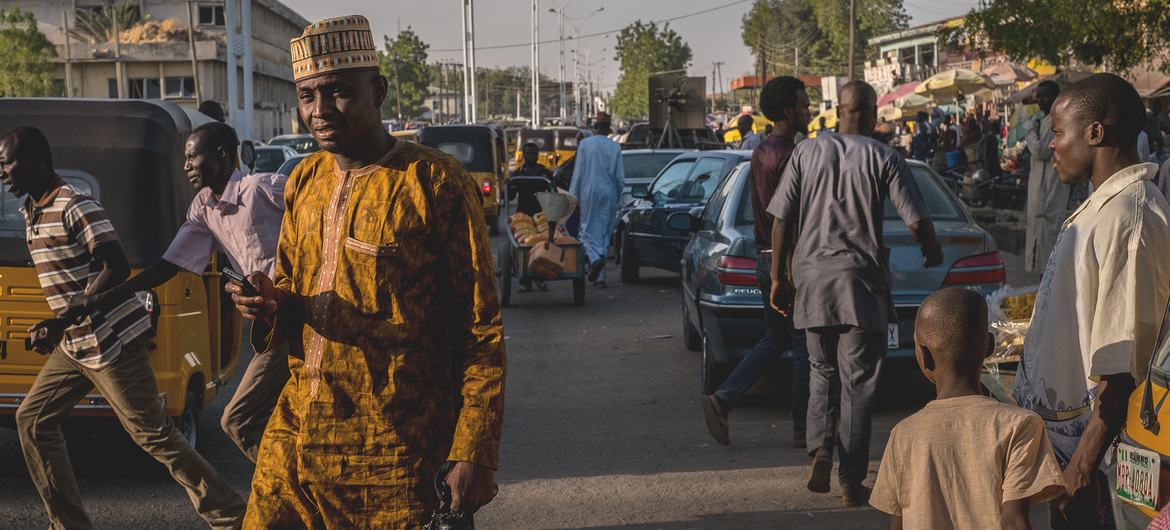
Dakar –In sub-Saharan Africa, approximately three out of four working women (76 percent) are employed in agrifood systems, and women make up 49 percent of the agrifood systems workforce.
Within agrifood systems, women’s employment in off-farm segments – such as production, processing, distribution, consumption and packaging – is increasing across the region, rising to 29 percent in 2022 from 21 percent in 2005.
UNITED NATIONS, Sep 8 2025 (IPS) –– When the high-level meeting of over 150 world leaders takes place at the United Nations, September 22-30, one of the political highlights would be the announcement by at least 10 Western nations to recognize Palestine as a sovereign nation state.
Protesters demonstrate outside the Columbia University campus in New York City. October 2024. Credit: UN Photo/Evan Schneider
The 10 countries– some already announcing their recognition ahead of the UN meeting — include UK, France, Canada, Australia, Portugal, Malta, Belgium, Spain, Ireland and Norway– proving the longstanding support for Israel is gradually diminishing in the Western world.
Millions of women and girls worldwide still cannot afford menstrual products or access water and sanitation facilities to manage their menstrual health and hygiene.
Periods make them miss school, work, and negatively impact their health, but it does not have to be that way.
Image
In Sitamarhi State, Bihar, India, in 2022, women hold sanitary pads during an awareness campaign as part of a menstrual hygiene management program organized by UNICEF. Photo: UNICEF/Priyanka Parashar
SRINAGAR & KISTIWAR, India, Sep 4 2025 (IPS)* ––The relentless rain that battered the mountains and valleys of Jammu and Kashmir this August shattered lives and records.
The Kishtwar cloudburst on August 26 buried Chesoti village beneath a torrent of mud and boulders, killing at least 65 people, with several still missing. Credit: Umar Manzoor Shah/IPS
Frosty morning in Pingjum Friesland, The Netherlands.
PHOTO:WMO Photostream/Anna Zuidema
Air pollution is the biggest environmental health risk of our time. It also exacerbates climate change, causes economic losses, and reduces agricultural productivity.
It knows no borders – everyone has a responsibility to protect our atmosphere and ensure healthy air for all.
By collaborating across borders, sectors, and silos, we can reduce air pollution through collective investments of time, resources and efforts.
Naminaue, Mozambique, 3 September 2025 – “This water is sweet,” says Merina, watching clear water flow from a newly rehabilitated borehole in Naminaue, northern Mozambique.
For the past five years she has lived in this displacement site, and for her, the taste of clean water brings back a rare sense of normalcy after years of conflict and loss.
Before displacement, Merina’s life in Litamanda village in Macomia District was steady. Her family farmed maize, rice, and sweet potatoes, slept on proper beds, and even watched Brazilian soap operas on television.
That ended the day armed groups attacked. Merina lost her husband in the violence and fled with nothing.
Merina scoops fresh water from the newly rehabilitated borehole – the first safe source in years. Photo: IOM 2025/Amanda Nero
PORTLAND, USA, Sep 4 2025 (IPS)** ––It is becoming increasingly apparent that planet Earth is evolving into the planet of the aged. In nearly every country around the world, the numbers and percentages of the aged, commonly defined as individuals aged 65 years or older, haveincreased rapidly.
.
Despite living longer lives, the aged are opposed to raising official retirement ages, reducing retirement benefits, or raising taxes on the elderly. They are increasingly protesting, resisting, and demanding that retirement ages stay the same and benefits remain intact. Credit: Shutterstock
 ©FAO
©FAO





 HUMAN WRONGS WATCH