(UN News)* — For over two years, tens of thousands of people have been killed in Gaza. The enclave faces its most severe economic collapse in history, and even amid a fragile ceasefire, children continue to die.
.
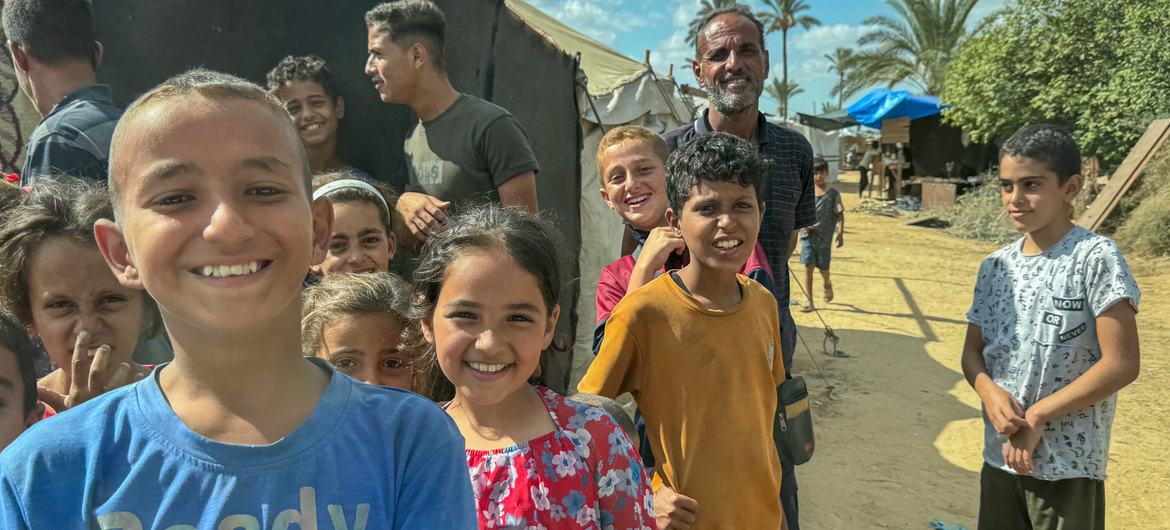
UNOCHA/ Olga Cherevko | Children queue for food at a community kitchen in Deir al Balah, Gaza, prior to the ceasefire agreement.
(UN News)* — The Occupied Palestinian Territory is now in its deepest economic crisis ever recorded, with Gaza suffering an “unprecedented and catastrophic” collapse, according to a new report from the UN Conference on Trade and Development (UNCTAD) presented in Geneva on Tuesday [].
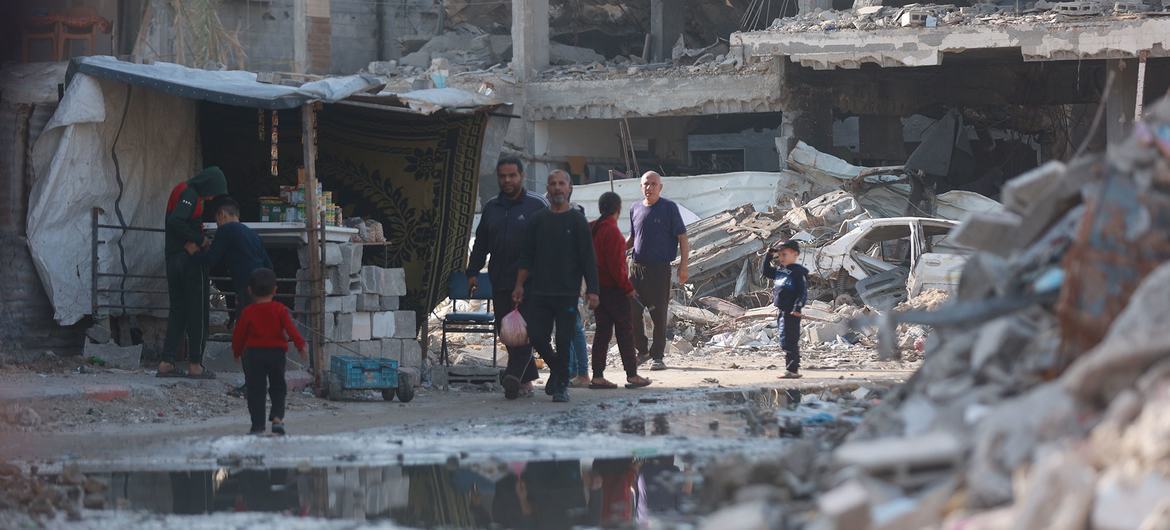
UN News | People walk through a destroyed neighbourhood of Gaza City.
Speaking at the launch of UNCTAD’s 2025 Report on the Economy of the Occupied Palestinian Territory, the agency’s Deputy Secretary-General Pedro Manuel Moreno said decades of movement restrictions, combined with the latest military operations, had “wiped out decades of progress” and left both Gaza and the West Bank facing long-term devastation.
(UN News)* — Women in Gaza are ensuring their families’ survival “with nothing but courage and exhausted hands” while violence continues and essentials remain in short supply, the UN’s gender equality agency warned on Tuesday [].
UN Women’s Chief of Humanitarian Action Sofia Calltorp, who just returned from a visit to the enclave last week, said that women there repeatedly told her “there may be a cease-fire, but the war is not over”.
.
“The attacks are fewer, but the killings continue,” she said.
(UN News)* —The UN High Commissioner for Human Rights, Volker Türk, says major companies and fast-moving technologies are creating new challenges for tackling rights abuses – and that governments and businesses need to step up.
UN Photo/Mark Garten | Volker Türk, UN High Commissioner for Human Rights, in an interview with UN News.
Opening the 14th UN Forum on Business and Human Rights in Geneva on Monday [24 November 2025] he said that corporate power has become increasingly influential in terms of social change.
He warned that without proper checks in place, new tools like generative artificial intelligence – or AI – could easily be misused.
“When powerful tech giants introduce new technologies, such as generative artificial intelligence,human rights can be the first casualty,” he said.
–In Belem, Brazil, as the United Nations climate summit (COP30) convened, I marched alongside thousands of activists and Indigenous peoples calling on governments to urgently address climate change and protect human rights.
The Group of Twenty (G20) comprises 19 countries (Argentina, Australia, Brazil, Canada, China, France, Germany, India, Indonesia, Italy, Japan, Republic of Korea, Mexico, Russia, Saudi Arabia, South Africa, Türkiye, United Kingdom and United States) and two regional bodies: the European Union and the African Union (as of 2023).
.
UN Secretary-General Antonio Guterres. Credit: UN Photo/Gustavo Stephan
The G20 members represent around 85% of the global GDP, over 75% of the global trade, and about two-thirds of the world population. South Africa assumed the G20 presidency on December 1 2024 and will step down on November 30 2025. The next G20 summit will be hosted by the US in 2026.
YAOUNDE, Cameroon / BARCELONA, Spain, Nov 24 2025 (IPS)** –– When South Africa assumed the Presidency of the G20, debt sustainability was placed front and centre, with the promise to launch a Cost of Capital Commission.
21 November 2025 — In response to the latest ‘Mutirão’ text, Nafkote Dabi, Oxfam International Climate Policy Lead, said:
.
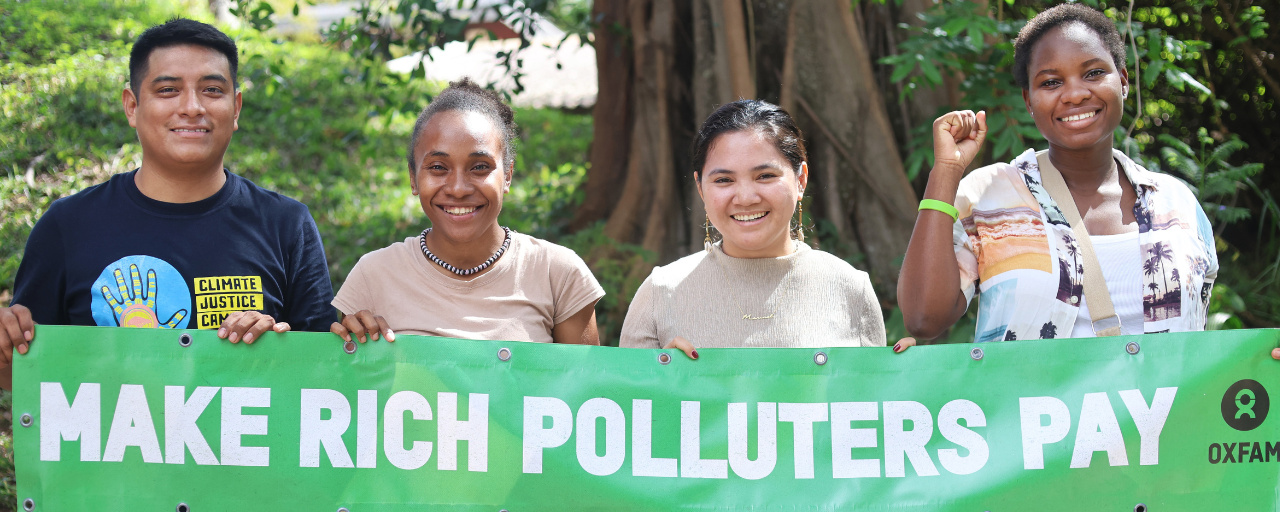
Climate activists Cynthia Houniuhi, Hilda Nakabuye, Marinel Ubaldo, and Pavel Martiarena at the Climate Justice Camp. (Photo: Tim Zijlstra/Oxfam).
“As COP30 races toward its close, world leaders are gambling with the planet — and with the lives of the poorest. Rich countries are treating adaptation finance as a bargaining chip.
Yet adaptation finance is a lifeline for all people, from farmers facing failed harvests to families already uprooted by climate disasters.
Rome –Disasters have inflicted an estimated $3.26 trillion in agricultural losses worldwide over the past 33 years – an average of $99 billion annually, roughly 4 percent of global agricultural GDP – according toa new reportby the Food and Agriculture Organization of the United Nations (FAO).
20 November 2025 —Extreme heat poses multiple risks for agrifood systems – damaging crops, stressing livestock and depleting fisheries – and threatens the livelihoods of an estimated 1.23 billion people.
.
There is an urgent need for science-informed solutions to strengthen resilience and sustainability, according to a new report from the Food and Agriculture Organization and WMO on “Extreme Heat and Agriculture.”



 Climate activists Cynthia Houniuhi, Hilda Nakabuye, Marinel Ubaldo, and Pavel Martiarena at the Climate Justice Camp. (Photo: Tim Zijlstra/Oxfam).

 HUMAN WRONGS WATCH