20 May 2021 (UNESCO)* — The International Decade for the Rapprochement of Cultures (IDRC) builds on the strong momentum created by and the achievements of both the International Decade for a Culture of Peace and Non-Violence for the Children of the World (2001-2010) and the International Year for the Rapprochement of Cultures (2010).
20 May 2021 (United Nations)* — Cultural events cancelled, cultural institutions closed, community cultural practices suspended, empty UNESCO World Heritage sites, heightened risk of looting of cultural sites and poaching at natural sites, artists unable to make ends meet and the cultural tourism sector greatly affected…
20 May 2021 (FAO)* — The origins of tea stretch back more than 5 000 years, but its contributions to health, culture and socioeconomic development are still as relevant today.
Tea is currently grown in very localized areas, and supports over 13 million people, including smallholder farmers and their households, who depend on the tea sector for their livelihoods.
International Tea Day [21 May] is an opportunity to celebrate the cultural heritage, health benefits and economic importance of tea, while working to make its production sustainable “from field to cup” ensuring its benefits for people, cultures and the environment continue for generations.
KUALA LUMPUR, Malaysia, May 18 2021 (IPS)* – Millions of people are expected to die due to delayed and unaffordable access to COVID-19 tests, treatment, personal protective equipment and vaccines. Urgent cooperation is desperately needed to save lives and livelihoods for all.
Jomo Kwame Sundaram
Vaccine apartheid Thus far, rich countries have bought up most available vaccine supplies.
By mid-April, rich countries had received more than 87 percent of the more than 700 million vaccine doses dispensed worldwide, while poor countries had received only 0.2 percent.
A quarter of the former’s population had been vaccinated compared to one in 500 of the latter’s!
By mid-May, less than a twelfth of the world’s population had been vaccinated, with ten rich countries getting four-fifths of all vaccines.
The Pfizer vaccine is mainly reaching the world’s rich.
18 May 2021 (FAO)* — For centuries bees, among the hardest working creatures on the planet, have benefited people, plants and the environment. By carrying pollen from one flower to another, bees and other pollinators enable not only the production of an abundance of fruits, nuts and seeds, but also more variety and better quality, contributing to food security and nutrition.
Pollinators such as bees, birds and bats, affect 35 percent of the world’s crop production, increasing outputs of 87 of the leading food crops worldwide, plus many plant-derived medicines.
Three out of four crops across the globe producing fruits, or seeds for use as human food depend, at least in part, on bees and other pollinators. Photo FAO/Greg Beals
18 May 2021 (United Nations)* — Bees and other pollinators, such as butterflies, bats and hummingbirds, are increasingly under threat from human activities.
Pollination is, however, a fundamental process for the survival of our ecosystems.
Nearly 90% of the world’s wild flowering plant species depend, entirely, or at least in part, on animal pollination, along with more than 75% of the world’s food crops and 35% of global agricultural land.
Not only do pollinators contribute directly to food security, but they are key to conserving biodiversity.
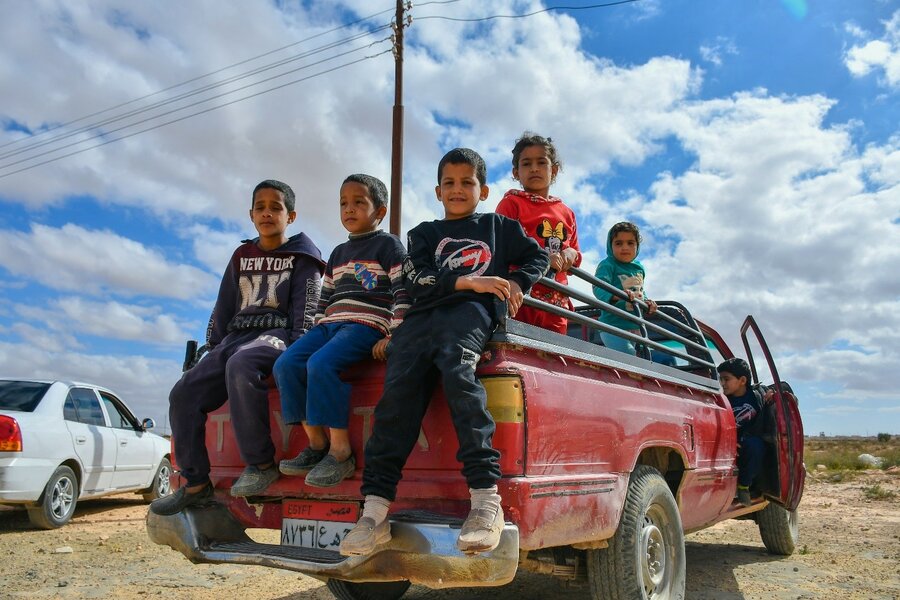
Lessons on securing education for girls and boys alike from a World Food Programme-backed initiative
Mahmoud’s children on a pickup truck rented for weekly shopping trips to town. Photo: WFP/Egypt
(WFP)* — Mahmoud Ibrahim is one of the 300 people living in the desert village of Mogama’a Ibrahim — a remote community in Egypt’s north-western coastal governorate of Marsa Matrouh.
Ta’iz, Yemen (IOM)* – Deciding to leave their home was a difficult call for Aisha and Tawfiq, but two years ago, out of fear for their lives, the couple fled their farm in Ta’iz, Yemen.
A displaced person standing in front of a shelter that he is helping to construct in Yemen. Photo: IOM 2021/Majed Mohammed
UNITED NATIONS, May 17 2021 (IPS)* – In most civil wars and military conflicts across the politically-volatile Middle East, including in Syria, Yemen and Palestine, the ongoing battles are being fought not on a level playing field but on an uneven killing field.
Escalated hostilities in the Gaza Strip have resulted in heavy casualties and large-scale displacement. More than 50 children have been killed in the current crisis in the Middle East, a senior UN official, said May 15. Credit: United Nations Office for the Coordination of Humanitarian Affairs (OCHA)
And it is more so in the current fighting between Israelis and Palestinians, described as a “Middle East carnage” where children are among the civilians killed in airstrikes. The fighting is largely a battle of weapons: sophisticated US-supplied state-of-the-art fighter planes vs home-made rockets and mortars.
15 May 2021 (openDemocracy)* — Israel is the most powerful state in the Middle East. Its military forces may not match the likes of Egypt or Turkey in numbers, but the might of its training, equipment, technologies and nuclear weapons make it unassailable.




 HUMAN WRONGS WATCH