(UN News)* —Extreme heat is breaking records around the world, with wildfires and poor air quality compounding the crisis, according to a report from the World Meteorological Organization (WMO) released Thursday [].
Extreme temperatures caused approximately 489,000 heat-related deaths annually between 2000 and 2019, with 36 per cent occurring in Europe and 45 per cent in Asia.
The health impacts of heat are especially severe in cities due to the so-called ‘urban heat island effect’ – the over-heating of dense city areas compared with their rural surroundings – which is magnifying problems as urbanisation continues.
Amid rising 21st-century temperatures, the WMO underscored that July 2025 was the third-warmest July ever recorded, behind those in 2023 and 2024.
An invitation for the reader to analyze and decide which countries, peoples, and/or cultures can be considered civilized in the 21st century—more specifically, in 2025.
A civilization or culture is defined as a set of customs, traditions, ethics, values, language, music, dance, gastronomy, clothing, religion, and social and political organization of a people, ethnic group, tribe, or nation.
British scholars of the 19th century classified the peoples and races as Civilized, Barbarians and Savages, based on their respective “evolutions.” Such classification was based primarily on three factors:
Charles Darwin’s Theory of Evolution;
the Industrial Revolution in the beginning of industrial capitalism; and
the Reformation of the Catholic Church, the schism from which Protestantism arose.
By Nargiz Shekinskaya in Awaza and Vibhu Mishra in New York.
(UN News)* — Trapped by geography and squeezed by global market forces, the world’s 32 landlocked developing countries remain among the poorest – and most overlooked.
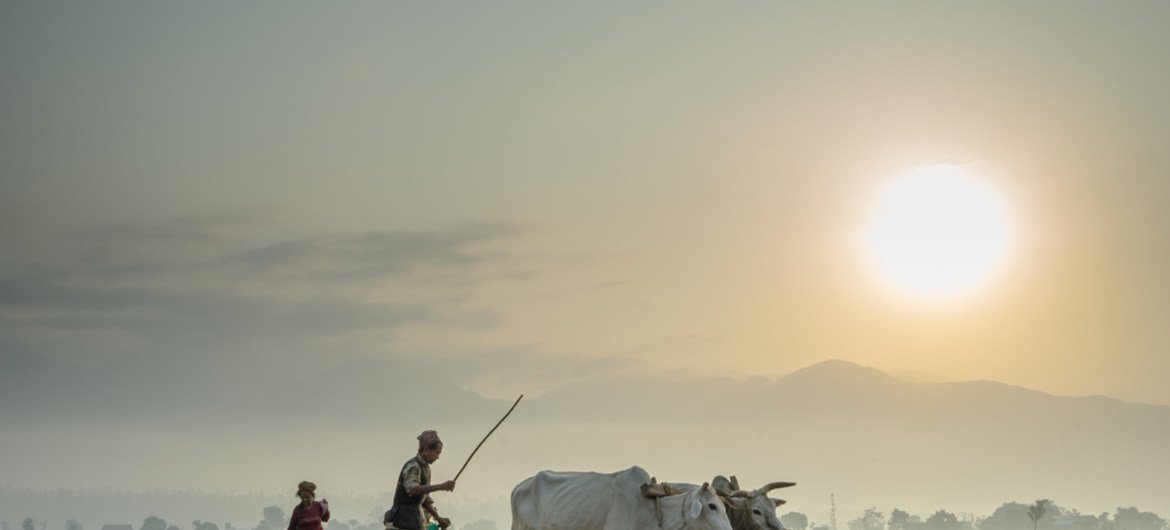
IFAD/Sanjit Das | In landlocked developing countries like Nepal (pictured), a lack of diversified industries and accessible markets limits local livelihoods – driving a growing exodus of young people seeking work abroad and often leaving older generations behind.
At a major UN conference underway this week in Awaza, Turkmenistan, calls are growing to tackle the high trade costs, investment gaps and growing digital divide that continue to hold these countries back.
Despite progress in some areas, landlocked nations – from Bolivia to Bhutan and Burkina Faso – account for just1.2 per cent of global exports, even though they represent over seven per cent of the world’s countries.
AWAZA, Turkmenistan, Aug 6 2025 (IPS)* ––Agriculture is a critical sector in landlocked developing countries, as more than half (55 percent) of the population is employed in the agriculture sector – significantly higher than the global average of 25 per cent.
As such, the deterioration of food security in landlocked developing countries (LLDCs) is an unfolding catastrophe.
A high-level event focused on agriculture at the ongoing Third United Nations Conference on Landlocked Developing Countries. Credit: Joyce Chimbi/IPS
There are 32 LLDCs, with a combined population of nearly 600 million people.
The prevalence of moderate or severe food insecurity rose from an estimated 43 percent in 2015 to 51 percent in 2023, and the rate of undernourishment from approximately 15 percent to 19 percent in the same period.
(UN News)* —At a major UN forum opening in Awaza, Turkmenistan, this week, parliamentarians from around the world are being urged to take decisive action to improve the lives of more than 600 million people living in landlocked developing countries (LLDCs).
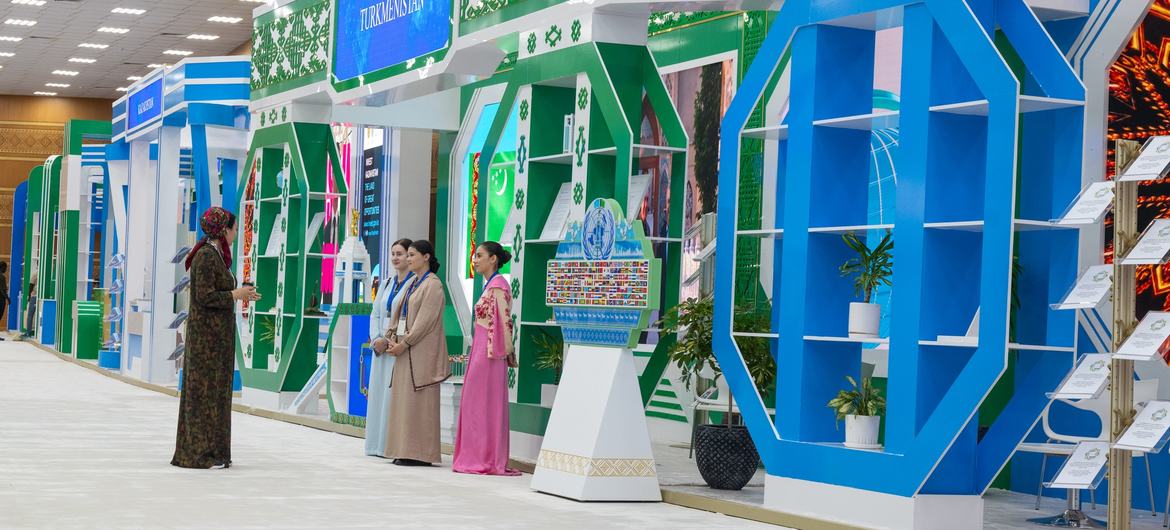
UN Photo/Eskinder Debebe | Final preparations being made at the venue of the LLDC3 conference in Awaza, Turkmenistan.
Speaking at the Parliamentary Forum of the Third UN Conference on LLDCs, senior UN leaders stressed that political will, matched with national legislative action, is essential if a new decade-long development plan is to make a real difference.
There are 32 such countries globally, home to over half a billion people. Many are also among the world’s least developed, hindered by high transport costs, limited access to global markets, and heightened vulnerability to climate impacts.
(UN News)* — Famine was declared in the Zamzam camp in North Darfur one year ago. And since then, little has changed – no aid trucks have reached the region, the nearby city of El Fasher is still under siege and food prices are four times higher than other parts of the country.
(United Nations)* — Landlocked Developing Countries (LLDCs) lack territorial access to the sea, leaving them dependent on transit neighbors for a route to world markets.
.
Located more than 500km from the Atlantic coast, Burkina Faso is one of 16 landlocked developing countries in Africa.
PHOTO:UNDP / Aurélia Rusek
This geographic disadvantage drives up transport costs, introduces avoidable delays, and exposes LLDCs to any political or economic instability along those corridors.
The results are stark: Average transport costs are more than twice those of neighboring coastal states.
Export opportunities shrink, foreign direct investment falls, and economic growth slows.
When a transit country is itself a developing economy—often the case—intraregional trade remains modest.
NAIROBI, Kenya / PARIS, France, Aug 5 2025 (IPS)** – One would expect that this year’s wetter than average rainy season in parts of Africa would be viewed with relief, not fear.
Credit: World Organisation for Animal Health
Yet many areas in the region sits at a knife’s edge—still recovering from years of drought and a historic famine, too much rain leads to flooding and water-borne diseases.
If you want to glimpse the strange, brutal logic that governs our world, don’t start with politicians or generals—start with the bank towers glittering above your city skyline and the endless parade of military hardware rolling across distant deserts.
These are the altars of the age: places where class warfare is waged relentlessly, not through open declarations but via the everyday rituals of finance and force.
And though the language of “class warfare” may evoke images of barricades and revolution, the reality today is far more insidious—a meticulously organized onslaught against the fabric of society itself, a crime against peace perpetrated not by outlaws, but by the very architects of our economic and military order.
Class warfare, in this sense, is neither forgotten rhetoric nor historical artifact.
KARACHI, Pakistan, Jul 30 2025 (IPS)* — “The last thing she asked for was a sip of water,” recalled Najma Maheshwari, referring to 19-year-old Shanti, a newlywed who died last week after brutal sexual violence allegedly inflicted by her husband, who is now in custody.
“Then she closed her eyes and never opened them again,” she said quietly, her voice steeped in sadness.
From beautiful bride, to victim of marital rape, this is the story of Shanti, a 19-year-old whose husband has been charged under the Domestic Violence (Prevention and Protection) Act of 2013.







 HUMAN WRONGS WATCH