More than 400 delegations of Venezuela participated in this first meeting, as well as 60 international delegations coming from across the country.
One of the focus will be the creation of an international movement of native peoples, along with a collective agenda for the fight against foreign intervention and extractivism. | Photo: MINCI (posted here fromteleSUR).
30 October 2019 (teleSUR)* — The 1st International Congress of Native Peoples has begun Tuesday [29 October 2019] in Venezuela and will last until Thursday, as part of the strategic actions that were outlined during the 25th Forum of Sao Paolo last month.
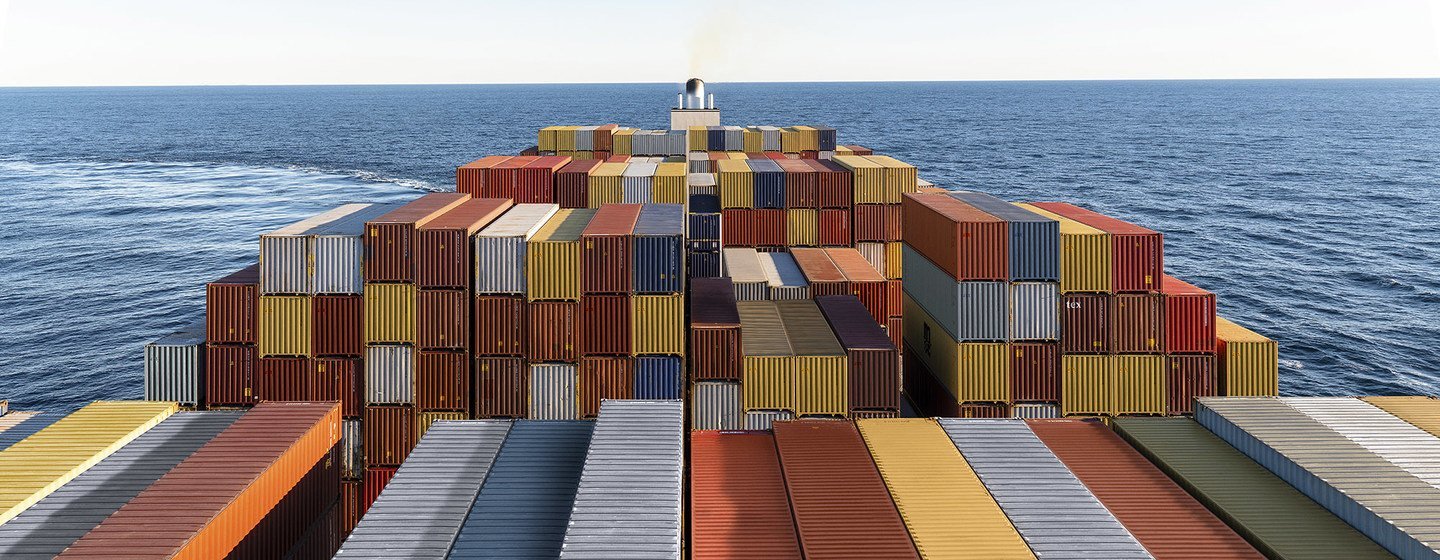
If emissions from the maritime industry are not cut, we are headed for “an environmental disaster”, Isabelle Durant, the deputy head of the UN trade body, UNCTAD, told the Global Maritime Forum summit on Wednesday [30 October 2019].
Her views were echoed by the UN shipping agency IMO, whose spokesperson, Lee Adamson, told UN News in an exclusive interview that current levels of emissions from shipping are “not acceptable”, and the industry needs a “new propulsion revolution”, to completely cut emissions from the sector.
Over half of the world’s population now live in cities, with numbers expected to double by 2050, but while urbanization poses serious challenges, cities can also be powerhouses for sustainable development; something the UN is spotlighting on World Cities Day, marked 31 October. *
The world’s mountain and glacier regions are facing unprecedented challenges due to climate change, imposing a crippling effect on the people and economies that rely on them, the UN’s weather agency explained on Tuesday [29 October 2019], ahead of a summit to address the world’s rapidly-changing water systems. *
UN News/Daniela Gross | Cordillera Huayhuash in August 2019. The Andes contain 99% of the world’s tropical glaciers and 71% are in Peru.
The earth’s glaciers, snow, permafrost and associated ecosystems, collectively known as the cryosphere, provide drinkable water for half of the world, but as the earth gets warmer, the supply is becoming unpredictable.
DAYLESFORD, Australia, 30 October2019 — About 12,000 years ago, late stone age humans precipitated the neolithic (agricultural) revolution that marked the start of the steady rise to civilization.
Robert J. Burrowes
Coincidentally, this occurred at the same time as the beginning of what is now known as the Holocene Epoch, the geological epoch in which humans still live.
However, since the industrial revolution commencing in about 1750, just 270 years ago, humans have been destroying Earth’s biosphere with such tremendous ferocity that the Earth we inherited at the beginning of the Holocene Epoch is vanishing before our eyes.
24 October 2019 (FAO)* — For as long as he could remember, Benito González from western Mexico had struggled to make ends meet and lived on the margin of society. As many indigenous peoples – anywhere – do.
His life started to change for the better in 2016, when the Government of Mexico and FAO made it possible for Benito and others in his community to grow their own food.They started off with a 200-square-metre greenhouse, a drip irrigation system, and a 5 000-cubic-meter water tank.
24 October 2019 (UN Environment)* — Without nitrogen, most of the world’s crops wouldn’t exist. Nitrogen is to corn, wheat and rice, what water is to fish.
Yearly, more than 100 million tonnes of nitrogen are applied to crops in the form of fertilizer, helping them grow stronger and better.
But issues arise when nitrogen run-off occurs, polluting air, water and land in the process. It is estimated that nitrogen discharge accounts for a third of agriculture’s greenhouse gas emissions.
Spearheaded by Sri Lanka, United Nations member states endorsed a proposed roadmap for action on nitrogen challenges called the Colombo Declaration on Sustainable Nitrogen Management
Colombo, 24 October 2019 (UN Environment)* – At a time when the world grapples with the menace of air pollution killing 7 million people prematurely every year, Sri Lanka, with support from the UN Environment Programme (UNEP), convened a two-day event at which member states came together to adopt what is being called the “Colombo Declaration” with an ambition to halve nitrogen waste by 2030.
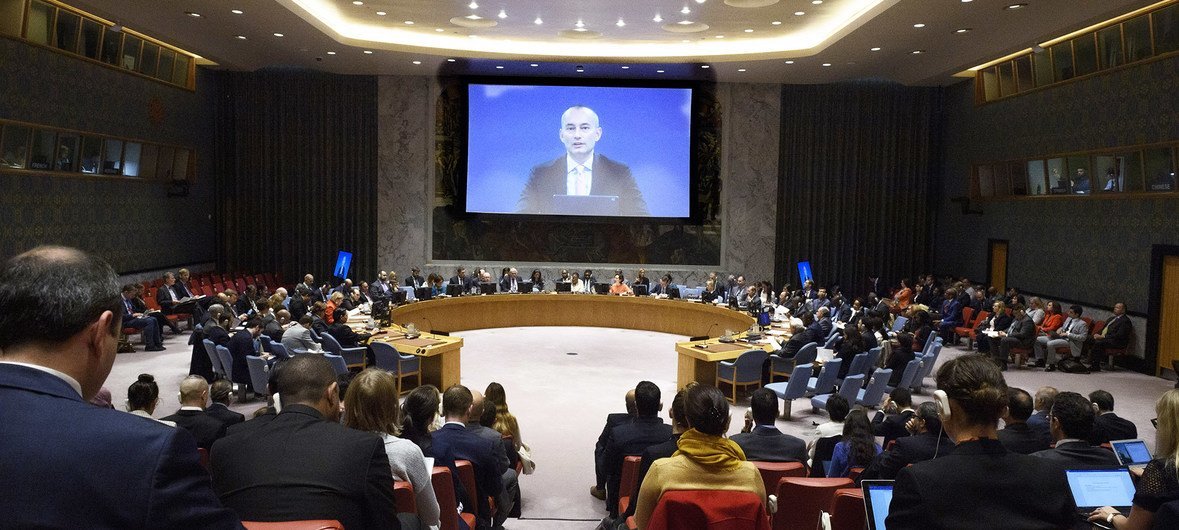
28 October 2019 (UN News)* —Pervasive deteriorating facts on the ground in Israeli-Palestinian conflict, “are pushing us every further” from achieving a viable two-State solution, the UN Special Coordinator for the Middle East Peace Process told the Security Council on Monday [28 October 2019].
UN Photo/Loey Felipe | Nickolay Mladenov, UN Special Coordinator for the Middle East Peace Process, addresses the Security Council via video-link.
With the spotlight on Israel and the Occupied Palestinian Territories, Special Envoy Nicolay Mlandenov detailed “new dangerous flashpoints” emerging in the region, under rapidly shifting developments in the Middle East as a whole, which have snowballed into a growing threat to international peace and security.
28 October 2019 (World Meteorological Organization)* — The world’s highest peaks, ranging from the Andes to the Alps and the Third Pole to the tropics, are being hit hard by climate change, and the impacts of this are cascading down to some of Earth’s most densely populated areas.





 HUMAN WRONGS WATCH