The U.S. federal debt has more than doubled since the 2008 financial crisis, shooting up from $9.4 trillion in mid-2008 to over $22 trillion in April 2019. The debt is never paid off. The government just keeps paying the interest on it, and interest rates are rising.
Ellen Brown
In 2018, the Fed announced plans to raise rates by 2020 to “normal” levels — a fed funds target of 3.375 percent — and to sell about $1.5 trillion in federal securities at the rate of $50 billion monthly, further growing the mountain of federal debt on the market.
When the Fed holds government securities, it returns the interest to the government after deducting its costs; but the private buyers of these securities will be pocketing the interest, adding to the taxpayers’ bill.
In fact it is the interest, not the debt itself, that is the problem with a burgeoning federal debt.
3 June 2019 (UN Environment)* — Transportation produces 25 per cent of emissions in Latin America and the Caribbean. With the air of most of the region’s capital cities becoming literally unbreathable, biking has captured the imagination of thousands of Latin Americans.Four of the main capitals have taken steps to promote sustainable mobility options to beat air pollution and are encouraging pedaling as a concrete measure to clean the air.
3 June 2019 (UN Environment)* — Air pollution is all around us. Indoors, outdoors, in cities and in the countryside. It affects us all, whether we realize it or not. For the longest time, we have taken the air we breathe for granted. There was air, there were smells, there was cold wind, there was hot air.
But recent research has started to shed light on some rather worrisome aspects of what the air around us really contains, and how it affects our bodies.
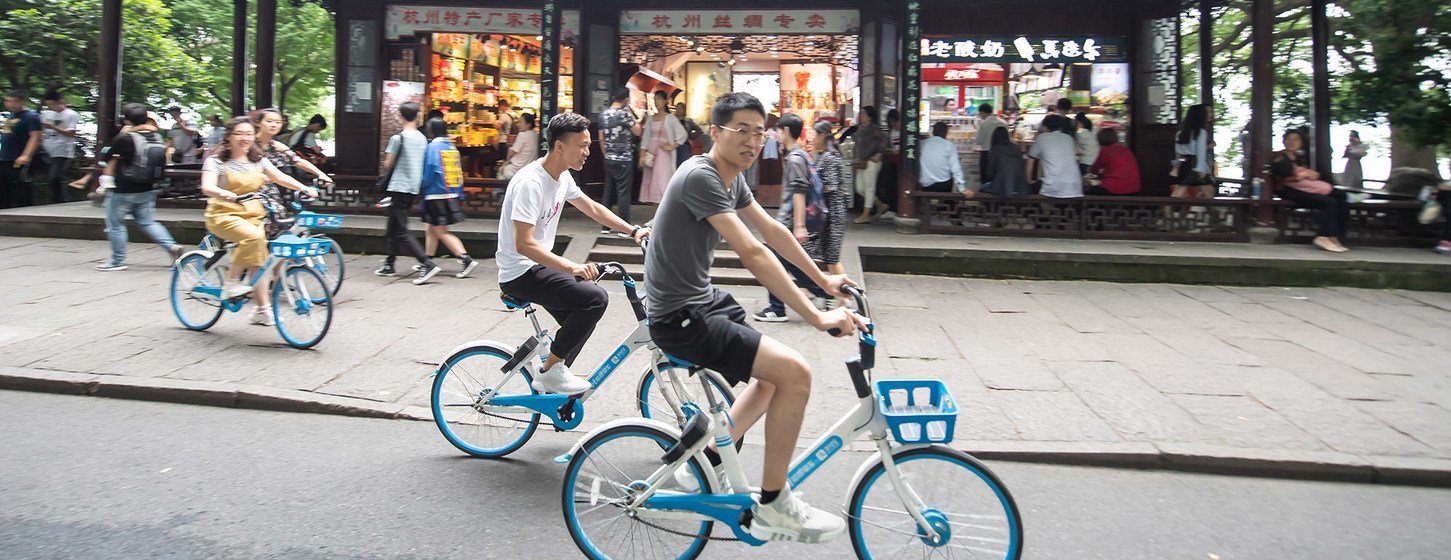
3 June 2019 — Cars have replaced bicycles as the primary means of transport in many Chinese cities but, with air pollution a major problem for the country, the bike is making a comeback, thanks to digital technology, and some 21st Century thinking.
Yimin Feng | Youth riding share bikes along the UNESCO World Heritage Site West Lake in Hangzhou, China.
ByWorld Health Organization* — As the world gets hotter and more crowded, our engines continue to pump out dirty emissions, and half the world has no access to clean fuels or technologies (e.g. stoves, lamps), the very air we breathe is growing dangerously polluted: nine out of ten people now breathe polluted air, which kills 7 million people every year.
The health effects of air pollution are serious – one third of deaths from stroke, lung cancer and heart disease are due to air pollution. This is having an equivalent effect to that of smoking tobacco, and much higher than, say, the effects of eating too much salt.
3 June 2019 (Other News)* — The terrible feeling I had on waking up and seeing the Italian voting results at the recent European elections was that my country was suddenly full of strangers.
European national parliaments with representatives from right-wing populist parties in May 2019: Right-wing populists represented in the parliament Right-wing populists providing external support for government Right-wing populists involved in the government Right-wing populists appoint prime minister | Tobias101 | CC BY-SA 4.0
Perhaps the most direct way to introduce this tough issue is what the United Nations secretary general, António Guterres, stated just one week ahead of the 5 June World Environment Day, which focuses this year on air pollution, caused chiefly by the use of fossil fuels both in transport, industry and even household cooking, heating, etc.
Monday May 27 was a public holiday in the UK, the fourth such “bank holiday” in the past six weeks. On each of these days, people made fewer commutes, they left their computers and machines switched off, and the country generally used less energy.*
Modern Times, about the dehumanisation of work (Image by United Artists • Public domain, Wikipedia)
In fact, my rough calculations below indicate that, depending on the season, each bank holiday could save more than 100,000 tonnes of carbon dioxide emissions.
Millions of mothers at risk due to prohibitive health care costs, lack of access to services and skilled professionals, and child marriage
UNICEF/UN0155822/Zammit
NEW YORK/ VANCOUVER (UNICEF)* – More than 5 million families across Africa, Asia, and Latin America and the Caribbean spend over 40 per cent of their non-food household expenses on maternal health services every year, UNICEF said today [3 June 2019] in a new analysis on maternal health.
Nearly two-thirds of these households, or around 3 million, are in Asia while approximately 1.9 million are in Africa.
I never thought you’d need a freezer in the Arctic..But April 2019 saw average temperatures that were 8 degrees above normal. It meant that this concert, performed entirely on instruments carved from Arctic ice, nearly didn’t happen. It was almost too warm to have an ice concert in the Arctic...
We brought four musicians and an ice carving artist to the Arctic to give the ice its own voice to sing, as a representation of the fragility of the region and how close it is coming to melting away. It’s an idea that only Greenpeace could pull off..




 HUMAN WRONGS WATCH