20/05/2019

75 percent of the world’s food crops, like apples, coffee and blueberries, owe their existence to pollinators. Left: ©FAO/ Richard Slaby
20 May 2019 (FAO)* — “It’s a bee!” someone screams as they jump up from their picnic blanket, knocking over their apple juice and flailing their arms, trying to get away from this flying creature. Does this scene sound familiar?
Many people are afraid of bees. And why not? They look like aliens. They have stingers that hurt more than you would expect and some people are very allergic, even deathly allergic, to them.
read more »
Posted in Africa, Asia, Latin America & Caribbean, Market Lords, Middle East, Mother Earth, Others-USA-Europe-etc., The Peoples |
1 Comment »
20/05/2019

Three out of four crops across the globe producing fruits or seeds for human use as food depend, at least in part, on bees and other pollinators. ©FAO/Greg Beals
19 May 2019 (FAO)* — It’s early May in one of Spain’s most prolific honey-producing region, and Julio Solana Muñoz is worried. The third-generation beekeeper has noticed that the flowers in the fields near his town aren’t anywhere near as numerous as they were even a year ago. His hives are dying off, too. In recent years, the mortality rate for his bees has climbed to nearly 35 percent.
read more »
Posted in Africa, Asia, Climate Crisis, Latin America & Caribbean, Market Lords, Middle East, Mother Earth, Others-USA-Europe-etc., The Peoples |
Leave a Comment »
19/05/2019
By Izumi Nakamitsu, United Nations High Representative for Disarmament Affairs*
Human suffering caused by war is not a new phenomenon.

Izumi Nakamitsu
And while our highest priority remains the prevention of war, evolving patterns of armed violence are posing new and more difficult challenges that require action.
The number of people killed in armed conflict has risen tenfold since 2005.
Conflict is migrating into villages, towns and cities, but governments and non-state actors are continuing to use weapons designed for open battlefields.
Many weapons originally intended for battlefield use, those that disperse multiple munitions over a wide area, fire without a direct line of sight to the target, or produce large blasts and fragmentation, pose serious humanitarian concerns when used in populated areas.
read more »
Posted in Africa, Asia, Latin America & Caribbean, Market Lords, Middle East, Migrants and Refugees, Mother Earth, Others-USA-Europe-etc., The Peoples, War Lords |
Leave a Comment »
18/05/2019
By Baher Kamal*
Amazingly organised social communities, bees ensure food chain. ‘Bee’ grateful to them… at least in their Wold Day!

Did you know that out of at least 20 000 species of bees only 7 of them are honeybees? Western honeybees produce 1.6 million tonnes of honey a year. ©StudioSmart/shutterstock.com | Photo from FAO.
While the (surprisingly) still called homo sapiens continues to destroy Mother Nature, bees and other pollinators, such as butterflies, bats and hummingbirds, carry on performing their vital role as one of the most marvellous, unpaid, life guarantors.
read more »
Posted in Africa, Asia, Latin America & Caribbean, Market Lords, Middle East, Mother Earth, Others-USA-Europe-etc., The Peoples |
4 Comments »
18/05/2019
18 May 2019 (teleSUR)* —
Canada has long been overrun with large numbers of missing and murdered Indigenous women and girls and over-representation of Indigenous people in correctional facilities.
The treatment of Indigenous peoples in Canada was reviewed and will henceforth be identified as a genocide, the Winnipeg-based Museum for Human Rights has declared.
read more »
Posted in Africa, Asia, Latin America & Caribbean, Market Lords, Middle East, Others-USA-Europe-etc., The Peoples, War Lords |
Leave a Comment »
18/05/2019
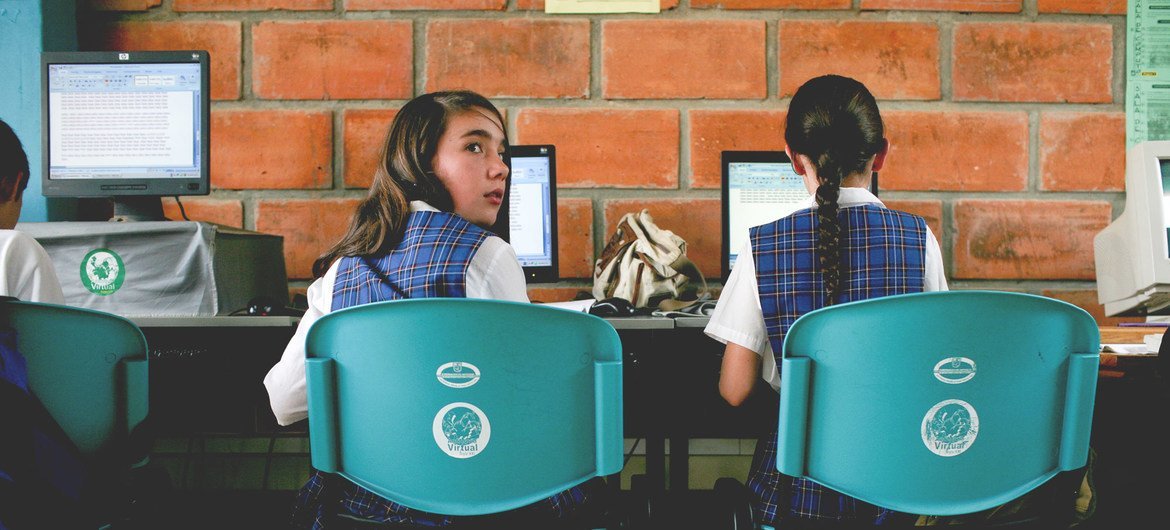
Why do most voice assistants have female names, and why do they have submissive personalities? The answer, says a new report released on Friday [17 May 2019] by UNESCO, the UN’s Education, Science and Culture agency, is that there are hardly any women working in the technical teams that develop these services and other cutting-edge digital tools.
World Bank/Charlotte Kesl | Two schoolgirls make use of classroom computers at San Jose, a rural secondary school in La Ceja del Tambo, Antioquia, Colombia. | Photo from UN News.
The publication, produced in collaboration with the Germany Government and the EQUALS Skills Coalition – an alliance of public and private sector partners which encourages the involvement of women and girls in scientific and digital technology sectors – is called “I’d Blush If I Could.”
Posted in Africa, Asia, Latin America & Caribbean, Middle East, Others-USA-Europe-etc., The Peoples |
Leave a Comment »
17/05/2019
STOCKHOLM, May 17 2019 (IPS)* – When the Stockholm International Peace Research Institute (SIPRI) concluded a three-day forum on “Peace and Development” on May 16, the primary focus was the daunting challenges threatening global security, including growing military interventions, spreading humanitarian emergencies, forced migration, increasing civil wars, extreme weather conditions triggered by climate change and widespread poverty and conflict-related hunger.

Sweden’s Minister for International Development Cooperation Peter Eriksson
read more »
Posted in Africa, Asia, Latin America & Caribbean, Market Lords, Middle East, Migrants and Refugees, Mother Earth, Others-USA-Europe-etc., The Peoples, War Lords |
2 Comments »
17/05/2019
India’s new comprehensive Cooling Action Plan targets an increase in sustainable cooling for the good of its population, while helping to fight climate change
17 May 2019 (UN Environment)* — Four years after temperatures hit the high forties in India, claiming over 2,000 lives, parts of the country are again baking in intense, and deadly, heatwaves. Throughout April and into May, the states of Madhya Pradesh, Maharashtra and Rajasthan have seen daily highs of 42°C.
As climate change increases, such temperatures are becoming the new normal. Combined with economic growth and urbanization, this brings a huge growth in cooling demand. The number of air conditioners in India is expected to rise from 15 million in 2011 to 240 million in 2030.
read more »
Posted in Africa, Asia, Latin America & Caribbean, Market Lords, Middle East, Mother Earth, Others-USA-Europe-etc., The Peoples |
Leave a Comment »
17/05/2019
Geneva, 16 May 2019 (IOM)* – Climate change and disasters are driving more people to move than ever before, whether due to sudden onset disasters like the unprecedented cyclones that devastated Southern Africa earlier this year, or destructive long-term weather patterns causing drought.

Women displaced from drought in Ethiopia receive emergency shelter from IOM. The Organization supports more than 70 countries to prevent and mitigate disaster displacement. Photo: Rikka Tupaz
read more »
Posted in Africa, Asia, Latin America & Caribbean, Market Lords, Middle East, Migrants and Refugees, Mother Earth, Others-USA-Europe-etc., The Peoples |
Leave a Comment »
16/05/2019
Immediate Action Is Needed to Save the Future

John Scales Avery
The central problem which the world faces in its attempts to avoid catastrophic climate change is a contrast of time scales.
In order to save human civilization and the biosphere from the most disastrous effects of climate change, we need to act immediately.
But it is difficult to mobilize public opinion behind urgently needed action because the most severe effects of global warming belong to the long-term future.
However, the Intergovernmental Panel on Climate Change, in their October 2018 report, used strong enough language to wake up at least part of the public: the children whose future is at stake.
Here is an excerpt from a speech which 16-year-old Swedish climate activist Greta Thunberg made at the Davos Economic Forum in January, 2019:
read more »
Posted in Africa, Asia, Latin America & Caribbean, Market Lords, Middle East, Migrants and Refugees, Mother Earth, Others-USA-Europe-etc., The Peoples, War Lords |
2 Comments »


 HUMAN WRONGS WATCH