The UN human rights office (OHCHR) said on Friday [3 May 2019] it was alarmed by reports that migrants and asylum seekers who are being held in Hungarian detention centres are being “deliberately deprived of food in contravention of international laws and standards”.
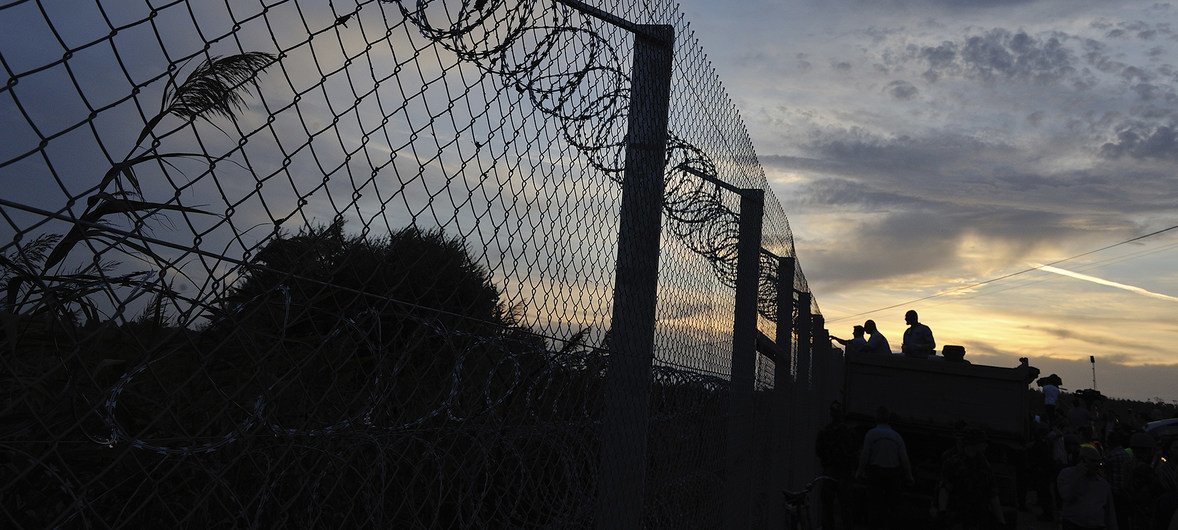
UNHCR/Mark Henley | Hungary’s strengthened razor wire border fence along an old railway line, to block the path of refugees and migrants. File photo, September 2015.
OHCHR Spokesperson, Ravina Shamdasani, told reporters in Geneva that under existing laws in Hungary, migrants and asylum seekers who are undocumented, are immediately detained in transit zones during the asylum procedure, or until they can be sent back to their country of origin.
Nicosia, 4 May 2019 (IOM)* — The International Organization for Migration (IOM) is deeply saddened by the recent news regarding a series of killings in Cyprus targeting young migrant women and girls and regrets the terrible loss of life.
Migrants, particularly migrant women, often find themselves in situations of vulnerability.
These shocking revelations highlight the need for strengthened capacity to provide protection and support to migrants and victims of violence, as well as strategies to combat the exploitation of migrant workers.
Further cooperative efforts are also needed to enhance inclusion and promote integration of migrants into local society and to enable receiving communities to harness the positive contributions that migrants make.
3 May 2019 (UN Environment)* — Nearly 80 per cent of the air we breathe is nitrogen, a harmless inert gas. However, nitrogen also combines with other atoms to form chemical compounds—known as “reactive nitrogen” or “fixed nitrogen” (Nr)—that are essential for life on Earth but, at high concentrations, also hugely damaging to the environment.
Photo Credit: Lynn Betts (Wikimedia Commons) | Photo from UN Environment.
“Altogether, humans are producing a cocktail of reactive nitrogen that threatens health, climate and ecosystems, making nitrogen one of the most important pollution issues facing humanity,” says UN Environment’s 2019 Frontiers Report.
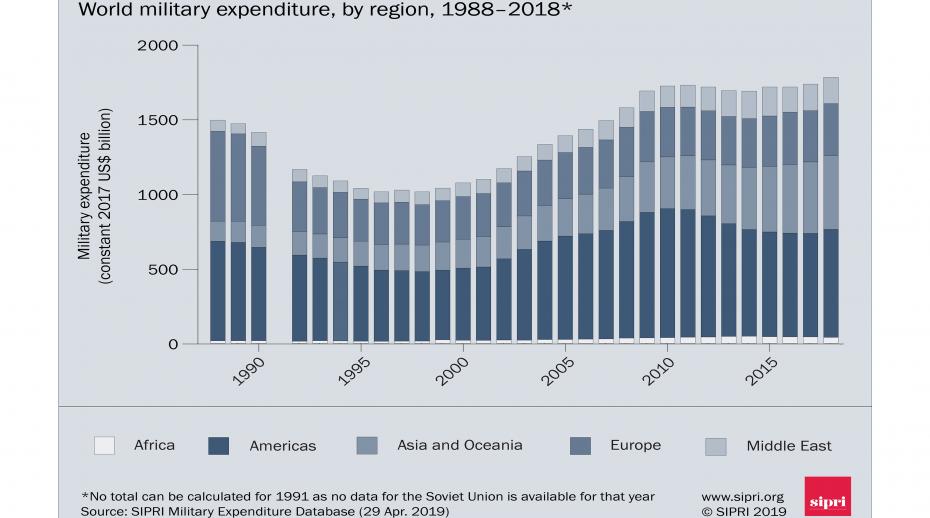
By the 29 April 2019 — Total world military expenditure rose to $1822 billion in 2018, representing an increase of 2.6 per cent from 2017, according to new data from the Stockholm International Peace Research Institute (SIPRI).*
World military spending 1988–2018. Data and graphic: SIPRI
The five biggest spenders in 2018 were the United States, China, Saudi Arabia, India and France, which together accounted for 60 per cent of global military spending. Military spending by the USA increased for the first time since 2010, while spending by China grew for the 24th consecutive year.
2 May 2019 (UN Environment)* — Burning plastic smells awful. It also gives you that choking feeling… which is no surprise when you know that plastic is basically made of oil and gives off toxic fumes when it burns.
Incineration of plastic waste in open fields is a major source of air pollution. About 12 per cent of most municipal solid waste is made up of plastic of one kind or another, and 40 per cent of the world’s garbage is burned, according to a the study “Toxic Pollutants from Plastic Waste – A Review.”
3 May 2019 (Wall Street International)* — Everybody has at least one opportunity in life to sample the first batch of cookies your little sister, brother, nephew, niece or neighbor kid cooks up. I can distinctly remember the day my little sister proudly presented me with three cookies that she had created. They were awful! I mean terrible. I could have choked to death if she hadn’t brought me a glass of milk with those darn things.
Aden, 2 May 2019 (IOM)* — The International Organization for Migration (IOM) is alarmed by reports of migrants dying of preventable illnesses, being shot and suffering other inhumane treatment in makeshift detention centres in Yemen, now in its fifth year of conflict.
Detained migrants treated by IOM’s health team in the 22nd of May Stadium where over 2,500 people are being held. Photo: Headon/IOM 2019
2 May 2019 — The deadly threat of lightning strikes, as well as their damaging impact on a country’s development, has been recognized in a new project supported by the UN Development Programme (UNDP).*
Ziemowit Porębski | Lightning strikes can cause fatalities, especially in developing countries. (file 2006)
There are more deaths from lightning in developing countries, especially in tropical electrical storm-prone regions, largely because more people work outdoors and fewer buildings are protected against strikes.
At a time when disinformation and mistrust of the news media is growing, a free press is “essential for peace, justice, sustainable development and human rights”, said the UN Secretary-General, in his message for World Press Freedom Day, marked on Friday [2 May 2019].
UN Photo/Violaine Martin | Journalists wait for the arrival of official delegations at the Geneva II Conference on Syria, in Montreux, Switzerland. UN Photo/Violaine Martin
2 May 2019 (Wall Street International)* — Transformation sometimes can be drastic. There is no better example in nature to reflect this, than metamorphosis. Like the conversion of a caterpillar into a butterfly – an incredible transformation in functionality, appearance, organization of components, and purpose – where a gross-looking, voracious, clumsy crawling worm, turns into a subtle, gracious, flying creature of beauty.







 HUMAN WRONGS WATCH