Human Wrongs Watch
By UNICEF*
Child marriage threatens the lives, well-being and futures of girls around the world
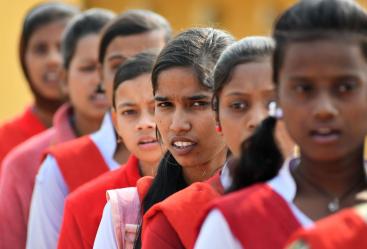
UNICEF/UN0280307/Boro
'Unseen' News and Views
Child marriage threatens the lives, well-being and futures of girls around the world
“As my daughters are getting educated, they don’t have to depend on others”

BIHAR, India, 8 March 2019 (UNICEF)* -– Imagine. You are a parent of four and you live in Bihar, one of the lowest income states in East India. As a child, you were lucky enough to go to school. But your family could not afford to keep you learning, so you were married off in your teens and dropped out.
Now, imagine. Your daughter’s future looks dramatically different than yours as a child. She has a brilliant opportunity ahead of her. She can complete her studies and pursue higher education. She gets a chance you never got: choosing what she wants in life.
Spotlight on improving social protection, inadequate public services and gender-blind infrastructure; identifying policy actions critical to propel gender equality and transform women’s lives
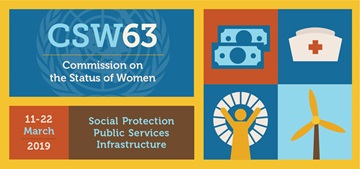
New York, 8 March 2019 (UN Women)* – Against the backdrop of a volatile global economy, rising conflict and instability, rapid population ageing, shrinking democratic spaces and push-back on women’s rights, the UN Commission on the Status of Women is set to begin next week at the UN Headquarters in New York.
This is the UN’s largest gathering on gender equality and women’s rights, and the single largest forum for UN Member States, civil society organizations and other international actors to build consensus, renew commitment and agree on better policy solutions.

At the International Conference on Population and Development, governments agreed that countries must uphold each individual’s right to make free and informed choices over their own sexual and reproductive health.
These rights – which encompass the right to sexual health information, the right to the highest possible standard of reproductive health care, and the empowerment and autonomy of women – are a precondition for achieving gender equality.
Yet 25 years later, these rights have not been realized for all.
Johan Galtung
In 1883 P. J. Reuter, head of the news agency carrying his name, wrote the following memorandum:
To: Agents and Correspondents
From: P. J. Reuter
Date: 1883Re: Please cover the following:
“…fires, explosions, floods, inundations, railway accidents, destructive storms, earthquakes, shipwrecks attended with loss of life, accidents to war vessels and to mail steamers, street riots of a grave character, disturbances arising from strikes, duels between and suicides of persons of note, social or political, and murders of a sensational or atrocious character.” (*)
Sounds familiar? Yes, it is called “news”.
It is all about action, nothing about structures generating them.
It is about persons high up, “of note, social or political”.
(People low down generate street riots and strike disturbances.)

Check out these four innovations “made in” Latin America, and the enthusiastic young leaders behind them.
A treasure inside avocados
Scott Munguía produces bioplastics from avocado seeds. This young Mexican chemical engineer discovered in 2011 that the avocado seed contains a biopolymer similar to the one present in corn, which is used to produce bioplastic.
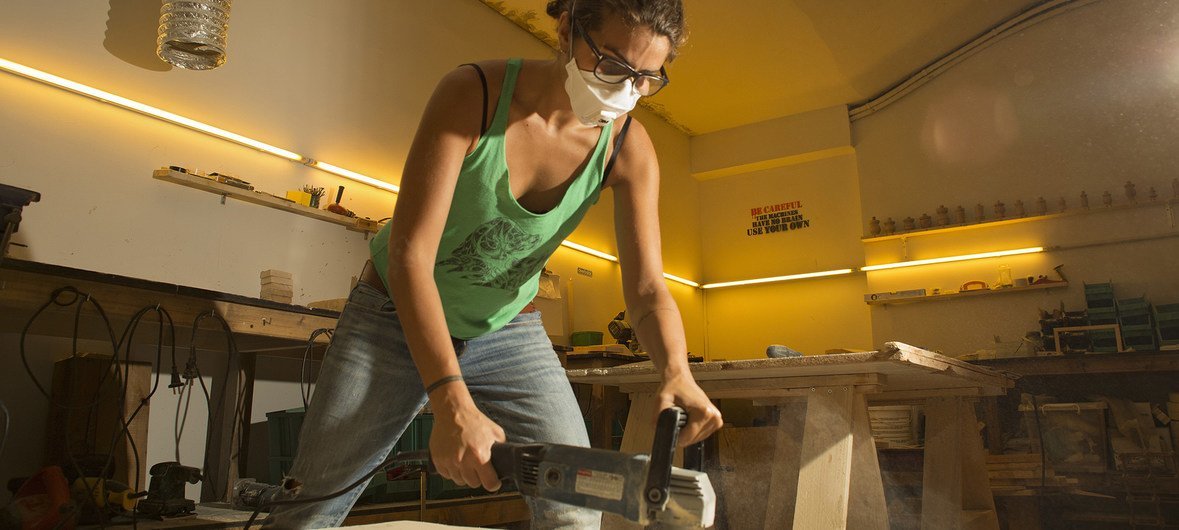
Women’s job opportunities have barely improved since the early 1990s, UN labour experts said on Thursday [7 March 2019], warning that female workers are still penalized for having children and looking after them.
.

.
Buenos Aires, March 2019 (Other News)* — These are times of retreat and confusion in South America.
A new geopolitical cycle can be seen in the domino effect that now has Venezuela in the eye of the emotional storm, after Brazil, Argentina, Nicaragua, Ecuador and, to a lesser degree, Honduras, Guatemala and Peru have been through (and in some cases are still going through) a period of political crisis and upheaval.
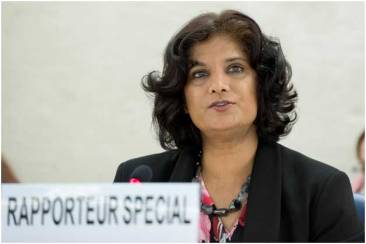
Urmila Bhoola, UN Special Rapporteur on Contemporary Forms of Slavery
The UN mandate on “contemporary forms of slavery” includes, but is not limited to, issues such as: traditional slavery, forced labour, debt bondage, serfdom, children working in slavery or slavery-like conditions, domestic servitude, sexual slavery, and servile forms of marriage, according to Urmila Bhoola of South Africa, the UN Special Rapporteur on Contemporary Forms of Slavery.

Death comes as an intrusion into the routine of our daily lives, sometimes forcing us to adapt radically; in any event encouraging us to ask some of the deepest questions about life and its purpose.
A subject which is normally dismissed as “morbid” pushes to the front of the stage and demands consideration.
 HUMAN WRONGS WATCH