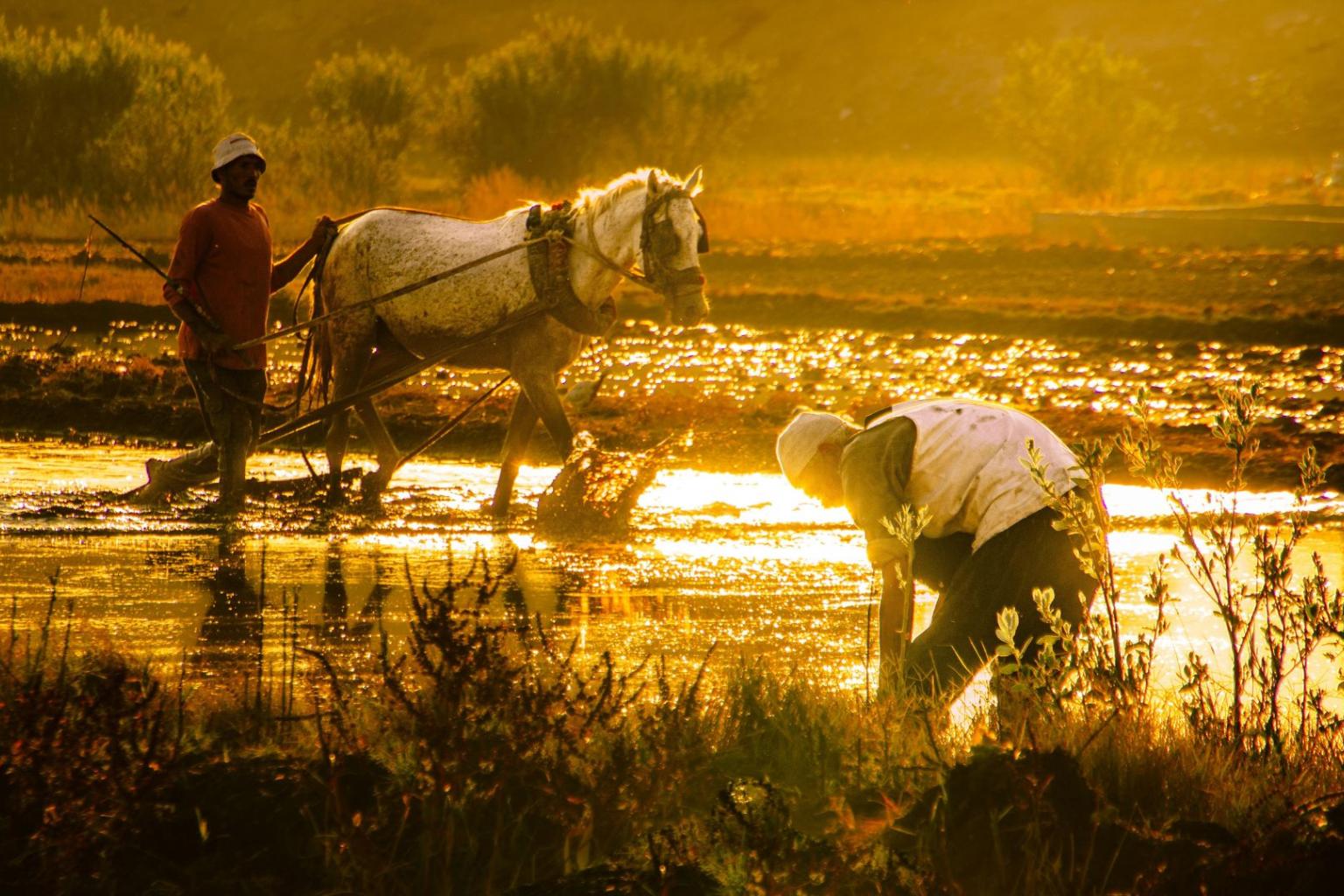
20 November 2025 —Extreme heat poses multiple risks for agrifood systems – damaging crops, stressing livestock and depleting fisheries – and threatens the livelihoods of an estimated 1.23 billion people.
.
There is an urgent need for science-informed solutions to strengthen resilience and sustainability, according to a new report from the Food and Agriculture Organization and WMO on “Extreme Heat and Agriculture.”
Digital violence goes even further than online harassment or extortion. Millions of girls are affected each year by child sexual exploitation and abuse through digital means. PHOTO:Annanahabed/Adobe Stock
Violence against women and girls remains one of the most prevalent and pervasive human rights violations in the world.
Globally, almost one in three women have been subjected to physical and/or sexual intimate partner violence, non-partner sexual violence, or both, at least once in their life.
What was once hailed as a vehicle for empowerment has, for millions of women and girls, become a source of fear. Fuelled by artificial intelligence, anonymity, and weak accountability, online abuse is rapidly escalating.
Yet, 1.8 billion women and girls still lack legal protection from online harassment and other forms of technology-facilitated abuse.
The alarm is being sounded this week by the UN agency for women’s rights, gender equality and women’s empowerment (UN Women) as the 16 Days of Activism campaign begins, calling for urgent action against soaring digital violence.
New report warns more children are at risk of falling into poverty as global funding cuts, conflict and climate threaten access to services crucial for health and wellbeing.
UNICEF/UNI630167/Frank Dejongh
.
NEW YORK – More than 1 in 5 children in low- and middle-income countries – or 417 million – are severely deprived in at least two vital areas critical for their health, development, and wellbeing, according to UNICEF’s flagship report issued on World Children’s Dayobserved on 20 November 2025.
(UN News)* — Seventeen civilians, including women in labour and patients receiving care, were slaughtered inside a Catholic Church-run health centre in eastern Democratic Republic of the Congo (DRC) last week.
The UN described it as one of the most appalling attacks in a new wave of violence by the Allied Democratic Forces (ADF), an armed extremist rebel group.
Four wards housing patients were set ablaze during the assault in Byambwe, a remote community about 60 kilometres west of Lubero in the restive North Kivu province, which has been plagued by fighting between a plethora of armed groups and national security forces for years.
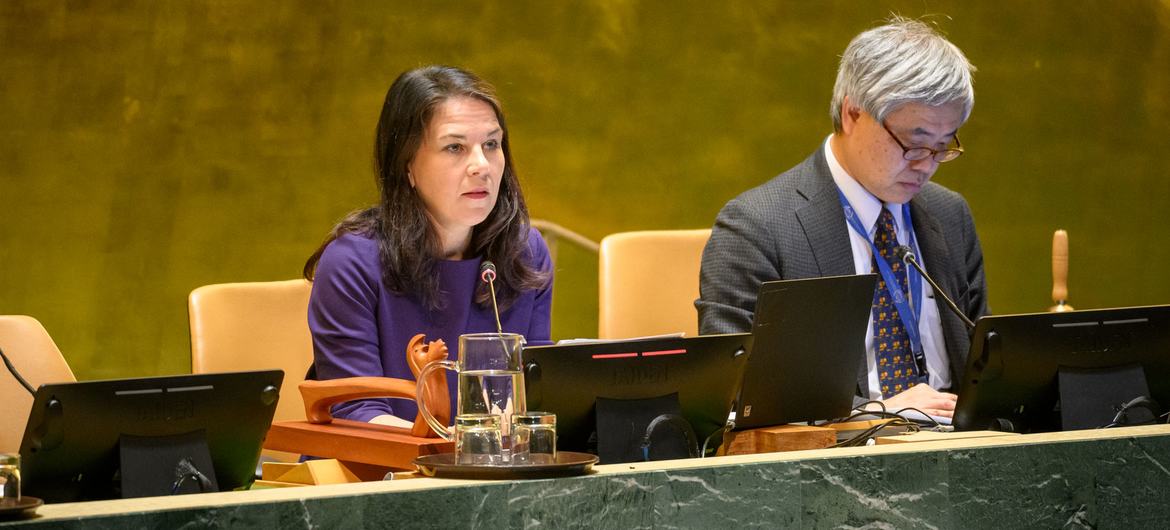
(UN News)* — General Assembly President Annalena Baerbock warned on Thursday [] that repeated deadlock in the Security Council has become the “poster child” for wider global gridlock, undermining trust in multilateral institutions.
UN Photo/Loey Felipe | General Assembly President Annalena Baerbock chairs a meeting on the report of the International Criminal Court.
The UN was founded to “save succeeding generations from the scourge of war,” Ms. Baerbock said, but the world body is struggling to meet that mandate when the Council isblocked by a veto from one of its five permanent members: China, France, Russia, the UK and the US).
When the United Nations Environment Assembly convenes in December, a key topic up for discussion will be the mounting environmental impact of artificial intelligence. Ahead of those talks, here’s a look back a story first published on 21 September 2024.
(UN News)* —When Salma* was just 15, she was forced to get married, even though she wanted to stay in school and become a doctor someday.
Agência Brasil/Joédson Alves | The National Council of Justice (CNJ) of Brazil signed a cooperation agreement with the iFood delivery platform to combat violence against women.
.
Instead, she found herself tied to a man who “changed from being kind to being a monster.” He would beat her “with his bare hands,” she said recently.
(UN News)* —Ending hunger by 2030 would cost just $93 billion a year — less than one per cent of the $21.9 trillion spent on military budgets over the past decade, according to the UN World Food Programme (WFP).
By 2026 a staggering 318 million people would face crisis levels of hunger or worse, more than double the figure recorded in 2019, the food agency reported in its 2026 Global Outlook.
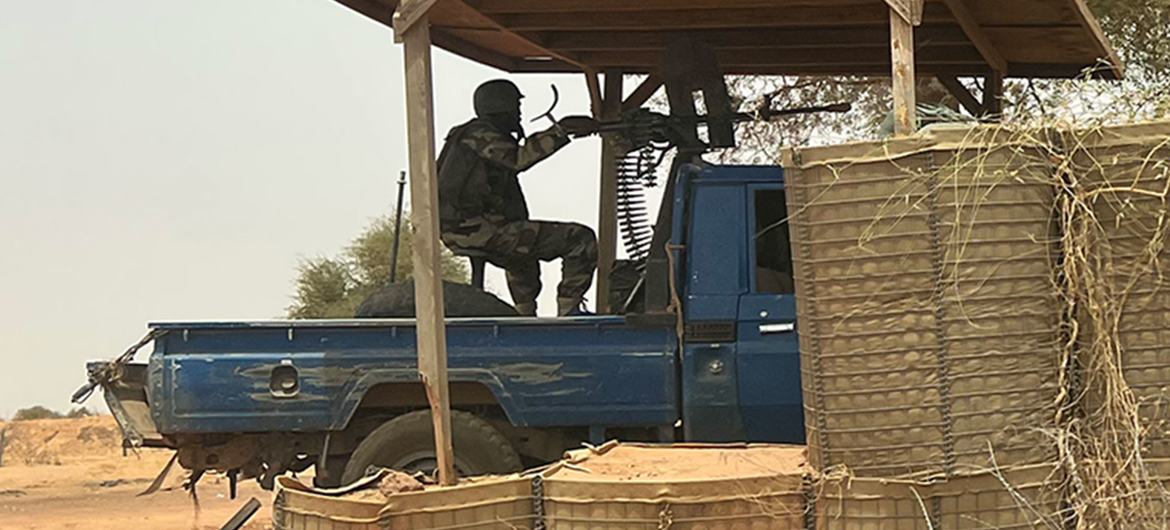
(UN News)* — Expanding terrorist networks, mass displacement and the collapse of essential services in West Africa and the Sahel are a growing concern worldwide.
UN News/Daniel Dickinson | A Nigerien soldier guards a strategic location in Ouallam, Niger.






 HUMAN WRONGS WATCH