An eyewitness account of one community being pushed to the brink as the World Food Programme is forced to cut food assistance to 10 million people.
.
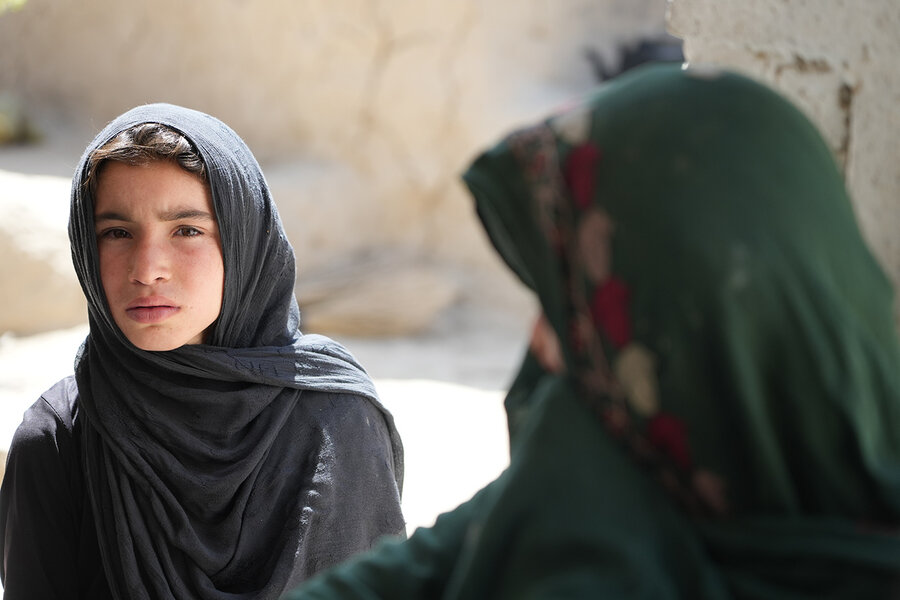
WFP is cutting food assistance to 10 million people in Afghanistan including this community in Kabul. Photo: WFP/Hasib Hazinyar
The children stare at us, all curious. They are, by now, used to seeing World Food Programme (WFP) staff zipping in and out of the informal settlement they live in on the outskirts of Kabul, in white SUVs.
Only this mission is not to deliver food or sign anyone up for anything. It’s simply to place on the record how people are doing after we cut food assistance to them altogether.
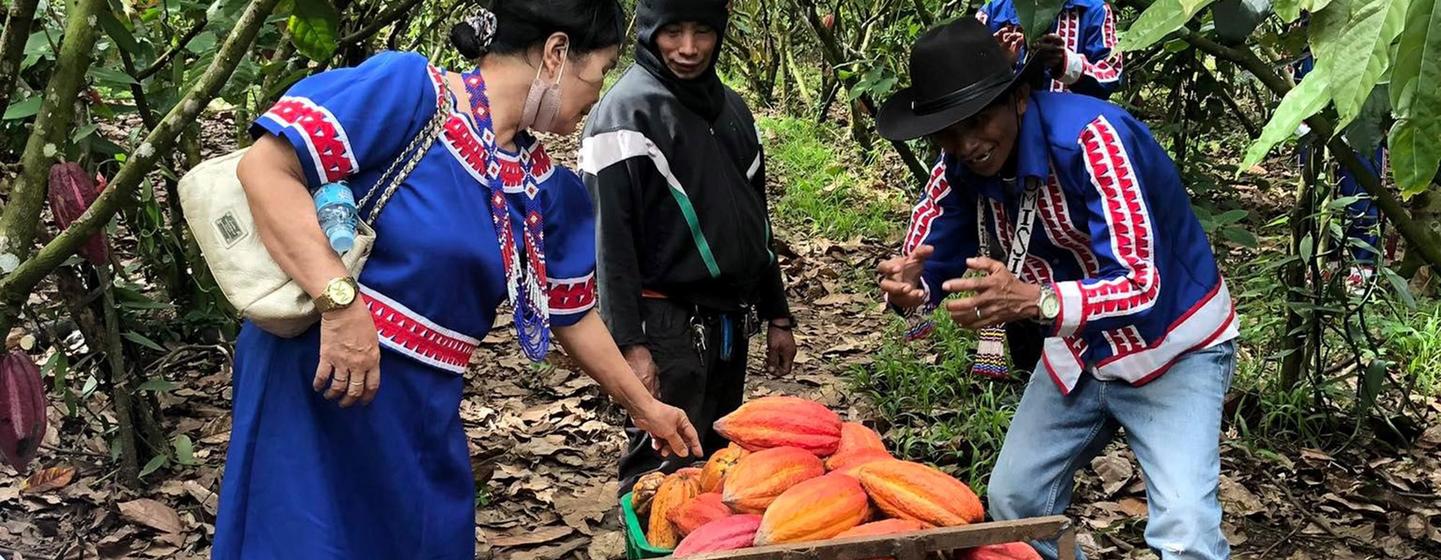
In the mountainous province of Bukidnon in the southern Philippines, local indigenous groups are being forced to adapt to the alarming impacts of climate change. With UN support, communities are making significant strides, using centuries-old knowledge to forge sustainable solutions.
Local tribal leader Jemuel Perino discussed the success of local initiatives, supported by the UN Development Programme (UNDP) Adaption Fund Climate Change Innovation Accelerator (AFCIA), in educating his community on effective prevention and mitigation techniques to deal with the growing impacts of climate change.
“The indigenous cultural communities have their own centuries-old knowledge, systems, and practices and have kept them alive,” Mr. Perino said. “In the Philippines, the Government is promoting their use in environmental protection and conservation.”
Climate-induced water insecurity poses one of the biggest threats to humanity and will lead to more hunger, disease and displacement.
Climate Change and Water Security. Oxfam‘s report “Water Dilemmas” highlights how a water security crisis, in large part driven by global heating from greenhouse gas emissions, will fuel hunger and disease and force more people to leave their homes. | Photo: Oxfamwash.org
Oxfam water engineers are having to drill deeper, more expensive and harder-to-maintain water boreholes used by some of the poorest communities around the world, more often now only to find dry, depleted or polluted reservoirs. | FrenchArabic
Climate justice is not just about survival but also about benefit sharing, reducing inequality and enabling a better society that thrives – Yamide Dagnet, Climate Justice Director at Open Society Foundations
A family shelter on the roof of their small house surrounded by floodwater in Jatrapur Union in Kurigram District, Bangladesh. Credit: Muhammad Amdad Hossain/Climate Visuals
BULAWAYO, ZIMBABWE, Aug 31 2023 (IPS)* – The failure to tackle the climate change crisis is an injustice to the millions who have lost lives and livelihoods through floods, extreme weather, and wildfires, pointing to the urgency of adaptation and mitigation finance, experts say.
IOM Calls for Increased Support, Sustainable Solutions for Rohingya Refugees
Rohingya refugees and humanitarians have faced unprecedented challenges in 2023, including fires, cyclones, and ongoing threats of monsoon-related disasters, putting their resilience to the test. Photo: IOM
Geneva/Cox’s Bazar, 25 August 2023 (IOM)*– As the Rohingya crisis marks its sixth year in Bangladesh, the plight of nearly 1 million refugees remains unchanged, trapped in a cycle of uncertainty and vulnerability.
UNITED NATIONS, Aug 30 2023 (IPS)* – The United Nations will host six “high-level” meetings, including two summits of world leaders– over a short span of five consecutive days, beginning September 18.
.
The 2023 SDG Summit will take place on 18-19 September 2023 in New York. It will mark the beginning of a new phase of accelerated progress towards the Sustainable Development Goals with high-level political guidance on transformative and accelerated actions leading up to 2030. Credit: UN Photo/Manuel Elias
The back-to-back meetings, described as unprecedented, includes the Sustainable Development Goals (SDG) Summit on September 18-19; a high-level dialogue on Financing for Development (FfD) on September 20; and a ministerial meeting of the Summit of the Future on September 21 (with the summit itself scheduled to take place September 2024).
(UN News)* — UN Secretary-General António Guterres marked Wednesday’s [] International Day of the Victims of Enforced Disappearance by condemning the “atrocious crime” and urging all Member States to hold those who perpetrate it accountable.
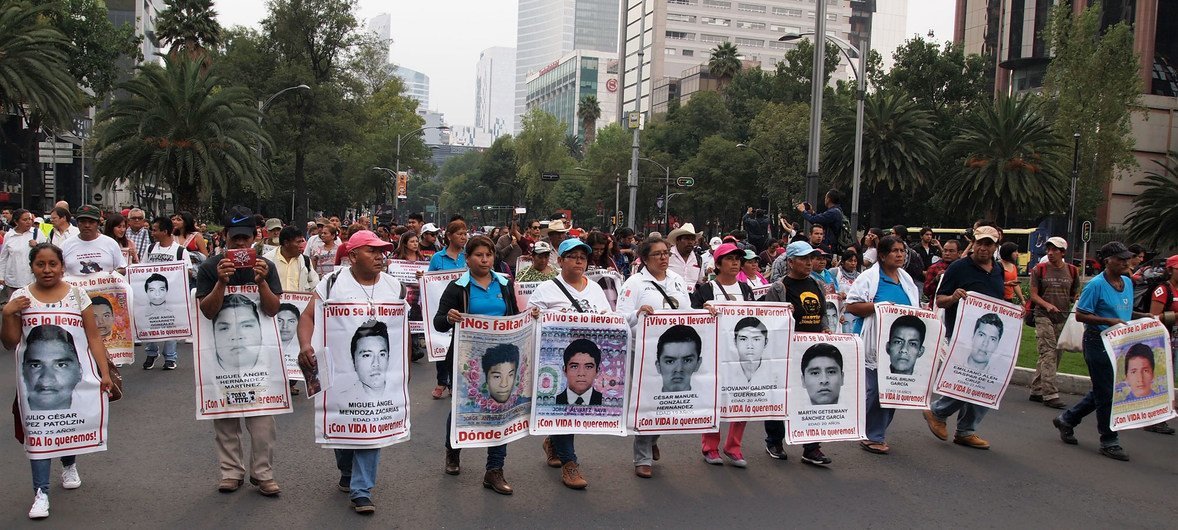
UNIC/Mexico | A protest rally in Mexico City on the case of Ayoitzinapa rural school attended by the 43 disappeared students.
Enforced disappearance has regularly been used as a tool for instilling fear and exert control over a population. The feeling of insecurity it generates is not limited to close relatives of the disappeared, but also their communities and society as a whole.
In a post on social media platform X, The UN chief said enforced disappearance was “a serious human rights violation that has frequently been used to spread terror…I call on countries to help put an end to this atrocious crime”.
(UN News)* — Criminal gangs in southeast Asia are using torture and abuse to force hundreds of thousands of people into an online scam operation which generates billions of dollars per year, the UN rights office (OHCHR) said on Tuesday [].
OHCHR said that at least 120,000 people across Myanmar and another 100,000 in Cambodia may be held in situations where they are forced to execute lucrative online scams – from illegal gambling to crypto fraud.
Other States including Lao PDR, the Philippines and Thailand have also been identified as main countries of destination or transit.
Victims, not criminals
“People who are coerced into working in these scamming operations endure inhumane treatment while being forced to carry out crimes,” said UN rights chief Volker Türk. “They are victims. They are not criminals,” he insisted.
It is in our connectedness with other people – in our memories of laughter, smiles, sharing sorrow, being heard, being looked at with kindness, being heard with attention, being remembered by someone, being upset with someone, being comforted – that we become alive as relational beings.
Sumeet Grover
From one perspective, we can only experience the richness of life when we are in relation with other people, amongst other people, and in between other people.
Our relationship with people is not the only relationship that we have: we also have a relationship with what goes on within our minds and bodies.
We have a relationship with a complex internal world that drives us, often out of awareness, until that internal world begins to feel unsettling.
People often come to psychotherapy because there is an uncomfortable relationship with one’s own mind, body or the people around them.





 HUMAN WRONGS WATCH