Responses to interview questions from Javad Heiran-Nia on ‘World Order in the Time of COVID-19,’ with emphasis on China & United States, especially as reflected in the restructuring of the world economy.
The underlying issue is whether the Chinese or U.S. approach to global policy and world order will gain the upper hand, and at what costs to humanity. The interview will be published in a forthcoming issue of Age of Reflection, a monthly magazine.
This post adds some observations at the end that do not appear in the interview.
1 – In recent years, and especially with the spread of the Corona virus and the way China and the United States have dealt with this virus, the issue of Chinese and American order has received more and more attention. Do you think it is relevant to talk about Chinese order?
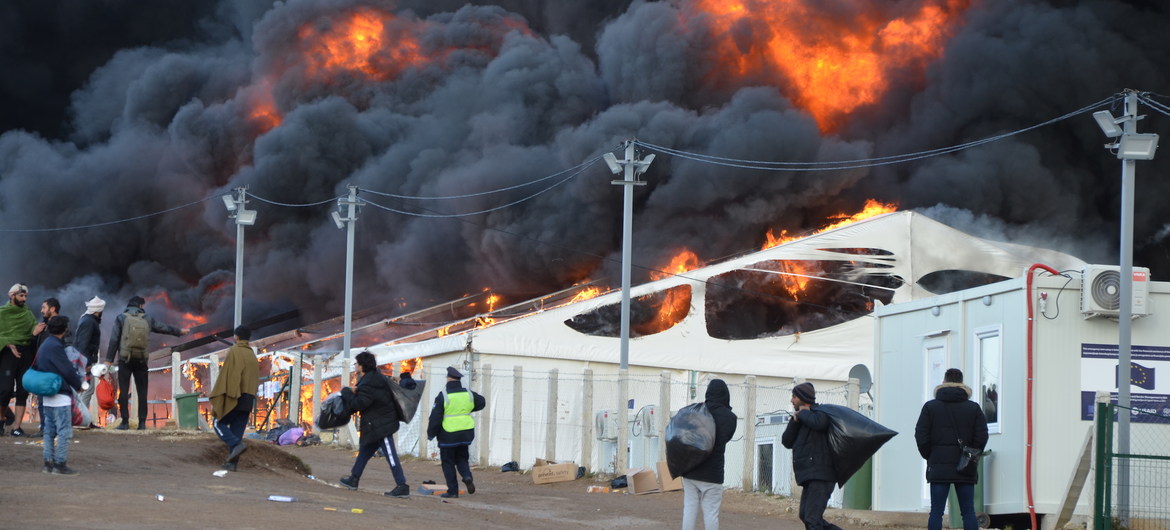
(UN News)* — The closure and subsequent fire, on Wednesday, at a migrant camp in Bosnia and Herzegovina has left thousands of migrants without shelter and protection, amid plummeting winter temperatures, the UN International Organization for Migration (IOM) has reported.
IOM 2020/Ervin Causevic | The fire rages at the Lipa emergency camp in Bosnia and Herzegovina that housed about 1,400 migrants.
Nearly all infrastructure at the Lipa Emergency Tent Camp, which housed about 1,400 migrants, has been destroyed or badly damaged. This number is in addition to some 1,500 migrants, asylum-seekers and refugees – including women and children – stranded in squats and forest camps nearby.
(UN News)* — In an open letter to Donald Trump on Tuesday [22 December 2020], an independent UN human rights expert asked the departing United States President to pardon Wikileaks founder Julian Assange.
Unsplash/Ashley Ross | Julian Assange is being held in high security Belmarsh Prison in southeast London (not pictured).
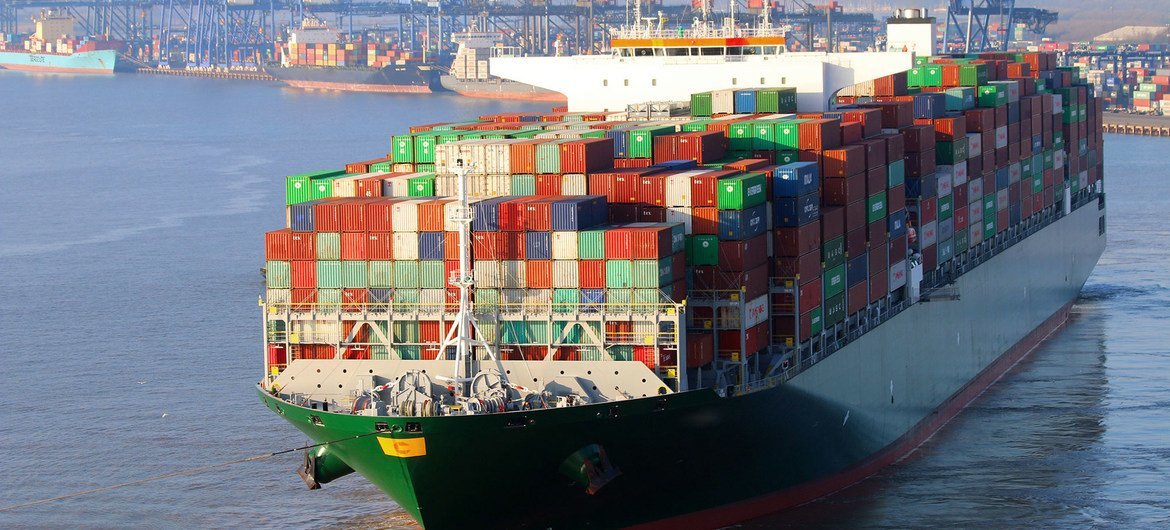
(UN News)* — Despite a sharp fall in global trade in 2020 due to the coronavirus pandemic and lingering trade tensions, Asia and the Pacific is expected to perform relatively less badly than the rest of the world, the United Nations development arm in the region said on Tuesday [22 December 2020].
IMO | A container ship unloads its cargo at a port.
Worldwide trade is expected to fall by 14.5 per cent in 2020 and following that trend, trade in the region could contract by around 1.9 per cent, estimates from the UN Economic and Social Commission for Asia and the Pacific (ESCAP) suggest.
The rest of the world, however, fared worse, and as a result, the region’s share in global merchandise export and import is expected to rise to an all-time high in 2020, to 41.8 per cent and 38.2 per cent respectively, up from 39.9 per cent and 36.9 per cent a year earlier.
NEW YORK, Dec 22 2020 (IPS)* – The year 2020 is ending with the world caught up in an unprecedented human and economic crisis. The pandemic has contaminated 75 million people and killed 1.7 million. With the lockdowns, the global economy has suffered the worst recession in 75 years, causing the loss of income for millions of people. In such a bleak environment, what will the new year bring? Whilst uncertainty is the only certainty, eight points are likely to be key in the year ahead:
Isabel Ortiz
1. A gradual but uneven recovery With the deployment of vaccines and public support, high-income countries will be on the path to recovery from the second half of 2021.
However, middle income and particularly low income countries in Africa, Asia and Latin America will see recovery delayed – unless the UN or China provide them with sufficient COVID19 vaccines and governments escalate public support.
UNITED NATIONS, Dec 22 2020 (IPS)* – The United Nations, which is commemorating its 75th anniversary, continues to remain bogged down in one of the world’s most politically and militarily volatile regions: the Middle East.
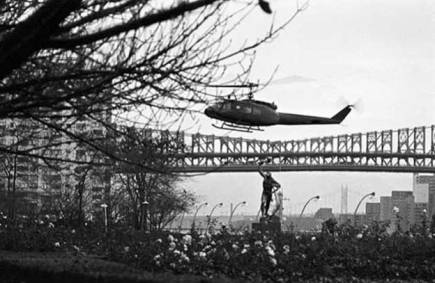
The Leader of the Palestine Liberation Organization (PLO), Yasser Arafat, arrived at UN Headquarters by helicopter. A view of the helicopter as it approached the North Lawn of the UN campus on 13 November 1974. But Arafat was denied a US visa for a second visit to the UN in 1988. Credit: UN Photo/Michos Tzovaras
Virtually every other week, the Security Council has a predictable item on its agenda: “consultations on the Middle East”—perhaps a never-ending saga.
21 December 2020 (Wall Street International)* — Health for all? The conflict between dominant social groups and universal rights is once again exploding loud and clear. It’s blowing up the fictions, the lies and highlighting the mystifications and the harmful consequences of the “world” response of the powerful to Covid-19.
To date, representatives of the populations of more than 90 countries in the world, “low-income” as the powerful define them, are willing to defend the request for the suspension of patents on medicines and vaccines against Covid-19, a request that has already been rejected and which is once again strongly rejected by the most powerful countries in the occidental world.
Workers Still Owed Wages for Months After Informing Government of Abuse
(Beirut) – Qatari authorities have failed to provide redress for hundreds of migrant workers who are suffering from months of unpaid wages at two companies, even though authorities have repeatedly been informed of these abuses, Human Rights Watch on 22 December 2020 said.
21 December 2020 (UN News)* — The United Nations is marking 2021 as the International Year of Fruits and Vegetables, spotlighting their vital role in human nutrition and food security, as well as urging efforts to improve sustainable production and reduce waste.
UNICEF/Giacomo Pirozzi | Fresh fruit and vegetables are set out for cooking in a village in Muzaffargarh district in Pakistan.
As everyone knows, Adam Smith invented the theory that individual self-interest is, and ought to be, the main motivating force of human economic activity, and that this, in effect, serves the wider social interest. He put forward a detailed description of this concept in an immense book, “The Wealth of Nations” (1776).
Adam Smith (1723-1790) had been Professor of Logic at the University of Glasgow, but in 1764 he withdrew from his position at the university to become the tutor of the young Duke of Buccleuch.
In those days a Grand Tour of Europe was considered to be an important part of the education of a young nobleman, and Smith accompanied Buccleuch to the Continent. To while away the occasional dull intervals of the tour, Adam Smith began to write an enormous book on economics which he finally completed twelve years later.





 HUMAN WRONGS WATCH