SANTIAGO, Chile, Sep 12 2025 (IPS)** – At eighty, the United Nations is bogged down by structural limitations and political divisions that render it powerless to act decisively – nowhere more clearly than in the Gaza genocide.
There is only one treaty in the world that, despite its limitations, binds nations together: the United Nations Charter. Representatives of fifty nations wrote and ratified the UN Charter in 1945, with others joining in the years that followed.
The charter itself only sets the terms for the behaviour of nations. It does not and cannot create a new world. It depends on individual nations to either live by the charter or die without it.
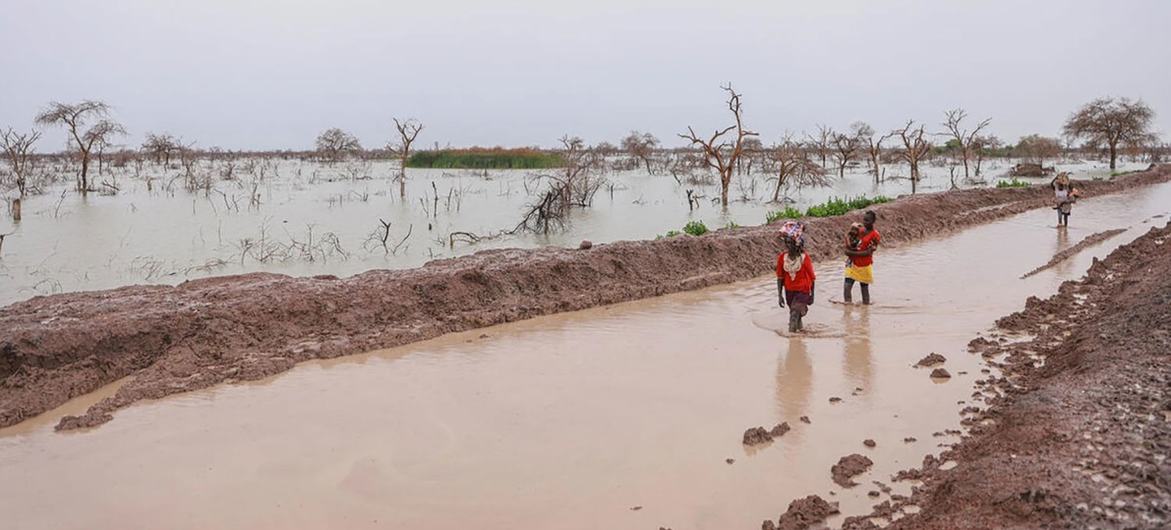
In recent weeks, widespread flooding has engulfed large parts of Jonglei, Upper Nile and Unity states in the north of the country.
The agency’s representative in South Sudan, Marie-Helene Verney, said that “if the flooding continues, up to 400,000 people are likely to be displaced by the end of the year, exceeding flood displacement levels seen in 2024.”
Dakar –In sub-Saharan Africa, approximately three out of four working women (76 percent) are employed in agrifood systems, and women make up 49 percent of the agrifood systems workforce.
Within agrifood systems, women’s employment in off-farm segments – such as production, processing, distribution, consumption and packaging – is increasing across the region, rising to 29 percent in 2022 from 21 percent in 2005.
SRINAGAR & KISTIWAR, India, Sep 4 2025 (IPS)* ––The relentless rain that battered the mountains and valleys of Jammu and Kashmir this August shattered lives and records.
The Kishtwar cloudburst on August 26 buried Chesoti village beneath a torrent of mud and boulders, killing at least 65 people, with several still missing. Credit: Umar Manzoor Shah/IPS
Frosty morning in Pingjum Friesland, The Netherlands.
PHOTO:WMO Photostream/Anna Zuidema
Air pollution is the biggest environmental health risk of our time. It also exacerbates climate change, causes economic losses, and reduces agricultural productivity.
It knows no borders – everyone has a responsibility to protect our atmosphere and ensure healthy air for all.
By collaborating across borders, sectors, and silos, we can reduce air pollution through collective investments of time, resources and efforts.
Naminaue, Mozambique, 3 September 2025 – “This water is sweet,” says Merina, watching clear water flow from a newly rehabilitated borehole in Naminaue, northern Mozambique.
For the past five years she has lived in this displacement site, and for her, the taste of clean water brings back a rare sense of normalcy after years of conflict and loss.
Before displacement, Merina’s life in Litamanda village in Macomia District was steady. Her family farmed maize, rice, and sweet potatoes, slept on proper beds, and even watched Brazilian soap operas on television.
That ended the day armed groups attacked. Merina lost her husband in the violence and fled with nothing.
Merina scoops fresh water from the newly rehabilitated borehole – the first safe source in years. Photo: IOM 2025/Amanda Nero
(UN News)* — Governments, academia and other stakeholders must “double down on delivering reparatory justice” for people from the African diaspora, the UN human rights office, OHCHR, said in a report published on Wednesday [].
UNITED NATIONS, Sep 4 2025 (IPS)* –– 2025 has been marked by a significant escalation of the climate crisis and its effects on vulnerable populations, as the World Meteorological Organization (WMO) warns that average global temperatures could exceed the 1.5°C threshold within the next five years.
.
A family prepares a banner to protest the effects of climate change on children outside their house in the village of Patzité, Quiché, Guatemala. Credit: UNICEF/Patricia Willocq
In Latin America and the Caribbean, rising temperatures and emissions continue to strain access to essential services and deepen poverty, particularly among children.
(UN News)* — Global education funding is facing sharp reductions that could leave an extra six million children out of school by 2026, the UN Children’s Fund (UNICEF) warned on Wednesday [3 September 2025].
Official Development Assistance (ODA) for education is projected to fall by $3.2 billion – a 24 per cent drop from 2023 – with just three donor governments accounting for nearly 80 per cent of the cuts.
Such a decline would push the number of out-of-school children worldwide from 272 million to 278 million, UNICEF said – the equivalent of shutting every primary school in Germany and Italy combined.
“Every dollar cut from education is not just a budgetary decision, it’s a child’s future hanging in the balance,” said UNICEF Executive Director Catherine Russell.
UNITED NATIONS, Sep 3 2025 (IPS)* –– Over the past decade, major strides have been made in expanding global access to water, sanitation, and hygiene (WASH) services, with billions of people around the world seeing improvements in overall health and well-being.
A woman pulls a floating toilet into the lake in Kaylar village in Shan State, Myanmar, on June 25, 2025. After the earthquake, the onset of the rainy season made access to safe sanitation challenging for displaced communities. Credit: UNICEF/Maung Nyan
Despite these gains, people largely from low-income countries and marginalized groups still lack access to clean water, leaving them vulnerable to disease and hindering social development and inclusion.

 ©FAO
©FAO




 HUMAN WRONGS WATCH