Without urgent donations, 1.3 million people risk losing food assistance.
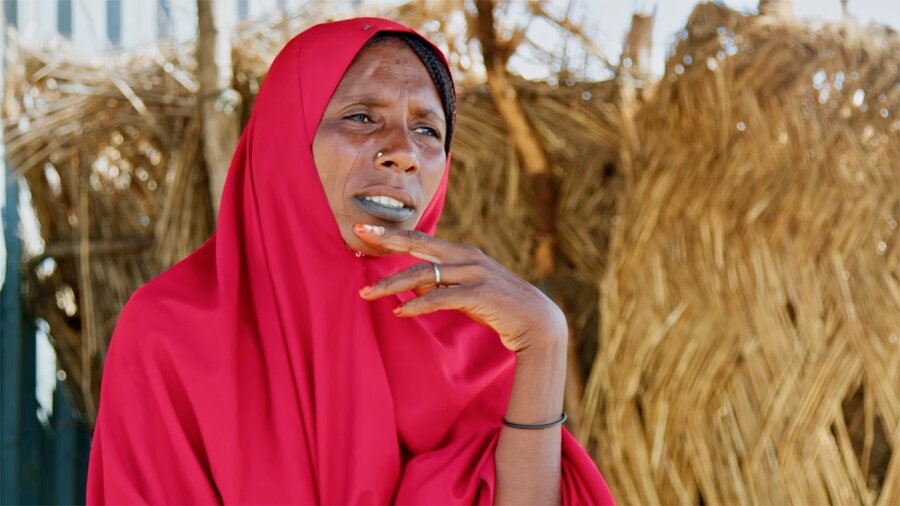
Displaced by conflict in northeastern Nigeria, Iya and her large family barely survive with WFP support. Now, that assistance may dry up altogether. Photo: WFP/Arete/Nommiyid Chantu
On the good days, Iya and her husband are barely able to feed their large family. On the bad ones, their seven children go to bed hungry in the small mud-brick hut they call home.
In northeastern Nigeria’s Mafa displacement camp, where the family lives, August is shaping into a month of many bad days.
“The support we get isn’t enough,” says 45-year-old Iya of the World Food Programme (WFP) food assistance. As a conflict-displaced person, her last name is being withheld for her protection. “As a parent, it’s never enough.”
N’Djamena, Chad, 8 August 2025 – In a country where legal frameworks are still taking root and taboos around human trafficking and exploitation run deep, Julienne Deyo stands as a determined force. A lawyer by training and justice advocate by conviction, she has been at the frontlines of the Chad’s fight against human trafficking since 2018.
Now Chair of the National Commission to Combat Trafficking in Persons and Director of Legal Affairs at the Ministry of Justice and Human Rights, Madame Deyo leads with both a steady resolve and a heart marked by the suffering she’s witnessed.
“It started with the stories of young boys,” she recalls. “Children sold off to cattle herders, sent into the bush, far from their families, walking behind herds. Some were bitten by snakes and died alone. No one seemed to care. How can anyone stay unmoved?”
Madame Deyo’s focus is as much on the survivors as it is on building a foundation that prevents such abuse from happening again. Illustration: AI-generated image
GENEVA – Uganda is on the verge of hosting two million refugees as escalating crises in Sudan, South Sudan and the Democratic Republic of the Congo (DRC) drive hundreds of people to cross the border daily in search of safety and lifesaving aid.
Since the start of 2025, an average of 600 people per day have arrived in the country, with numbers expected to reach two million by year’s end.
Already Africa’s largest refugee-hosting country and the third largest globally, Uganda is currently home to 1.93 million refugees, over a million of whom are below the age of 18.
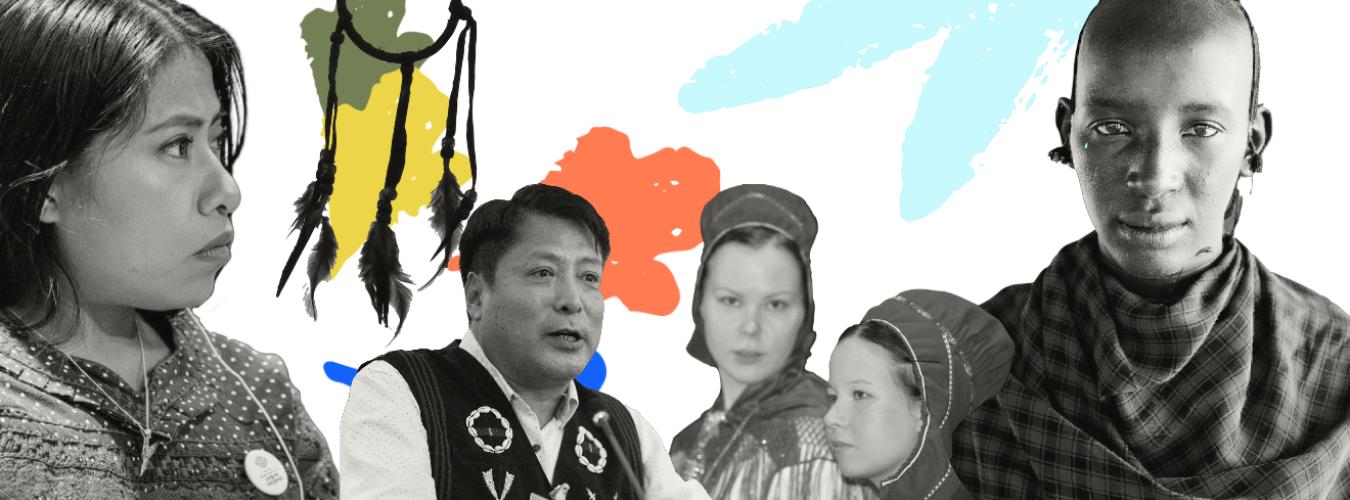
Indigenous peoples consider 22% of the world’s land surface their home. They live in areas where around 80% of the planet’s biodiversity is found on not-commercially-exploited land. UN Composition with photographs by Manuel Elias, Alessia Pierdomenico, Evan Schneider and Marcel Crozet (left to right.)
Watch
Young Indigenous Activists Fight to Save Their Languages and Cultures | United Nations
An estimated 476 million Indigenous Peoples live across 90 countries, representing 5,000 different cultures.
Without proper safeguards, AI risks harming Indigenous rights through inequitable distribution of the groundbreaking technology, environmental damage and the reinforcement of damaging colonial legacies.
The growing amount of electricity generation needed for AI data centres and other infrastructure is also intensifying climate change pressures, according to the UN.
Sana’a, Yemen — Fourteen men and four women set off from the Horn of Africa, drifting into the unknown across the sea.
After surviving the journey to Yemen, Sennait gave birth at a migrant centre and now hopes to rebuild her life with her baby. Photo: AI-generated image
.
Among them was Sennait*, a 20-year-old Ethiopian woman carrying the weight of her father’s recent death and the scars of a harrowing trek from her village to the coastal town of Bossaso.
.
Her life had once been simple. She went to school, laughed with friends, and helped her father tend their small farm.
(UN News)* — UN Secretary-General António Guterres has expressed grave concern over Israel’s decision to “take control of Gaza City”, his Spokesperson said in a statement on Friday [].
The announcement following an Israeli cabinet meeting “marks a dangerous escalation and risks deepening the already catastrophic consequences for millions of Palestinians, and could further endanger more lives, including of the remaining hostages,” it said.
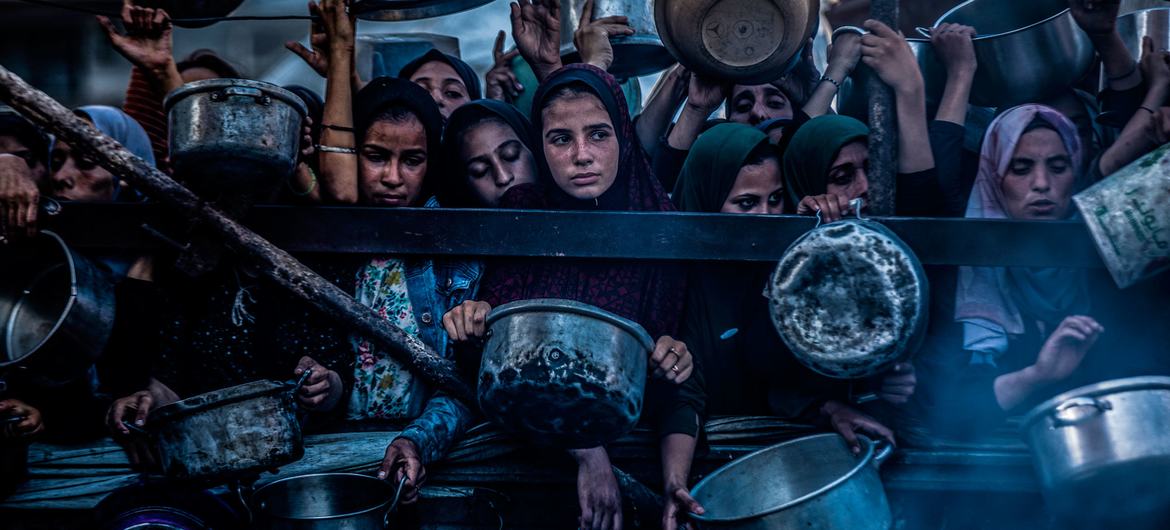
The statement noted that Palestinians in Gaza continue to endure a humanitarian catastrophe of horrific proportions.
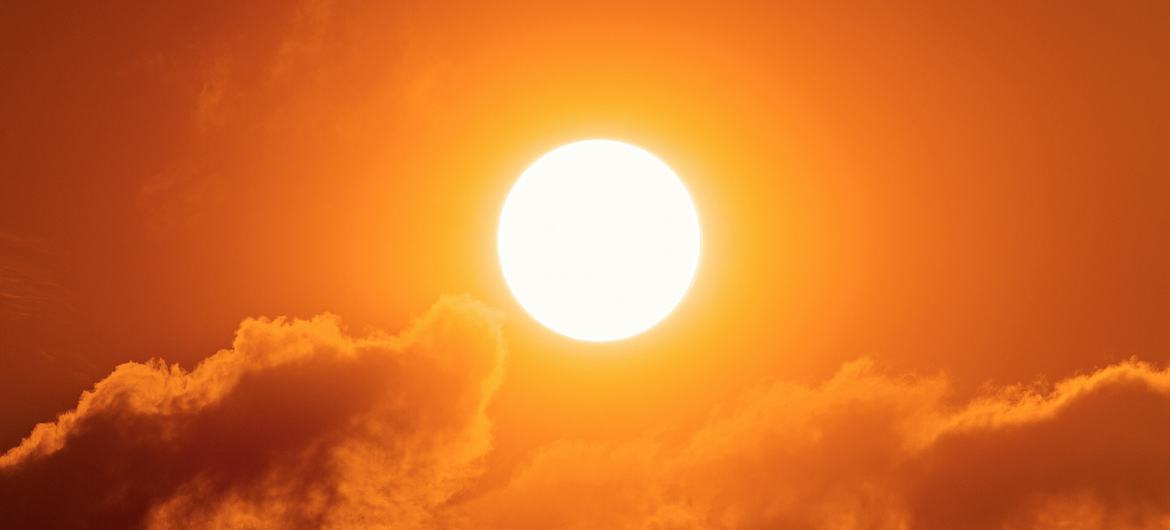
(UN News)* —Extreme heat is breaking records around the world, with wildfires and poor air quality compounding the crisis, according to a report from the World Meteorological Organization (WMO) released Thursday [].
Extreme temperatures caused approximately 489,000 heat-related deaths annually between 2000 and 2019, with 36 per cent occurring in Europe and 45 per cent in Asia.
The health impacts of heat are especially severe in cities due to the so-called ‘urban heat island effect’ – the over-heating of dense city areas compared with their rural surroundings – which is magnifying problems as urbanisation continues.
Amid rising 21st-century temperatures, the WMO underscored that July 2025 was the third-warmest July ever recorded, behind those in 2023 and 2024.
An invitation for the reader to analyze and decide which countries, peoples, and/or cultures can be considered civilized in the 21st century—more specifically, in 2025.
A civilization or culture is defined as a set of customs, traditions, ethics, values, language, music, dance, gastronomy, clothing, religion, and social and political organization of a people, ethnic group, tribe, or nation.
British scholars of the 19th century classified the peoples and races as Civilized, Barbarians and Savages, based on their respective “evolutions.” Such classification was based primarily on three factors:
Charles Darwin’s Theory of Evolution;
the Industrial Revolution in the beginning of industrial capitalism; and
the Reformation of the Catholic Church, the schism from which Protestantism arose.
By Nargiz Shekinskaya in Awaza and Vibhu Mishra in New York.
(UN News)* — Trapped by geography and squeezed by global market forces, the world’s 32 landlocked developing countries remain among the poorest – and most overlooked.
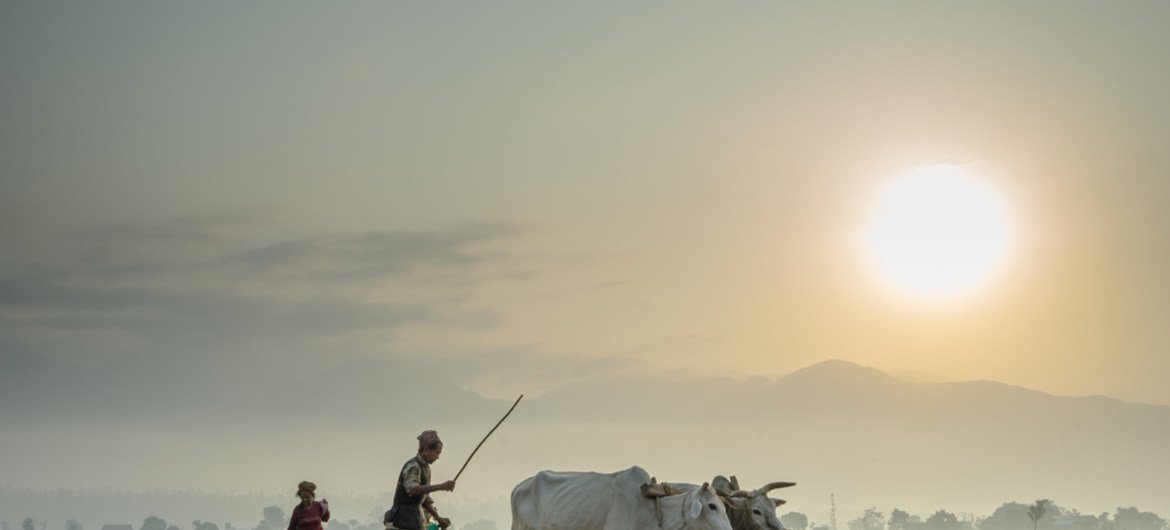
IFAD/Sanjit Das | In landlocked developing countries like Nepal (pictured), a lack of diversified industries and accessible markets limits local livelihoods – driving a growing exodus of young people seeking work abroad and often leaving older generations behind.
At a major UN conference underway this week in Awaza, Turkmenistan, calls are growing to tackle the high trade costs, investment gaps and growing digital divide that continue to hold these countries back.
Despite progress in some areas, landlocked nations – from Bolivia to Bhutan and Burkina Faso – account for just1.2 per cent of global exports, even though they represent over seven per cent of the world’s countries.




 HUMAN WRONGS WATCH