MADRID, Feb 23 2023 (IPS)* – While the world’s biggest powers and their giant private corporations continue to attach high priority to their military –and commercial– dominance, both of them being shockingly profitable, entire generations are being lost to deadly armed conflicts, devastating climate catastrophes, diseases, hunger and more imposed impoverishment.
In Nigeria’s Northeast the number of children suffering from acute malnutrition is projected to increase to two million in 2023. Credit: UNOCHA/Christina Powell.
Part Iof this series of two articles focussed on the unprecedented suffering of the most innocent and helpless human beings – children– in 11 countries. But there are many more.
According to the UN Children Fund (UNICEF), hundreds of thousands of children continue to pay the highest price of a mixture of man-made brutalities, with their lives, apart from the unfolding proxy war in Ukraine, and the not yet final account of victims of the Türkiye and Syria earthquakes, which are forcing children to sleep in the streets under the rumble, amid the chilling cold.
7 Feb 2023 – A few weeks ago, the world’s power brokers — politicians, CEOs, millionaires, billionaires — met in Davos, the mountainous Swiss resort town, for the 2023 World Economic Forum. In an annual ritual that reads ever more like Orwellian farce, the global elite gathered — their private jets lined up like gleaming sardines at a nearby private airport — to discuss the most pressing issues of our time, many of which they are chiefly responsible for creating.
The 2023 meeting was organized around the theme of “Cooperation in a Fragmented World” and the topics up for debate were all worthy choices: climate change, Covid-19, inflation, war, and the looming threat of recession.
Glaringly missing, however, was any honest investigation of the deeper context behind such an epic set of crises — namely, the reality of worldwide poverty and the extreme inequality that separates the poor from the rich on this planet.
Every year, Oxfam, a global organization that fights inequality to end poverty and injustice, uses the occasion of Davos to release its latest rundown on global inequality.
(Human Rights Watch)* — US President Joe Biden and members of the House of Representatives repeatedly scapegoated migrants during both this week’s presidential State of the Union address and during a hearing on the US-Mexico border held by the House of Representative’s Committee on Oversight and Accountability.
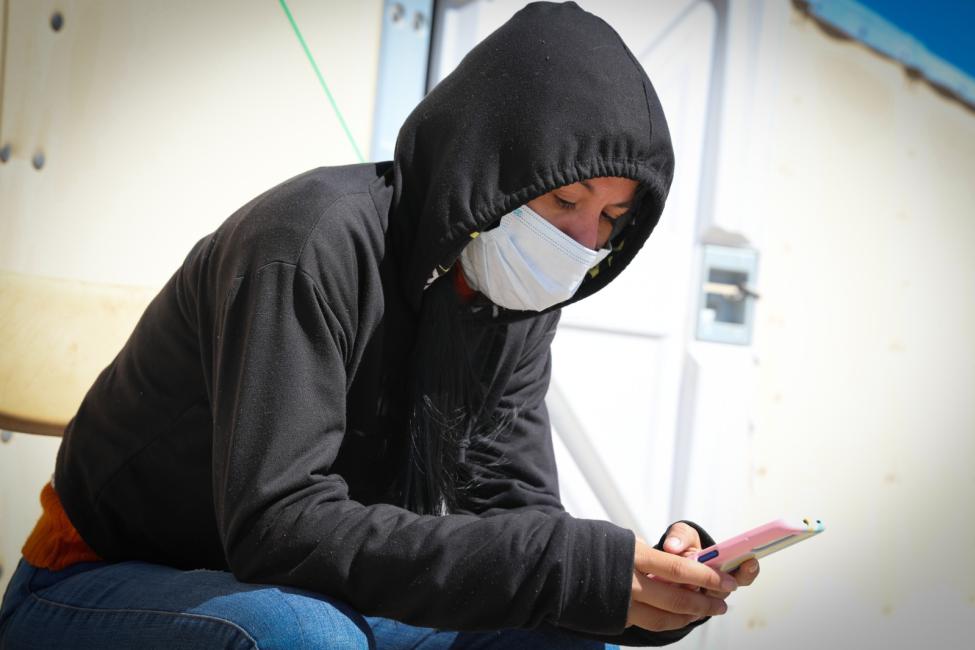
San José, 8 February 2023 (IOM)* – Migrant smugglers are using social media and instant messaging applications to promote and provide their illegal services, according to a study published by the International Organization for Migration (IOM). The study found that digital technology has made it easier for migrant smugglers to exchange money, goods, and information. Most of these activities occur on commonly used services and applications rather than on the dark web.
The study by IOM shows that young migrants use instant messaging and geolocation in their smartphones to contact smugglers and navigate their journeys. Photo: María Gema Cortés / IOM
Smugglers use social media and video platforms to promote their services by sharing short videos of successful crossings. Social networks also play a critical role in connecting migrants and smugglers, allowing them to interact and share information. Instant messaging and real-time geolocation technologies facilitate journey planning and execution.
Humans are capable of great compassion and unselfishness. Mothers and fathers make many sacrifices for the sake of their families. Kind teachers help us through childhood, and show us the right path. Doctors and nurses devote themselves to the welfare of their patients.
Sadly there is another, side to human nature, a darker side. Human history is stained with the blood of wars and genocides. Today, this dark, aggressive side of human nature threatens to plunge our civilization into an all-destroying thermonuclear war.
Humans often exhibit kindness to those who are closest to themselves, to their families and friends, to their own social group or nation. By contrast, the terrible aggression seen in wars and genocides is directed towards outsiders.
Human nature seems to exhibit what might be called “tribalism”: altruism towards one’s own group; aggression towards outsiders. Today this tendency towards tribalism threatens both human civilization and the biosphere.
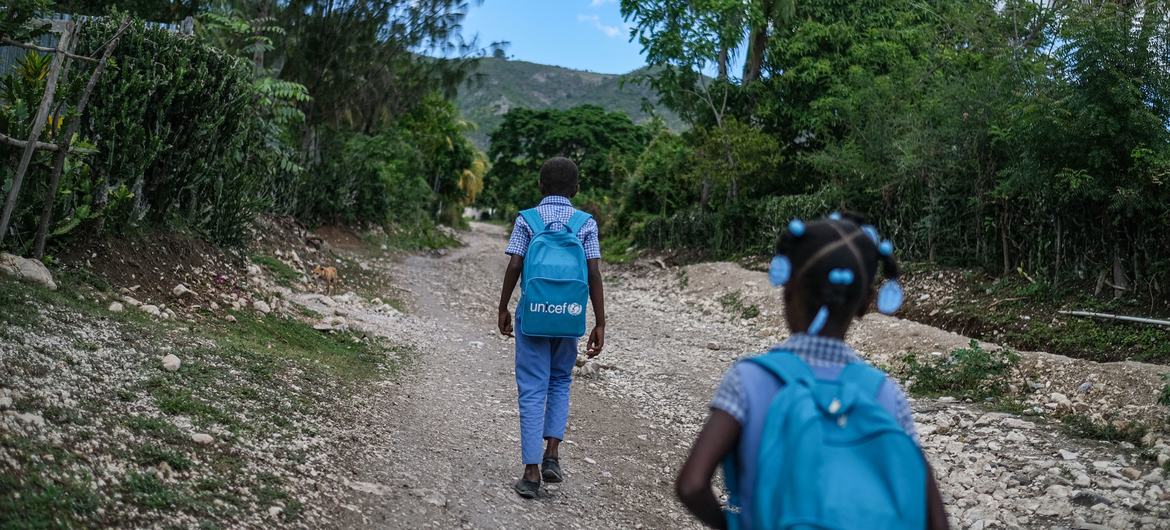
(UN NEWS)* — Acts of armed violence targeting schools in Haiti have spiked nine-fold in one year amid rising insecurity and widespread unrest, UNICEF warned on Thursday [].
“Violence continues to take a heavy toll on children’s lives in and around Port-au-Prince, and schools are no longer spared,” said Bruno Maes, the UN Children’s Fund (UNICEF) representative in Haiti. “As children reel from the effects of armed violence, insecurity in Haiti shows no sign of abating.”
‘Huge impact’ on children
“The targeting of schools by armed groups is having an enormous impact on children’s safety, wellbeing and ability to learn,” Mr. Maes said.
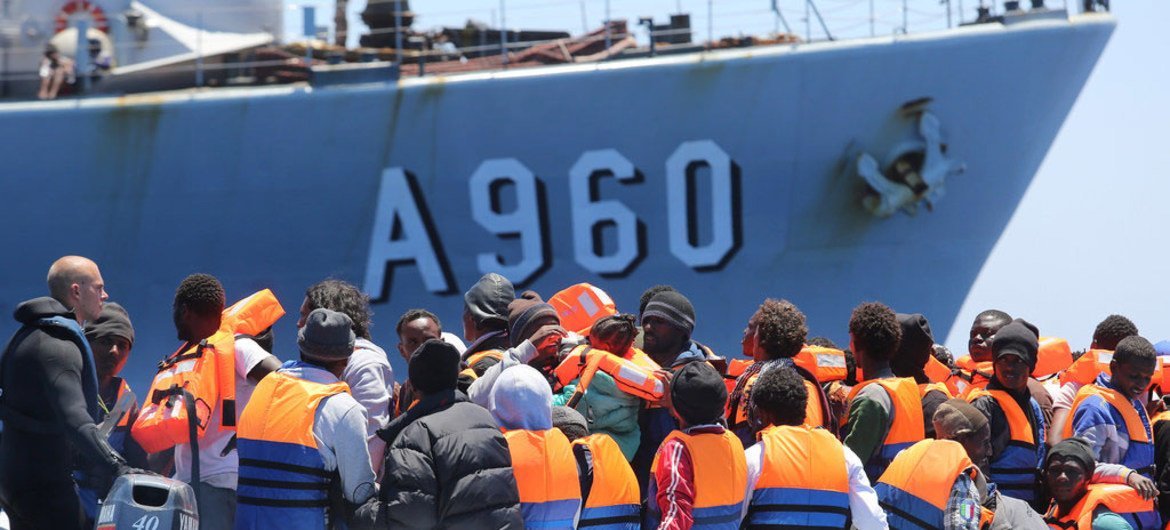
(UN News)* — Activists working with sea-rescue charities in Italy should not be criminalized, a UN independent human rights expert said on Thursday [], ahead of a trial against crew members from several non-governmental organizations (NGOs).
IOM/Francesco Malavolta (file) | Migrants from the Mediterranean are rescued in the Channel of Sicily, Italy (file).
Preliminary criminal proceedings opened last May in Sicily against 21 people charged with aiding and abetting illegal immigration in connection with several search-and-rescue missions conducted between 2016 and 2017.
Those accused include four crew members of the Iuventa, a former fishing trawler credited with saving some 14,000 migrant lives in the Mediterranean Sea, and human rights activists from other civilian vessels.
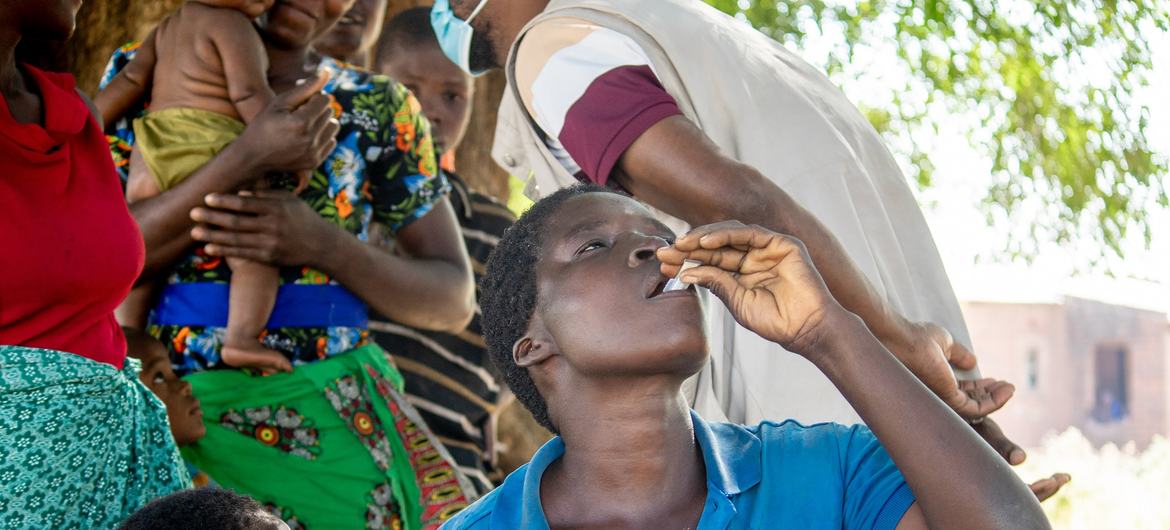
(UN News)* — Africa is currently experiencing an exponential rise in cholera cases, amid a global surge in the disease, the World Health Organization (WHO) reported on Thursday [].
Unicef Malawi | Daina Denja takes the cholera vaccine during UNICEF’ cholera vaccine campaign at Misili village in Chikwawa district, Malawi.
Across the continent, cases in January were 30 per cent higher than for the whole of last year.
Most new infections and deaths have occurred in Malawi, which is facing its worst outbreak in 20 years.
10 countries affected
Overall, 10 African countries are affected by cholera. The waterborne disease causes acute watery diarrhoea and can kill within hours but is easily treatable.
Besides Malawi, cases have been reported in neighbouring Mozambique and Zambia, as well as in Burundi, Cameroon, the Democratic Republic of the Congo (DRC) and Nigeria.
Bangkok, 14 Januray 2023 (FAO)* – Asia’s cities are growing at such a fast pace that nearly 55 percent of the region’s enormous population is expected to reside in urban areas by 2030, and that will have equally enormous consequences for urban food security and nutrition, according to the main findings of a new report by four United Nations agencies.
ABUJA, 16 January 2023 (UNICEF)* — Nearly 25 million Nigerians are at risk of facing hunger between June and August 2023 (lean season) if urgent action is not taken, according to the October 2022 Cadre Harmonisé, a Government led and UN-supported food and nutrition analysis carried out twice a year.
UNICEF/UN028425/Esiebo
This is a projected increase from the estimated 17 million people currently at risk of food insecurity. Continued conflict, climate change, inflation and rising food prices are key drivers of this alarming trend.
Food access has been affected by persistent violence in the north-east states of Borno, Adamawa and Yobe (BAY) and armed banditry and kidnapping in states such as Katsina, Sokoto, Kaduna, Benue and Niger.



 HUMAN WRONGS WATCH