History will likely remember the Covid-19 pandemic as the first time since records began that inequality rose in almost every country at once. However, not everyone was affected in the same way.
Julissa Álvarez is a 44-year old hairdresser living in the Dominican Republic. Because of COVID-19-induced lockdowns, she has lost her clients and livelihood, on which she relied to put food on the table for her partner and their six children. Photo: Valerie Caamaño/Oxfam
It was said at first that viruses don’t discriminate. But as we’ve witnessed again, crises, and societies, do.
Winnie Byanyima, Executive Director of UNAIDS
COVID-19 has magnified the fissures in society. It has seen marginalized communities, who were already on the edge, taking the hardest economic hit, getting stuck at the back of the line for vital services and getting scapegoated for the crisis.
Yet the crisis has also seen the most excluded communities being, once again, the first to step up to help—rooted in their expertise from experience, in their empathy and in their insistence that health for all and a recovery for all is possible.
Bonn/ New York (UN Framework Convention on Climate Change (UNFCCC)* – UN Climate Change on 26 February 2021 published the Initial NDC Synthesis Report, showing nations must redouble efforts and submit stronger, more ambitious national climate action plans in 2021 if they’re to achieve the Paris Agreement goal of limiting global temperature rise by 2°C—ideally 1.5°C—by the end of the century.
City Skyline | Credit: Pexels
“2021 is a make or break year to confront the global climate emergency. The science is clear, to limit global temperature rise to 1.5C, we must cut global emissions by 45% by 2030 from 2010 levels,” said UN Secretary-General António Guterres.
Nairobi, 24 February 2021(UNEP)* –Ministers of environment and other leaders from more than 150 nations on 23 February 2021 concluded a two-day online meeting of the Fifth United Nations Environment Assembly (UNEA-5) in which the Assembly warned that the world risks new pandemics if we don’t change how we safeguard nature.
The Green Gigaton Challenge backed by the United Nations Environment Programme (UNEP) and partners, catalyses public and private funds to combat deforestation, with the goal to cut annual emissions by 1 gigaton by 2025.
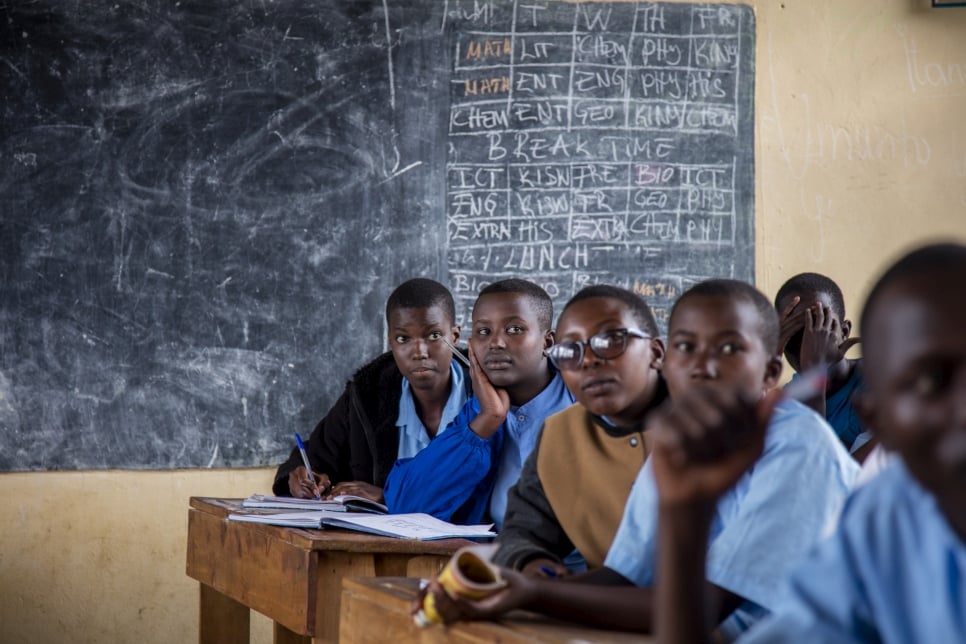
GENEVA/WASHINGTON (UNHCR)* — The average annual cost of educating refugees is less than 5 percent of public education expenditure in developing nations hosting 85 percent of the world’s refugees, according to a joint World Bank – UNHCR report released on 25 February 2021. | Español
The principle of inclusive education, in this case, opening education up to all refugee children and their inclusion into national education systems can also lead to better services for local communities in host countries.
(UN News)* — More collective action is needed to address the risks climate change poses to global peace and security, the UN Secretary-General told a high-level Security Council debate on Tuesday [23 February 2021], as renowned natural historian David Attenborough warned countries that the planet faces total ‘collapse’.
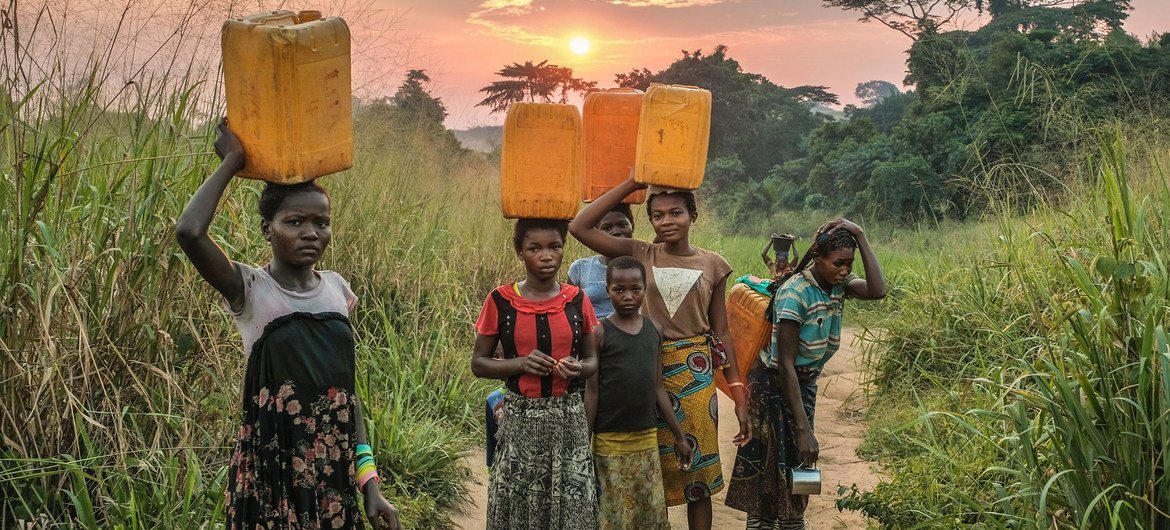
CIFOR/Axel Fassio | Young girls carry water from a source near Yangambi, Democratic Republic of the Congo.
.
Climate shocks such as record high temperatures and a “new normal” of wildfires, floods and droughts, are not only damaging the natural environment, said UN chief António Guterres, but also threatening political, economic and social stability.“The science is clear: we need to limit the global temperature increase to 1.5 degrees by the end of the century,” the Secretary-General said.
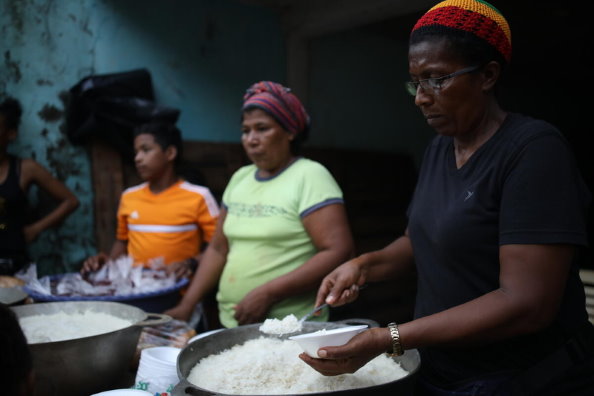
WFP/Oscar Duarte, women cooking free meals for the children of the community named Guililandia, who were affected by the Hurricane. Part of the rice she has served to the children was WFP rice.
As the climate warms, a destructive pest is spreading its wings and damaging the livelihoods of fruit growers in southern Africa. The invasive fruit fly, Bactrocera dorsalis, is preventing farmers like Susan Zinoro, a mango farmer from Mutoko, Zimbabwe, from literally and figuratively enjoying the fruits of their labour.
Mango farmers Susan and Batsirai Zinoro from Mutoko District, Zimbabwe are using Integrated Pest Management methods to control a fruit fly pest. Credit: Busani Bafana/IPS
BULAWAYO, Zimbabwe, Feb 23 2021 (IPS)* – Every harvest season, Susan Zinoro, a mango farmer from Mutoko, Zimbabwe, buries half the mangoes she’s grown that season. They have already started rotting either on the tree or have fallen to the ground before harvest. It’s a difficult task for Zinoro because she knows she is throwing away food and income meant for her family.
Implementation of nature-based solutions has been growing. But there is an urgent need to gather more evidence on the outcomes of adaption projects worldwide. As temperatures rise and climate change impacts intensify, nations must urgently step up action to adapt to the new climate reality or face serious costs, damages and losses, the 2020 edition of the UN Environment Programme (UNEP) Adaptation Gap Report finds.*
(UNEP)* — Implementation of nature-based solutions has been growing worldwide for the past two decades. Since 2006, multilateral funds serving the Paris Agreement have backed around 400 adaptation projects in developing countries, half of which started after 2015. The majority focus on agriculture and water, with drought, rainfall variability, flooding and coastal impacts.





 HUMAN WRONGS WATCH