For many years, the elite private members’ club has sustained the outgoing US president. But is it all about to fall apart?
Donald Trump greets supporters at an airport in Lansing, Michigan, during the 2020 presidential election campaign | Matthew Dae Smith/Lansing State Journal/USA Today Network/Sipa USA/PA Images
21 January 2021 (openDemocracy)*— As Donald Trump leaves office, the place that has come to symbolise Brand Trump is Mar-a-Lago – his 20-acre, 128-room private members’ club in Palm Beach, Florida. With much of the Trump business empire heavily indebted and losing money, Mar-a-Lago is one of its few genuine cash cows.
KUALA LUMPUR, Malaysia, Jan 26 2021 (IPS)* – Current development fads fetishize data, ostensibly for ‘evidence-based policy-making’: if not measured, it will not matter. So, forget about getting financial resources for your work, programmes and projects, no matter how beneficial, significant or desperately needed.
Jomo Kwame Sundaram
Measure for measure
Agencies, funds, programmes and others lobby and fight for attention by showcasing their own policy agendas, ostensible achievements and potential. Many believe that the more indicators they get endorsed by the ‘international community’, the more financial support they can expect to secure.
Collecting enough national data to properly monitor progress on the Sustainable Development Goals is expensive. Data collection costs, typically borne by the countries themselves, have been estimated at minimally over three times total official development assistance (ODA).
Remember aid declined after the US-Soviet Cold War, and again following the 2008-9 global financial crisis. More recently, much more ODA is earmarked to ‘support’ private investments from donor countries.
When a society is deeply troubled, and governed in ways that seem under the influence of dark forces and disinformation becomes part of everyday life, it seems natural that all sorts of explanations will flourish.
Richard Falk
Few of us can handle uncertainty, and so many affirm falsehoods for the sake of achieving a specious clarity about the unknowable, or at least convert uncertainty into congenial forms of certainty, a dynamic that explains the rise of cultist thinking in our time and the spread of extremist versions of religious teachings.
One variant of this phenomenon that has gained salience during the Trump presidency was supposedly pernicious role of the American ‘deep state.’
Trumpists complaining that unelected bureaucrats were subverting the great leader’s agenda while anti-Trumpists were disappointed that this source of influence didn’t find ways to remove such a political imposter given the damage he was doing national self-confidence and to the international rendering of the previously high end American brand. Some asked in exasperated tones ‘why is the deep state asleep?’
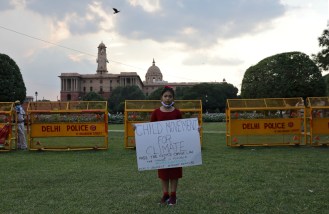
26 January 2021 (UNEP)* — People, including children and indigenous communities, are increasingly turning to the courts to compel governments and businesses to respect and accelerate commitments on climate change.
REUTERS/Anushree Fadnavis / 26 Jan 2021
According to a report from the United Nations Environment Programme (UNEP), published today [26 January 2021], the number of climate change litigation cases has surged in the last four years and now stands at 1,550 in 38 countries (39 including the courts of the European Union).
As of 1 July 2020, some 1,200 of these cases were filed in the United States and 350 in all other countries combined.
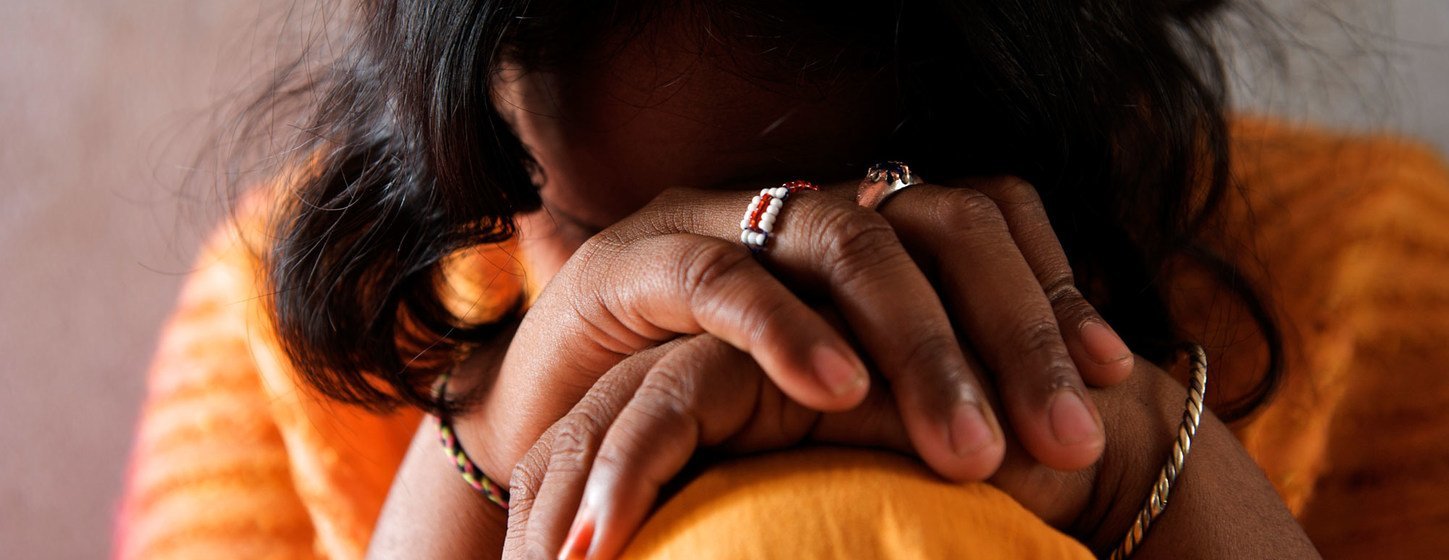
25 January 2021 (UN News)* — Trafficked and sexually exploited woman and girls can find themselves facing prosecution and conviction for those very same crimes, in some countries, a new UN report shows. The study aims to help prosecutors to better handle these complex cases, and protect the genuine victims.
A 2017 criminal case in Canada, to take one example from the report, involved an 18-year-old woman defendant was charged with the forced prostitution of two female minors, aged 14 and 16.
.
She had instructed one of them on how to dress, and what to do with clients, and taken away the cell phone of the other, to prevent her from escaping.
21 January 2021 (UNEP)* — As Brazil grapples with the COVID-19 crisis and rising rates of deforestation, some are fighting back to restore the natural environment while honouring the memory of their lost loved ones.
Photo: RBMA / 18 Jan 2021
Bereaved families and civil society organizations, with the support of the Atlantic Forest Biosphere Reserve and the Atlantic Forest Restoration Pact, which include some of Brazil’s most respected restoration scientists, launched a tree-planting, wildlife conservation and restoration drive on 12 December 2020 to honour the memories of those who have lost their lives to COVID-19 and to thank health workers.
The Pact is helping restoration efforts across 17 states in Brazil.
22 January 2021 (FAO)* — 2020 was a particular year, and one in which we spent more time online than ever. From virtual meetings to e-birthday parties, our participation in online activities soared – including internet learning. The benefits are many: you can study what you like, when you like, wherever you like. And if you are looking for new courses to get those brain synapses going, you should check out FAO’s extensive catalogue of online, completely free, courses!
21 January 2021 (openDemocracy)* — Since the adoption of the UN Trafficking Protocol, most efforts to eliminate exploitation of migrant workers have focused on human trafficking. Hundreds of millions of dollars are spent every year on counter-trafficking initiatives, particularly on trainings to ‘raise awareness’, criminal investigation and prosecution, and shelter and ‘rehabilitation’ services.
22 January 2021 (UNHCR)* — On the evening of 31 December, as the hours ticked down to the New Year, 40-year-old Aguiratou Diallo was at home with her four children in their village near the town of Koumbri in northern Burkina Faso, when a group of armed men burst into the courtyard outside.
“They threatened to hurt us if we were still there when they returned the next day. Then they fired into the air to scare us,” said Aguiratou, whose husband was away at work at the time.
By Sébastien Farcis, French journalist based in New Delhi*
For the past nine years, Rajesh Kumar Sharma has been operating a makeshift school between two pillars of the aerial metro that runs across India’s capital. More than 200 children from the surrounding slums attend this open-air classroom every day.
A primary school student attends a Hindi class at the makeshift school under a bridge in New Delhi. Rajesh Kumar Sharma, who started the school, can be seen in the background, teaching other students. cou_04_19_wide_angle_inde_internet_site.jpg
(UNESCO)* — This school does not appear on any map. It does not have whole walls or a complete roof, let alone tables or chairs. Like the small street shops that keep the Indian capital alive, the “Free school under the bridge” has simply merged into New Delhi’s sprawling urban space. It nestles between the massive number five and number six pillars of the aerial metro of this megalopolis of over 20 million inhabitants.




 HUMAN WRONGS WATCH