(UN News)* —More than half a million people in Gaza are trapped in famine, marked by widespread starvation, destitution and preventable deaths, according to a new UN-backed food security report released on Friday [].
UNITED NATIONS, Aug 22 2025 (IPS)* –– The Integrated Food Security Phase Classification (IPC) has officially declared that there is famine in Gaza. The world’s biggest food monitoring system raised its classification to Phase 5, the highest level on its food insecurity scale.
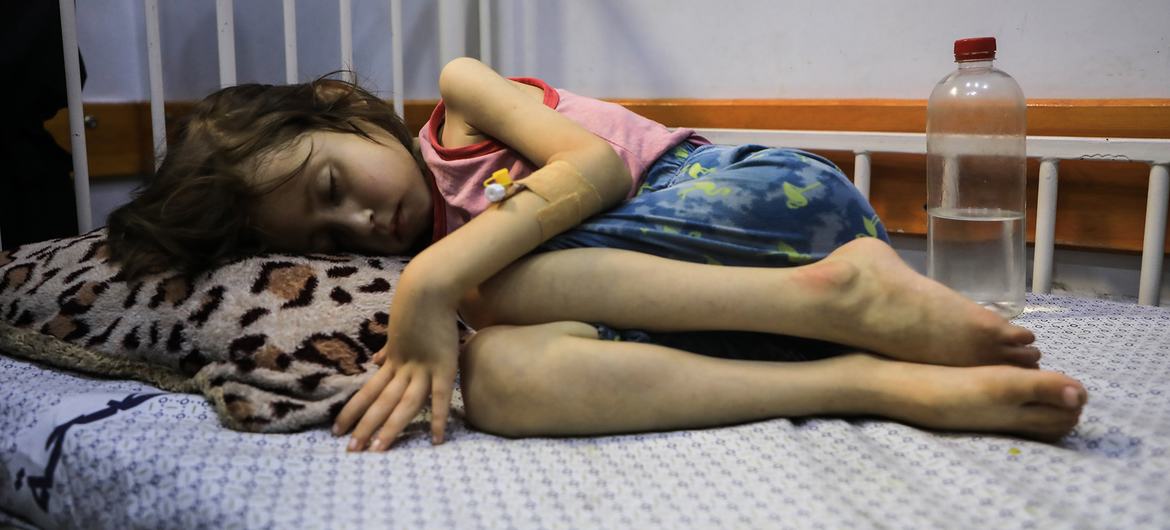
The IPC confirmed famine conditions in Gaza City, Deir al Balah and Khan Younis. Credit: UNICEF/Mohammed Nateel
The latest IPC analysis – the sixth on the crisis in Gaza – confirms that as of mid-August famine is occurring in Gaza City and warns that by mid-September it will expand to Deir al Balah and Khan Younis.
More than half a million Palestinians are facing “catastrophic levels” of hunger.
(UN News)* —UN aid teams in Gaza say that they’re only able to get less than half the lifesaving food support that is needed into the war-torn enclave.
In an alert from the World Food Programme (WFP), the agency said that half a million people “are on the brink of famine”, a claim backed up by multiple humanitarian agencies.
The latest worrying data is showing widespread acute malnutrition.
(UN News)* — With intensifying Israeli activity in and around Gaza City reportedly continuing on Thursday [], UN chief António Guterres renewed his urgent call for a ceasefire, as Palestinians fled intense airstrikes, artillery shelling and gunfire.
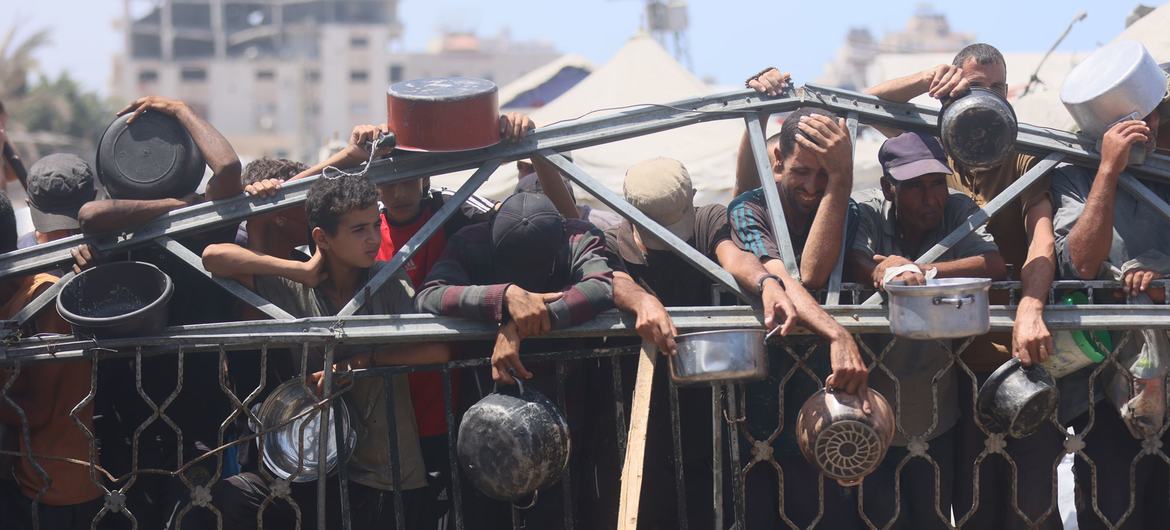
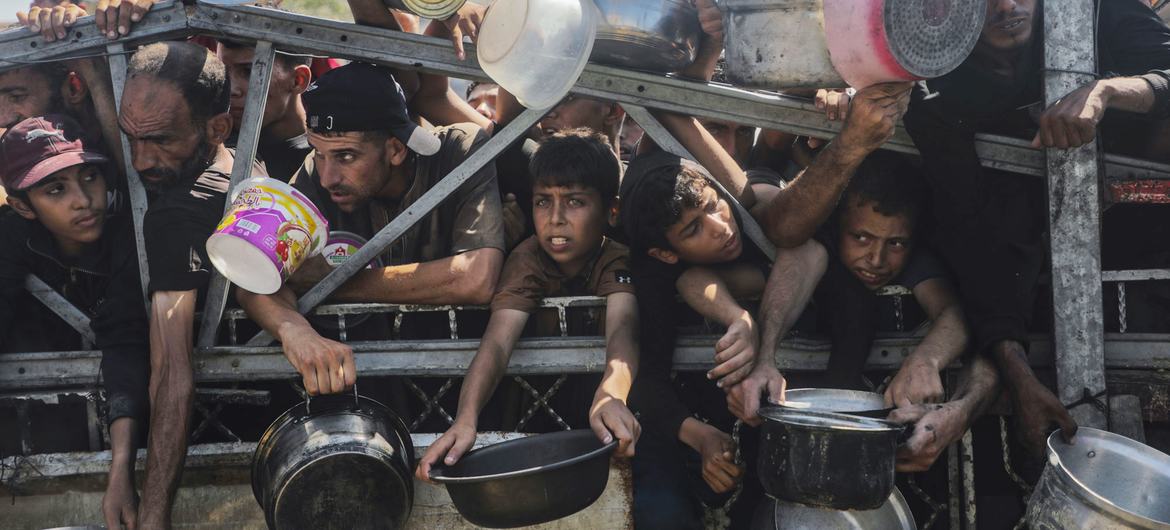
UN News | People wait for food at a community kitchen in western Gaza City.
“It is vital to reach immediately a ceasefire in Gaza,” the UN Secretary-General told reporters on the sidelines of the Ninth Tokyo International Conference on African Development (TICAD9), “and the unconditional release of all hostages and to avoid the massive death and destruction that a military operation against Gaza City would inevitably cause.”
Around one million people still live in the city – Gaza’s largest – in the north of the war-torn enclave.
In July, major news organizations published the image of 18-month-old Muhammad Zakariya Ayyoub al-Matouq, a Palestinian child so emaciated that his bones protruded through his back, while his mom cradled him in her arms. Instead of a diaper, he wore a black plastic bag.
(UN News)* — Israeli airstrikes and shootings near aid hubs run by the Gaza Humanitarian Foundation (GHF), a controversial US and Israel-backed initiative, have seen a dramatic increase in deaths and injuries leading to amputations, compounding the suffering of Palestinians struggling to stave off malnutrition and starvation as the conflict continues.
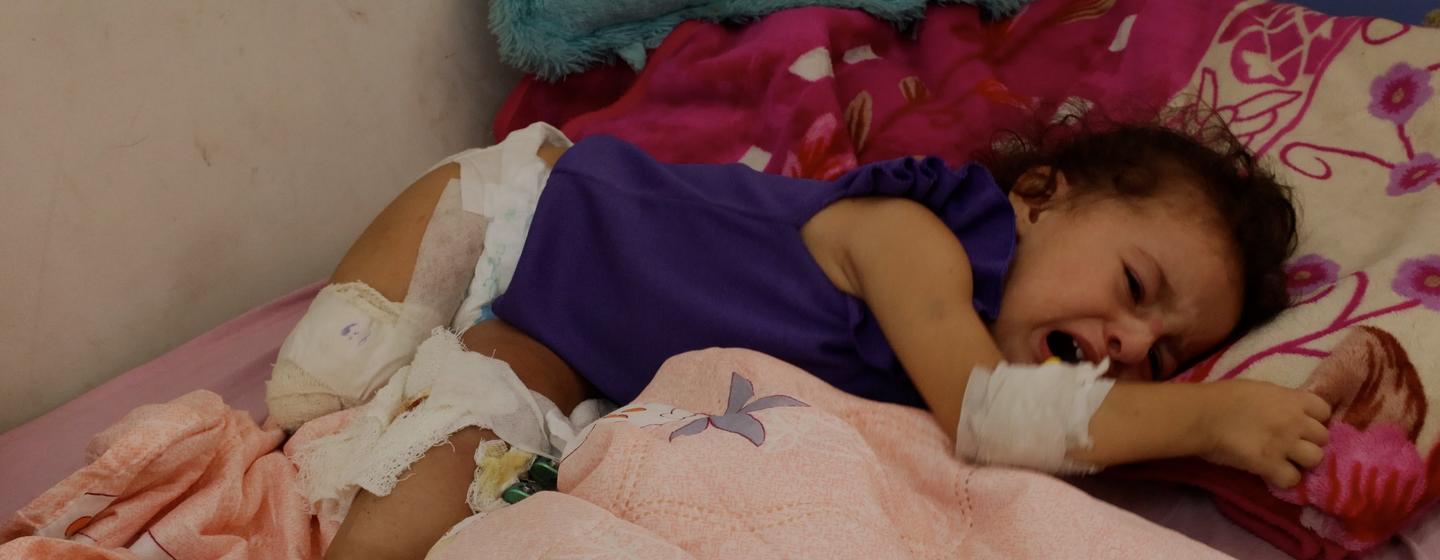
UN News | Palestinian child Maryam Abu Alba lying on a hospital bed in Gaza.
At the Al-Shifa Hospital in Gaza City, a small child, Maryam Abu Alba, is crying in pain. “The neighbour’s house was bombed, and their home was hit,” says her grandmother.
“One of her legs had to be amputated, and metal plates had to be inserted into the other one, which was fractured. She is in severe pain.”
(UN News)* — The International Criminal Court (ICC) has strongly rejected new sanctions announced by the United States on Wednesday [] against four more of its personnel in a renewed push surrounding investigations into US and Israeli officials
UN Photo/Rick Bajornas | The International Criminal Court is based in The Hague, Netherlands.
The sanctions target judges Kimberly Prost of Canada and Nicolas Guillou of France, as well as two deputy prosecutors: Nazhat Shameem Khan of Fiji and Mame Mandiaye Niang of Senegal.
This follows earlier measures against four other judges and the ICC prosecutor.
(UN News)* —The Israeli military has escalated attacks across Gaza City, reportedly deciding to press ahead with plans to take full control which will only lead to further “mass killings of civilians” and displacement, UN human rights officials warned on Wednesday [].
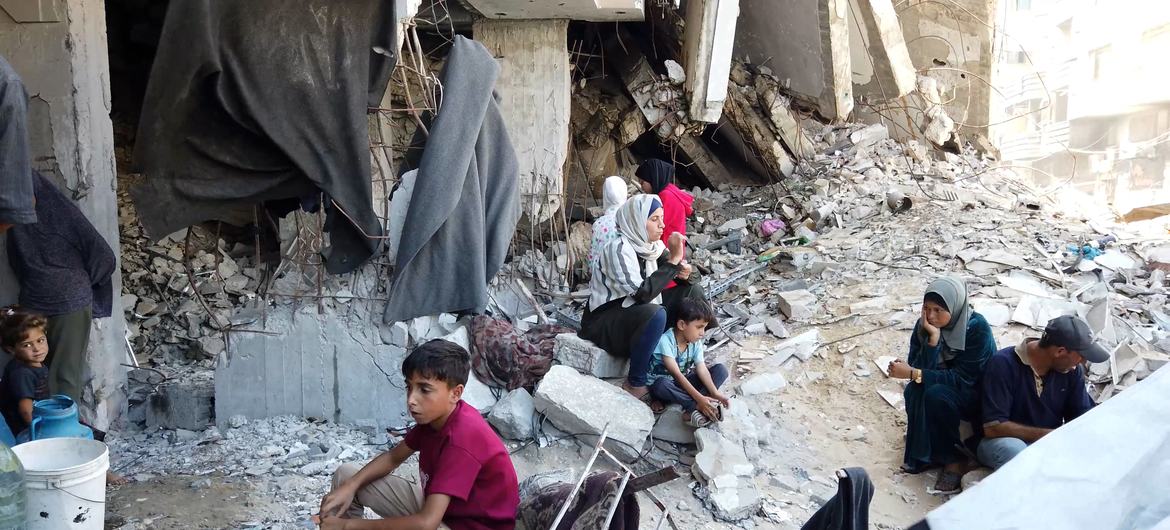
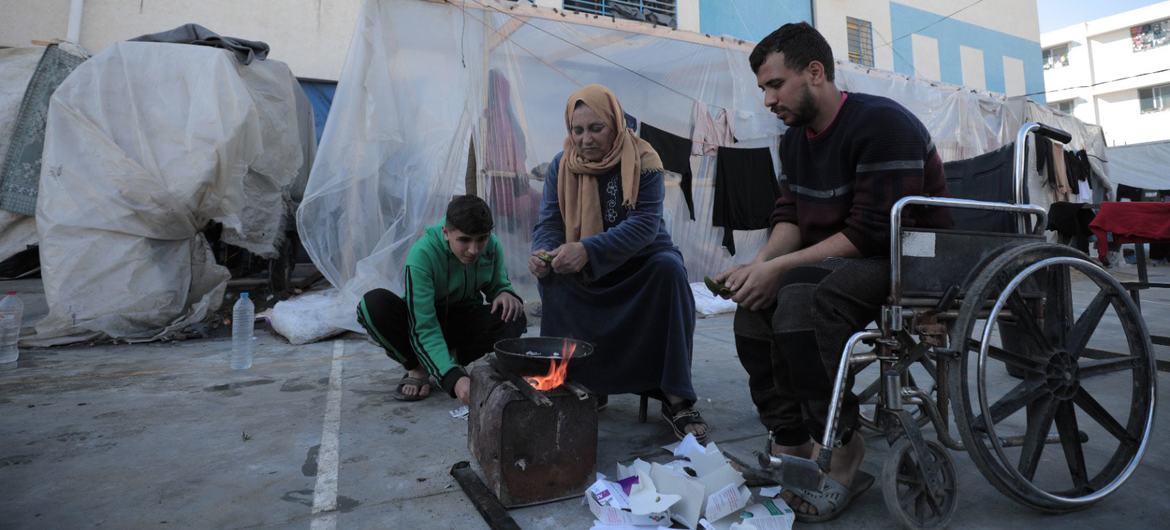
UN News | Displaced people from Jabalia, Gaza, live in a destroyed building in downtown Gaza City.
Recent attacks have been particularly devastating in the Az Zaytoun neighbourhood, where airstrikes, artillery shelling and gunfire are continuous and intense, causing a high number of civilian casualties and the large-scale destruction of residential buildings and public facilities, the UN human rights office, OHCHR, in the Occupied Palestinian Territory said in a statement.
(UN News)* —The small trickle of aid entering Gaza is totally insufficient to alleviate starvation and displacement in the Strip, UN humanitarians said on Tuesday [].
“The risk of starvation is everywhere in Gaza,” UN Human Rights Office spokesperson Thameen Al-Kheetan told reporters in Geneva.
“This is a direct result of the Israeli government’s policy of blocking humanitarian aid,” he said.
Mr. Al-Kheetan insisted that in the past few weeks, Israeli authorities have only allowed aid to enter in quantities that remain “far below what would be required to avert widespread starvation”.
(UN News)* — When Israeli forces in Gaza issue a new displacement order ahead of an incursion into a neighbourhood or city, Palestinian civilians are expected to pack their bags and flee – perhaps for the third, fourth, or tenth time.
But for an increasing number of Palestinians, including those who cannot hear the orders or whose mobility is impaired, following these orders may be impossible. Yet, failure to do so, could cost them their lives.
“In a normal situation, people with disabilities suffer the most. And in wartime, of course, the situation is heightened further,” said Muhannad Salah Al-Azzeh, member of the UN Committee on the Rights of Persons with Disabilities at a public dialogue this week in Geneva.
With the number of disabled people in Gaza increasing every day, Mr. Al-Azzeh said that the minimum level of safety for people with disabilities is not being upheld.




 HUMAN WRONGS WATCH