29 May 2021 (UN News)* — A renewed focus on boosting the production of millets and highlighting their benefits, is critical to reducing over-reliance on more commonly grown crops, boosting diverse diets, and food security.
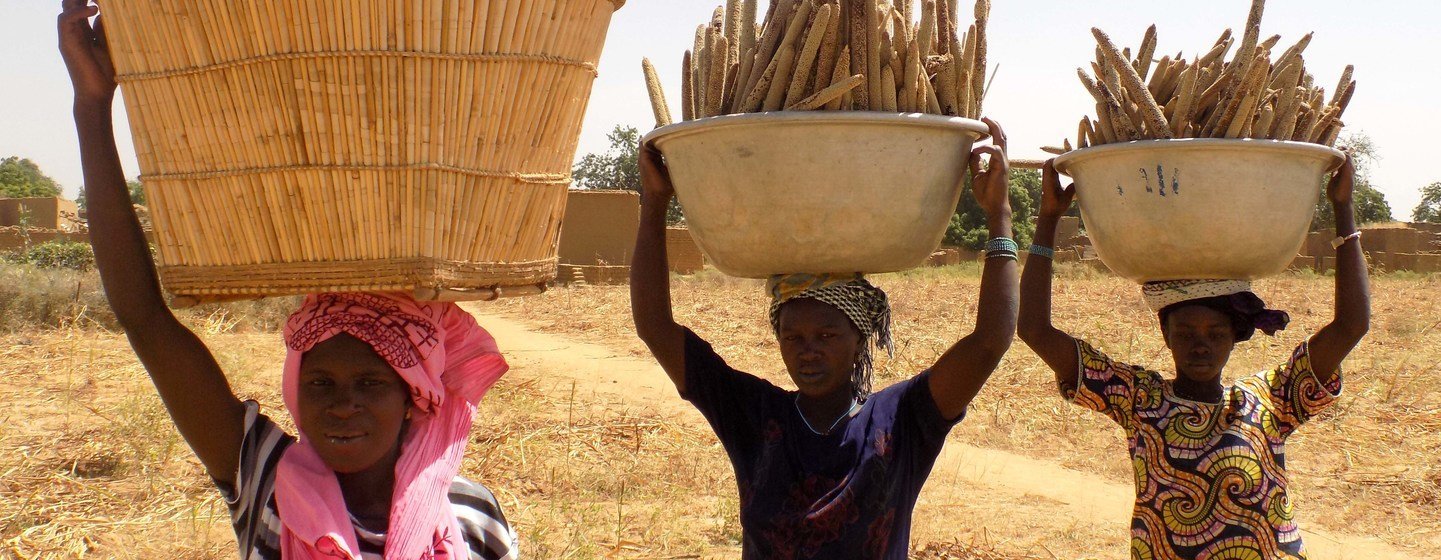
ICRISAT/Agathe Diama | Women carrying pearl millet harvest home in Mali
That’s especially true during periods of natural disaster when food becomes scarce, according to Dr Nancy Aburto, an agriculture expert at the Food and Agriculture Organization (FAO).
.
She spoke to UN News earlier this year, saying that following the UN General Assembly’s recent adoption of a resolution proclaiming 2023 as the International Year of Millets in March 2021, efforts are afoot to promote cultivation as a solution to climate and global food security challenges.
High-level event co-hosted by FAO, Costa Rica, Spain and the Vatican
Women at work in an Amazonian food system.
ROME (FAO)* — Indigenous peoples and afro-descendants’ knowledge, innovations and resilience capacities are essential for the transformation to a more sustainable and climate-friendly world and should be included in the policy-making processes, agreed the High-Level Seminar convened on 27 May 2021 by the Food and Agriculture Organization of the United Nations (FAO), the governments of Costa Rica, Spain and the Vatican.
HYDERABAD, India (IPS)* – As the sun sets over the canopy of Albizia amara trees, a thin blanket of fog begins to descend over the forests of the Malai Mahadeshwara Hills Wildlife Sanctuary, which lies roughly 150 km south of the Indian city of Bangalore.
Geneva (UNEP)* – A total investment in nature of USD 8.1 trillion is required between now and 2050 – while annual investment should reach USD 536 billion annually by 2050 – in order to successfully tackle the interlinked climate, biodiversity, and land degradation crises, according to the State of Finance for Nature report released on 27 May 2021.
The report finds that annual investments in nature-based solutions will have to triple by 2030 and increase four-fold by 2050 from the current investments into nature-based solutions of USD 133 billion (using 2020 as base year).
27 May 2021 (UNEP)* — The ongoing loss of natural spaces, including forests, has become a systemic risk for the global economy, warns a new report from the United Nations Environment Programme (UNEP) and several partners.
.
REUTERS/Aly Song / 27 May 2021
Over the past decade, 26 per cent of global tree cover loss was caused by the production of just seven agricultural commodities – cattle, oil palm, soy, cocoa, rubber, coffee and wood fibre – said the State of Financing for Naturereport.
Barring major changes, the toll on forests and other wild spaces will continue to mount, ultimately imperiling industries that rely on natural resources.
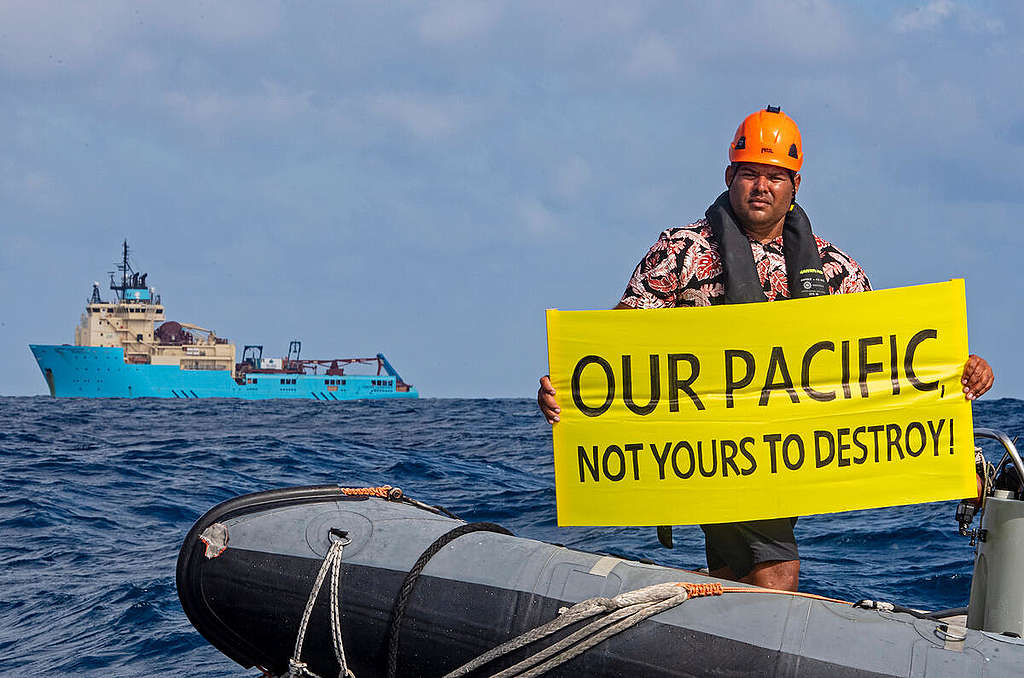
Deep sea mining companies are currently out in the Pacific carrying out tests in an attempt to prove their industry is safe for the environment. A few weeks ago, one of those companies, GSR, lost control of a 25-tonne robot at the bottom of the ocean. Bearing witness to this and confronting this industry at sea is Victor Pickering, a Fijian activist onboard Greenpeace’s Rainbow Warrior ship..
Nairobi (UNEP)* – A new atlas published on 26 May 2021 shows that 54 per cent of the world’s land surface consists of vast tracts of land covered by grass, shrubs or sparse, hardy vegetation that support millions of pastoralists, hunter-gatherers, ranchers and large populations of wildlife–and store large amounts of carbon.
Yet while most climate plans focus on forests, much less importance is given to rangelands, leaving these massive planetary ecosystems supporting people and nature exposed to a wide variety of threats.
Geneva, 27 May 2021 (WMO) – There is about a 40% chance of the annual average global temperature temporarily reaching 1.5°C above the pre industrial levels in at least one of the next five years – and these odds are increasing with time, according to a new climate update issued by the World Meteorological Organization (WMO).
There is a 90% likelihood of at least one year between 2021-2025 becoming the warmest on record, which would dislodge 2016 from the top ranking, according to the Global Annual to Decadal Climate Update, produced by the United Kingdom’s Met Office, the WMO lead centre for such predictions.
I would like to announce the publication of a book which discusses the duty of scientists and engineers to try to prevent the catastrophes that currently threaten human society and the biosphere.
The book may be freely downloaded and circulated from the following link:
Science and technology have conferred many benefits on human society, but as we start the 21st century, most thoughtful observers believe that our science-driven and information-driven industrial civilization has entered a period of crisis.
All indices are increasing rapidly – population, total wealth, industrial output, rates of scientific discovery, and so on. But it is clear that the total human footprint on the face of nature has become too great.
Nairobi (UNEP)* – Despite progress in key environmental areas such as clean water, sanitation, clean energy, forest management and waste, countries are still living unsustainably and are on course to miss the environmental dimensions of the 2030 Agenda for Sustainable Development, according to the Measuring Progress: Environment and the SDGs report.





 HUMAN WRONGS WATCH