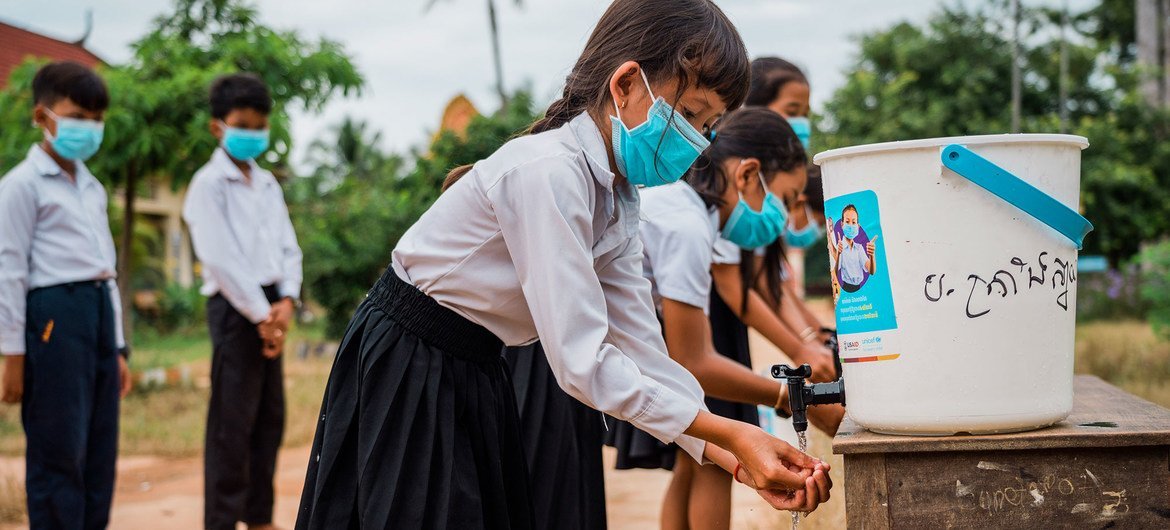
(UN News)* — A UN-backed fund, launched on Tuesday [17 November 2020 ], is set to take on the centuries-old crisis centred around sanitation, hygiene and menstrual health, which now impacts more than four billion people across the world.
Speaking, via a video message, at the launch of the Fund, UN Deputy Secretary-General Amina Mohammed described safe sanitation and hygiene as “critical to the response that we want to see, first, because it is about human dignity; second, it is a health issue.”
(UN News)* — The United Nations released $100 million of emergency funding on Tuesday [17 November 2020] to stave off the risk of famine in seven countries most at risk from a hunger epidemic fueled by conflict, economic decline, climate change and the COVID-19 pandemic.
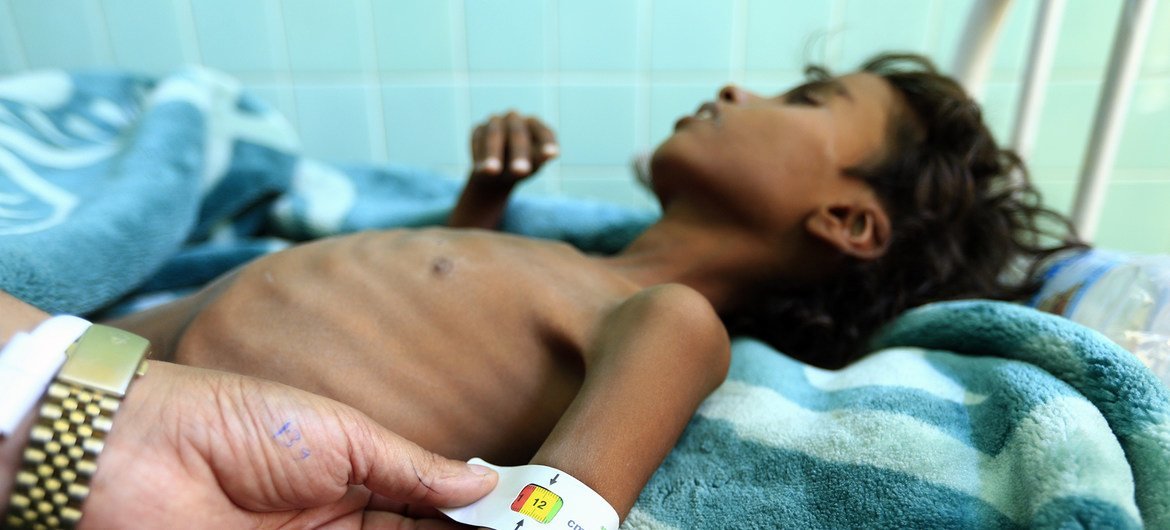
UNICEF | A Yemeni child suffering from malnutrition at a treatment centre in a hospital in Sana’a. (file)
Mark Lowcock, head of the UN Office for the Coordination of Humanitarian Affairs, said $80 million would be split between Afghanistan, Burkina Faso, the Democratic Republic of the Congo, Nigeria, South Sudan and Yemen, which would get the biggest tranche of $30 million. A further $20 million had been set aside for Ethiopia, where droughts could worsen an already fragile situation.
It’s something that many of us might take for granted. In New York State for example, ingredients for a simple meal – perhaps a soup or a simple stew – costs just 0.6 percent of someone’s income.
Contrast this with South Sudan, where a shopper would have to spend an astonishing 186 percent of their income to do the same.
Such a difference brings into sharp focus the huge inequalities at play between those people in developing countries and others in more prosperous parts of the world.
Conflict and climate change have long affected people’s ability to afford food across multiple countries, as they are driven from their land and livelihoods and left unable to produce or buy the produce they need to feed their families.
(UN News)* — “Hunger is an outrage in a world of plenty”, the UN chief told the governing body of the Organization’s food agency on Monday [16 November 2020], highlighting the important role of food security in cementing peace.
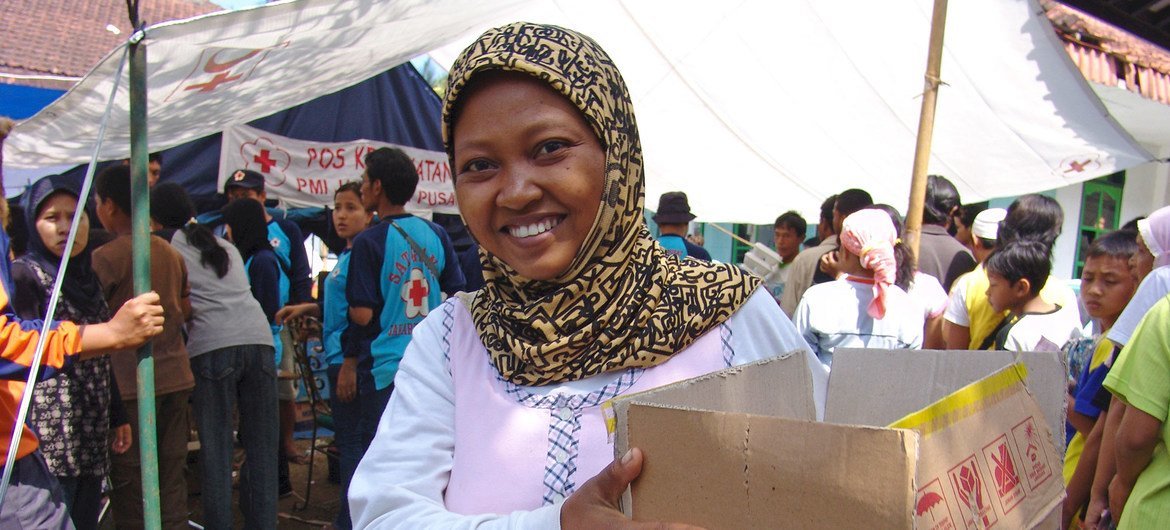
WFP/Barry Came | Displaced victims of the West Java tsunami in Indonesia collect World Food Programme (WFP) food aid.
.
“An empty stomach is a gaping hole in the heart of a society. A stunted child’s growth in the mind is progress for her and for everyone”, Secretary-General António Guterresattested to the Executive Board of the World Food Programme (WFP).
The Teal Sisters, Zambia, survivors and advocates for cervical cancer elimination
(WHO)* — WHO‘s Global Strategy to Accelerate the Elimination of Cervical Cancer, launched today [17 November 2020], outlines three key steps: vaccination, screening and treatment.
Successful implementation of all three could reduce more than 40% of new cases of the disease and 5 million related deaths by 2050.
Black women are mobilising to win seats at the table in this month’s municipal elections – amid death threats and COVID-19 restrictions. Português. Español.
Taina Rosa (left) and Lauana Nara, candidates in this week’s municipal elections, want more Black women in office. | Credit: Dokttor Bhu Bhu and Allan Calisto
13 November 2020 (openDemocracy)* — “When she was murdered, the Black women’s movement dealt with this collective trauma by turning it into institutional political action,” says Ana Carolina Lourenço, co-founder of Mulheres Negras Decidem (Black Women Decide).
On 14 July 2020, Ruksana Begum fetches water near the raised homestead where her family has been living since floodwaters submerged their house in Amtola Char in Chilmari Upazila, Kurigram, Bangladesh. UN Water
(United Nations)* — Over half of the global population or 4.2 billion people lack safe sanitation and around 297,000 children under five – more than 800 every day – die annually from diarrhoeal diseases due to poor hygiene, poor sanitation or unsafe drinking water.
Without safely managed, sustainable sanitation, people often have no choice but to use unreliable, inadequate toilets or practise open defecation.
Eriam Sheikh,7 year old comes out after using the toilet on stilts or floating toilet built over a drain passing by Rafiq Nagar in Mumbai. PHOTO:UN Water
16 November 2020 (United Nations)* — World Toilet Day celebrates toilets and raises awareness of the 4.2 billion people living without access to safely managed sanitation. It is about taking action to tackle the global sanitation crisis and achieve Sustainable Development Goal 6: water and sanitation for all by 2030.
15 November 2020 (UN News)* — With the world population expected to rise to 9.7 billion by 2050, food production will need to keep pace, and experts believe the Ocean can provide much of the sustenance we need. The second story in our two-part series on aquaculture focuses on the opportunities for significantly scaling up fish farming.
Aquaculture, or fish farming, is one of the fastest growing food-production sectors in the world, according to the Food and Agriculture Organization (FAO), reaching an all-time record high of 114.5 million tonnes in 2018.




 HUMAN WRONGS WATCH