(UN News)* — According to the United Nations, the world needs an extra $4 trillion every year to tackle some of the world’s biggest challenges – ending poverty and hunger, fighting climate change, and reducing inequality.
— A growing network of online communities known collectively as the “manosphere” is emerging as a serious threat to gender equality, as toxic digital spaces increasingly influence real-world attitudes, behaviours, and policies, the UN agency dedicated to ending gender discrimination has warned.
Unsplash/Anthony Tran | Women and girls are feeling less comfortable to be exposed to the risks and threats when they engage in digital platforms, according to UN Women.
With more than 5.5 billion people connected online – nearly all of them active on social media – digital platforms have become central to how people interact, UN Women highlights.
However, they are also being weaponised to spread misogyny and hate.
More than 12 million people – one quarter of the population – are at risk of gender-based violence
GEDAREF STATE, SUDAN, 19 June 2025 (UN Population Fund)* – “Every woman and girl here is at risk, no matter her age or background. No one is safe,” said Khadija*, a midwife at a maternity clinic in Sudan’s eastern Gedaref State.
(UN News)* — Last year, 41,370 grave violations against children were documented and verified by the United Nations, according to the UN Secretary-General’s annual report on children in armed conflict, released on Thursday .
UN News | 8,554 grave violations against children occurred in Israel and the Occupied Palestinian Territories.
This number represents a 25 per cent increase from 2023, marking the third consecutive year that violations have increased.
22,495 violations were committed against children themselves while the remaining targeted infrastructure such as schools and humanitarian aid intended for and used by children.
A girl at the Mother and Child Health Center in Mogadishu, Somalia, visited by the UN Special Representative on Sexual Violence in Conflict. PHOTO:UN/Tobin Jones
“The horror of these heinous crimes echoes long after the guns fall silent.
Too often, perpetrators walk free, cloaked in impunity, while survivors often bear the impossible burden of stigma and trauma.
(UN News)* — Civilian deaths in conflict surged by 40 per cent last year, according to new data released by the UN human rights office (OHCHR) with already marginalised groups facing disproportionate levels of discrimination.
At least 48,384 individuals – mostly civilians – were killed in 2024, based on casualties recorded by OHCHR.
“Behind every statistic is a story. Behind every data point, a person,” said UN rights chief Volker Türk.
This alarming rise in civilian deaths exposes major failures to protect some of the most vulnerable in both peacetime and conflict situations, “painting a picture of a global human rights landscape in need of urgent action,” he said.
Unsplash/Jon Tyson | UNESCO says that hate speech is on the rise worldwide.
“It is an alarm bell: the louder it rings, the greater the threat of genocide,” he warned.
As part of its core mission to combat hatred, discrimination, racism and inequality, the UN is stepping up efforts to challenge hate speech wherever it arises.
“Hate speech is poison in the well of society. It has paved the way for violence and atrocities during the darkest chapters of human history,” Mr. Guterres added.
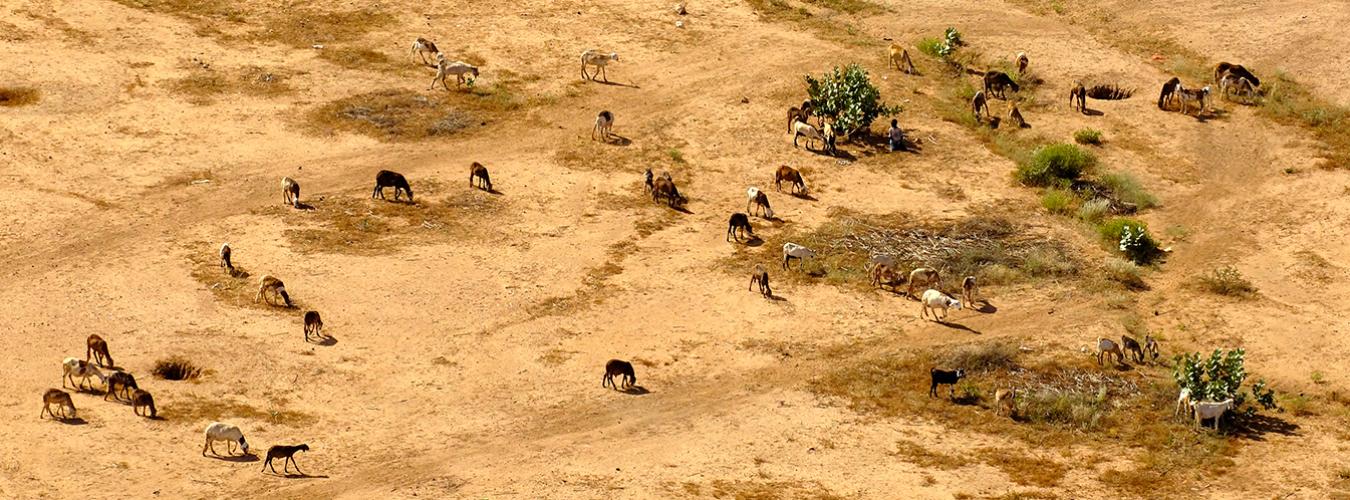
Up to 40% of all land area worldwide already considered degraded.
Healthy land underpins thriving economies, with over half of global GDP dependent on nature. Yet we are depleting this natural capital at an alarming rate: every minute, the equivalent of four football fields is lost due to land degradation.
.
A young boy herds his families cattle in the dry and desolate lanscape of the city of Tawaila in Northern Darfur. UN Photo/Fred Noy.
.
This drives biodiversity loss, increasing drought risk and displacing communities. The ripple effects are global—from rising food prices to instability and migration.
KUALA LUMPUR, Malaysia, Jun 17 2025 (IPS)* – Wars, economic shocks, planetary heating and aid cuts have worsened food crises in recent years, with almost 300 million people now threatened by starvation.
FAO statistics indicate enough output to feed the world’s eight billion plus another three billion!
Clearly, inadequate food due to population growth cannot explain persistent hunger. Yet, the number of hungry people has been rising for more than a decade.
So, why are so many hungry if there is more than enough food for all?
The multi-stakeholder 2025 Global Report on Food Crises (GRFC) notes 2024 was the sixth consecutive year of high and growing acute food insecurity, with 295.3 million people starving!
In 2023, 733 million people experienced chronic hunger. Over a fifth (22.6%) of the 53 countries/territories assessed in this year’s GRFC were especially vulnerable.
MONTEVIDEO, Uruguay, Jun 16 2025 (IPS)** – At a White House meeting, presidents Nayib Bukele and Donald Trump exchanged praises and joked about mass incarceration while discussing an unprecedented agreement: the USA would pay El Salvador US$6 million a year to house deportees – of any nationality, potentially including US citizens – in its Centre for Terrorism Confinement (CECOT), a notorious mega-prison.
Credit: Kevin Lamarque/Reuters via Gallo Images
This agreement marked the evolution of Bukele’s authoritarian model from a domestic experiment to an exportable commodity for strongmen worldwide.






 HUMAN WRONGS WATCH