(Wall Street International)* — The climate crisis was made vivid by the October 2018 report of the Intergovernmental Panel on Climate Change. In the words of 16-year-old Swedish climate activist Greta Thunberg: “According to the IPCC, we are less than 12 years away from not being able to undo our mistakes. In that time, unprecedented changes in all aspects of society need to have taken place, including a reduction of our CO2 emissions by at least 50%…”
15 August 2019 (IGWIA)* — While much of the world has focused on the fires raging in the Amazon, the world’s largest forest–the Siberian Taiga in Russia–has been on fire for most of 2019.
Demonstration held in Krasnoyarsk on 22 Aug 2019. Signs read (left to right): Sign 1: “Summer 2019 – Evenkia is covered in smoke and on fire. Photos from Tura, Baikit, Vanavara settlements taken 9 August 2019, Indigenous Day”; Sign 2: “Investment projects are the destruction of the traditional environment of Evenkia — Ecocide. Photos from forest plots and the results of industrial logging by company Kraslessinvest”; Sign 3: “Baikit forest, 50km from Baikit, forest fires 2019 — Ecocide”. Photo: Nikita Kaplin
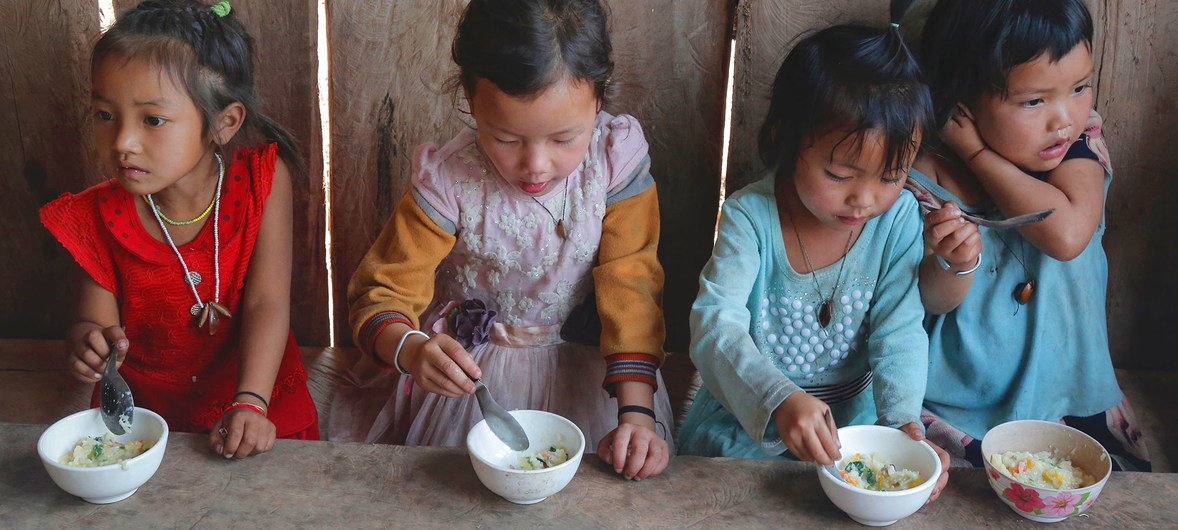
15 October 2019 (UN News)* — Across the globe, at least one-in-three children under-five are malnourished and not developing properly, UNICEF revealed on Tuesday [15 October 2019], in its most comprehensive report on children, food and nutrition in 20 years.
“An alarmingly high number of children are suffering the consequences of poor diets and a food system that is failing them,” the UN children’s agency (UNICEF) warned.
In this Voices from the Global South podcast, Dr James Kairo, one of the lead authors of the ‘Special Report on the Ocean and Cryosphere in a Changing Climate,’ a special report by the Intergovernmental Panel on Climate Change (IPCC) speaks to IPS from the Africa Climate Risk Conference that was held in Ethiopia’s capital, Addis Ababa.
ADDIS ABABA, Oct 15 2019 (IPS)* – “Special reports come to address issues that need deeper understanding and deeper research,” Dr James Kairo, one of the lead authors of the ‘Special Report on the Ocean and Cryosphere in a Changing Climate,’ a special report by the Intergovernmental Panel on Climate Change (IPCC), told IPS.
The report focused on what would happen to oceans and cryosphere (frozen parts of our world) which include the polar and high mountains if temperatures increase beyond 1°C above pre-industrial levels to 1.5°C, and beyond.
Campaign highlights gross paradox of hunger and food waste
11 October (World Food Programme)* — World Food Day is marked on 16 October 2019 to shine a spotlight on the issue of global hunger. The figures are eye-watering: enough food to feed the world’s 7 billion people while one in nine people goes to bed hungry every night. Equally if not more damning, one-third of the food produced for human consumption is lost or wasted — amounting to about 1.3 billion tons per year.
A smallholder farmer in Masaka, in the south of Malawi. Photo: WFP/Badre Bahaji
Achieving Zero Hunger is not only about addressing hunger, but also nourishing people, while nurturing the planet. This year, World Food Day calls for action across sectors to make healthy and sustainable diets affordable and accessible to everyone. At the same time, it calls on everyone to start thinking about what we eat.*
.
16 October 2019 (FAO)* — In recent decades, we have dramatically changed our diets and eating habits as a result of globalization, urbanization and income growth.
.
We have moved from seasonal, mainly plant-based and fibre-rich dishes to diets that are high in refined starches, sugar, fats, salt, processed foods, meat and other animal-source products.
15 October 2016, Accra/Abuja (FAO)* – The celebration of the International Day of Rural Women provides the opportunity to celebrate rural women’s important roles in food production and processing, food security and nutrition and reduction of rural poverty.
Rome, 15 October 2019 (IFAD)* – A powerful short film featuring acclaimed poet Maya Angelou was launched today by the International Fund for Agricultural Development (IFAD) on the International Day of Rural Women to raise awareness of the power and potential of rural women to help fight global hunger.
15 October 2019 (UN Women)* — This year on International Day of Rural Women (15 October), we’re celebrating the vital role that rural women play in climate action with a spotlight on “Rural women and girls building resilience” theme.
Photo: UN Women/Ryan Brown
As the world faces an increasingly critical need to address climate change, the important impact that rural women and girls have on building resilience is undeniable.
Today it is in the news that 906,000 hectares have burned in the Amazon forests so far in 2019. It is in the news that an even larger –although harder to determine- number of hectares have burned this year in African forests and savannahs.
Prof. Howard Richards
The media often mention that the fires of 2019 continue an ominous trend. There has been worldwide a steadily increasing loss of vegetation to flames that has been accelerating for several decades. The feedback loop is negative. Less vegetation means less rainfall means less vegetation.
It is in the news that millions of people around the world –inspired by a Swedish teenager so honest that looking at a picture of her will cure a headache—have taken to the streets demanding that something must be done.




 HUMAN WRONGS WATCH