15/09/2020
(UN News)* — The COVID-19 pandemic has upended a world embroiled in chaos, unleashing catastrophic health, social and economic consequences along with irreparable harm to humanity, according to UN-backed report published on Monday [14 September 2020].
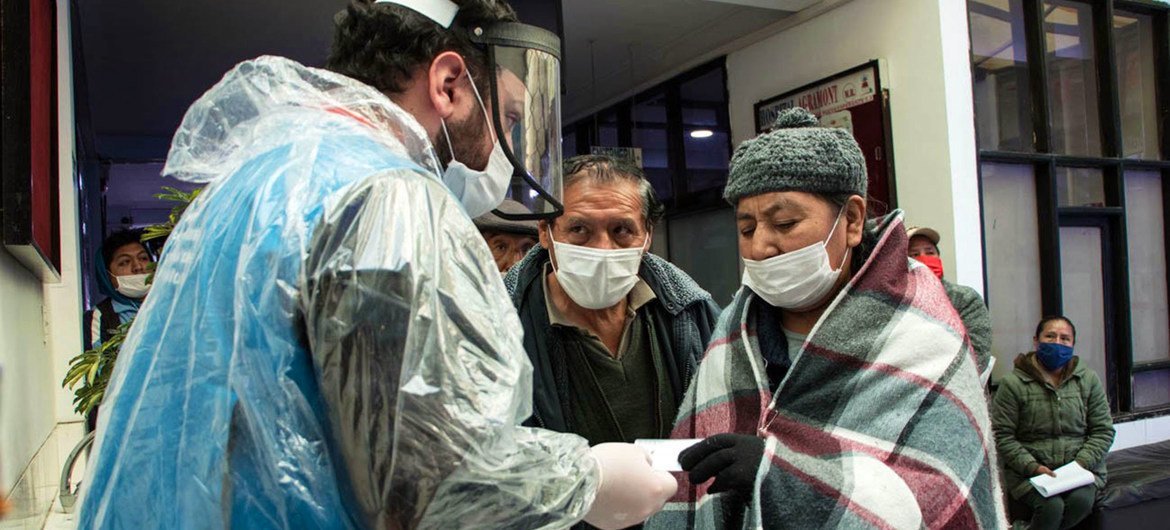
WFP/Morelia Eróstegui | During the COVID-19 pandemic, the World Food Programme (WFP), is distributing electronic cash cards to 1,500 families in El Alto and La Paz, Bolivia.
A World in Disorder, issued by the Global Preparedness Monitoring Board (GPMB), an independent monitoring and accountability body which prepares for global health crises, (GPMB), notes that the coronavirus has killed close to a million people, impacting health systems, food supplies and economies.
Posted in Africa, Asia, Latin America & Caribbean, Market Lords, Middle East, Others-USA-Europe-etc., The Peoples |
Leave a Comment »
14/09/2020
JFK, 9/11 and the American Left
On November 23, 1963, the day after John F. Kennedy’s assassination, Fidel Castro gave a talk on Cuban radio and television.[1] He pulled together, as well as he could in the amount of time available to him, the evidence he had gathered from news media and other sources, and he reflected on this evidence.

read more »
Posted in Africa, Asia, Latin America & Caribbean, Market Lords, Middle East, Others-USA-Europe-etc., The Peoples, War Lords |
Leave a Comment »
14/09/2020
By Robert J. Burrowes*
On 16 August 1819, an estimated 60,000 pro-democracy and anti-poverty activists were peacefully protesting the utterly corrupt nature of the Parliament in Westminster and demanding the reform of parliamentary representation (which afforded less than 2% of people the right to vote).

Robert J. Burrowes
The gathering took place in St Peter’s Field, Manchester in England.
The protest was precipitated by the acute economic slump, including chronic unemployment and harvest failure, following the conclusion of the Napoleonic Wars as well as by enforcement of the Corn Laws which kept the price of bread high, by blocking (or imposing tariffs on) the import of cheap grains, at the expense of ordinary people.
read more »
Posted in Africa, Asia, Climate Crisis, Latin America & Caribbean, Market Lords, Middle East, Migrants and Refugees, Mother Earth, Others-USA-Europe-etc., The Peoples, War Lords |
Leave a Comment »
13/09/2020
It is hard to know where things began when we are already in the middle of it all
12 September 2020 (Wall Street International)* — It is hard to know where things began when we are already in the middle of it all. This is especially so as we suffer through today’s difficult, complicated and partially obfuscated time. Perhaps the beginning occurred in 1865 when the American Civil War was officially declared ended, but continued to seethe in less organized ways.
read more »
Posted in Africa, Asia, Climate Crisis, Latin America & Caribbean, Market Lords, Middle East, Migrants and Refugees, Mother Earth, Others-USA-Europe-etc., The Peoples |
Leave a Comment »
13/09/2020
 World leaders have been urged to stay home in the first “virtual” UN General Assembly sessions in the 75-year history of the United Nations. The annual high-level sessions, with mostly pre-recorded video speeches, begin September 22. The UN says there will be “no marvelling at seemingly endless presidential motorcades on First Avenue and no “standing-room only” moments in the gilded General Assembly Hall, as the Organization’s busiest time of the year is reimagined in the time of COVID-19. Credit: Anton Uspensky, UN News
read more »
Posted in Africa, Asia, Climate Crisis, Latin America & Caribbean, Market Lords, Middle East, Migrants and Refugees, Others-USA-Europe-etc., The Peoples, War Lords |
Leave a Comment »
13/09/2020
10 September 2020 (UN Environment)* — They say a picture is worth a thousand words, a map could be worth a million. To understand the complex interactions between nature and human society, the United Nations Environment Programme (UNEP) has teamed up with MapX – an online platform for managing geospatial data on natural resources.
 Glacial lakes in Bhutan. Photo: NASA 2016
“Nature’s value is often invisible in the economic choices we make,” said Salman Hussain, Head of Ecosystem Services Economics at UNEP.
“As a result, we have been drawing down our natural capital without accounting for the costs of nature’s ability to provide humanity with essential services.”
Posted in Africa, Asia, Latin America & Caribbean, Market Lords, Middle East, Migrants and Refugees, Mother Earth, Others-USA-Europe-etc., The Peoples |
Leave a Comment »
13/09/2020
 With a narrative label that tells its backstory, Jumla bean sales are up, and business is looking bright for Lalita and her family. ©Organic World and Fair Future Pvt. Ltd.
The Sinja Valley in northwest Nepal is a breathtaking place with a rich history. Plunging mountainsides and rocky caves hide ruins of grand palaces and temples: remains of the capital city of the influential Western Malla kingdom that ruled the area between the 12th and 14th century.
read more »
Posted in Africa, Asia, Latin America & Caribbean, Market Lords, Middle East, Mother Earth, Others-USA-Europe-etc., The Peoples |
Leave a Comment »
13/09/2020
COX’S BAZAR, Bangladesh, 10 September 2020 (UNFPA)* — The 25th of August marked a tragic anniversary: three years since the mass influx of hundreds of thousands of Rohingya refugees into Bangladesh from neighbouring Myanmar.
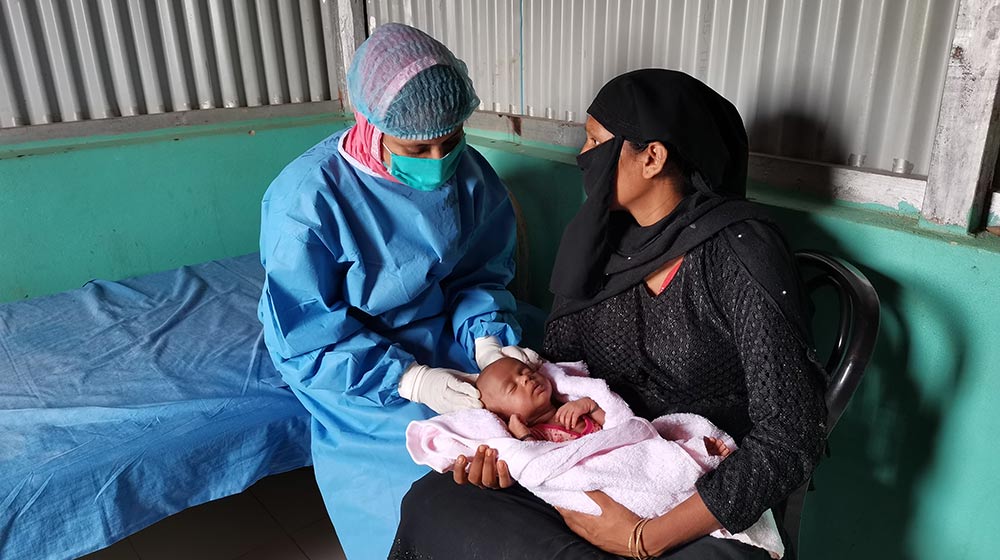
Midwife Rotna speaks with Minara about her newborn baby. Maternal health services are continuing despite the pandemic. © UNFPA
Today, there are around 1 million Rohingya refugees living in Bangladesh. Nearly 90 per cent of them are living in a network of 30-plus camps in Cox’s Bazar District, where crowding and sanitation conditions leave them vulnerable to the COVID-9 pandemic.
But close collaboration between humanitarian partners – including UNFPA – and the Government of Bangladesh has managed to limit the spread of the coronavirus within the camps.
read more »
Posted in Asia, Market Lords, Migrants and Refugees, Others-USA-Europe-etc., The Peoples, War Lords |
Leave a Comment »


 HUMAN WRONGS WATCH