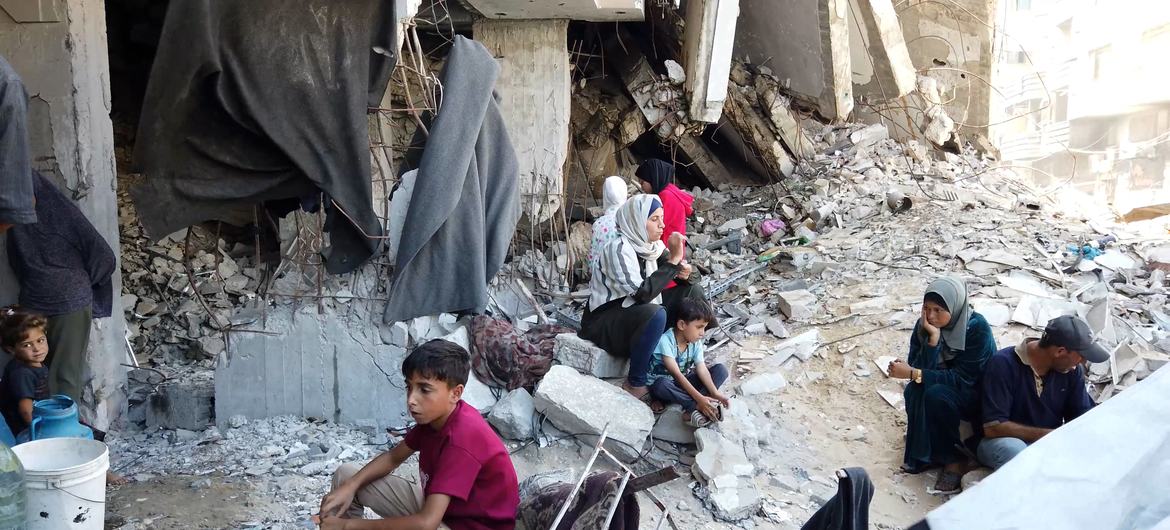
(UN News)* —The Israeli military has escalated attacks across Gaza City, reportedly deciding to press ahead with plans to take full control which will only lead to further “mass killings of civilians” and displacement, UN human rights officials warned on Wednesday [].
UN News | Displaced people from Jabalia, Gaza, live in a destroyed building in downtown Gaza City.
Recent attacks have been particularly devastating in the Az Zaytoun neighbourhood, where airstrikes, artillery shelling and gunfire are continuous and intense, causing a high number of civilian casualties and the large-scale destruction of residential buildings and public facilities, the UN human rights office, OHCHR, in the Occupied Palestinian Territory said in a statement.
13 Aug 2025 – But did you know? Is this discussed now when the UN turn 80 in October? No, politicians, media and scholars generally focus on war and ignore humanity’s most important peace-maker.
“UNITED NATIONS, Aug 12 2025 (IPS) – The United Nations, facing a liquidity crisis, has been threatening to lay-off about 20 percent of its estimated 37,000 employees world-wide: a proposed move that has triggered widespread protests from staff unions both in New York and Geneva.”
UNITED NATIONS, Aug 18 2025 (IPS)* –When the 193-member General Assembly commemorates the UN’s 80th anniversary during a high-level meeting in mid-September, how many political leaders and delegates will be barred from entering the United States –despite the 1947 US-UN Host Country Agreement?
.
The preambular words of the UN Charter displayed at the United Nations Headquarters, in New York. Credit: UN Photo/Mark Garten
This White House proclamation –a virtual black List –restricts travel into the U.S. by nationals from 19 countries who will be refused US visas.
The list includes Afghanistan, Myanmar, Burundi, Chad, Republic of the Congo, Cuba, Equatorial Guinea, Eritrea, Haiti, Iran, Laos, Libya, Sierra Leone, Somalia, Sudan, Togo, Turkmenistan, Venezuela, and Yemen. In addition, Egypt is under review.
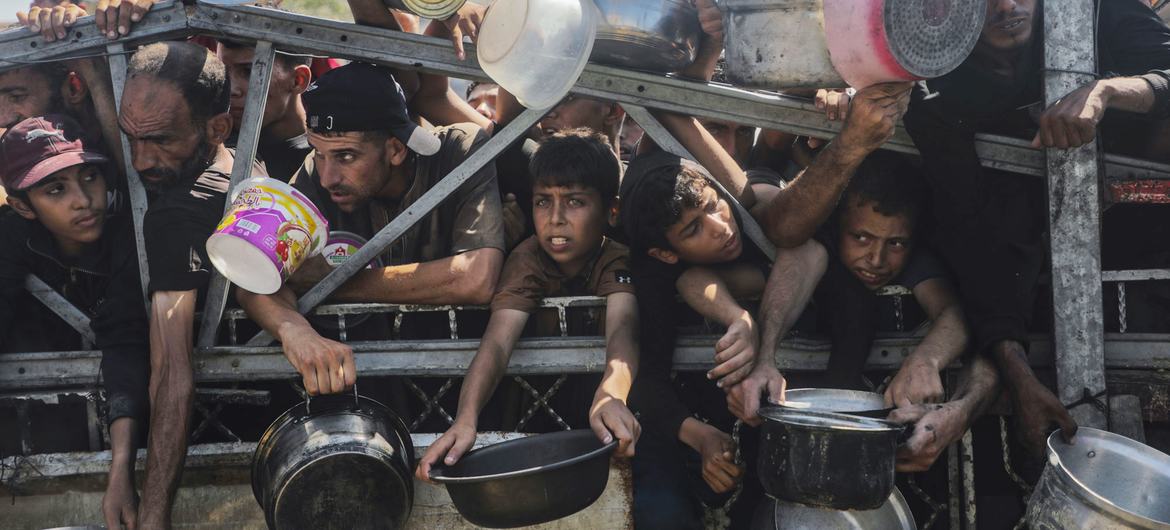
(UN News)* —The small trickle of aid entering Gaza is totally insufficient to alleviate starvation and displacement in the Strip, UN humanitarians said on Tuesday [].
“The risk of starvation is everywhere in Gaza,” UN Human Rights Office spokesperson Thameen Al-Kheetan told reporters in Geneva.
“This is a direct result of the Israeli government’s policy of blocking humanitarian aid,” he said.
Mr. Al-Kheetan insisted that in the past few weeks, Israeli authorities have only allowed aid to enter in quantities that remain “far below what would be required to avert widespread starvation”.
On 19 August, we mark the World Humanitarian Day — a time to honor those who step into crises to help others, and to stand with the millions of people whose lives hang in the balance.
PHOTO:United Nations
This year the message is clear: the humanitarian system is stretched to its limits; underfunded, overwhelmed and under attack.
Where bombs fall and disasters strike, humanitarian workers are the ones holding the line keeping people alive, often at great personal risk. But more and more those who help are becoming targets themselves.
In 2024 alone over 380 humanitarian workers were killed. Some in the line of duty, others in their homes. Hundreds more have been injured, kidnapped or detained, and there is reason to fear 2025 could be worse.
“The vast majority of governments want a strong agreement, yet a handful of bad actors were allowed to use process to drive such ambition into the ground,” said one environmentalist.
.
Plastic waste washes ashore in the Maldives archipelago. Credit: UNDP
NEW YORK, Aug 18 2025 (IPS)** –– Negotiators in Geneva adjourned what was expected to be the final round of plastics treaty negotiations on Friday [15 August 2025] without reaching an agreement, a failure that environmentalists blamed on the Trump-led United States, Saudi Arabia, and other powerful nations that opposed any effort to curb plastic production—the primary driver of a worsening global pollution crisis.
Al-Kufra, Libya, 11 August 2025 – Khartoum mornings once carried a familiar rhythm. The call to prayer echoed softly through the narrow streets, blending with the clatter of market stalls opening and the sound of children shuffling to school.
For 45-year-old NourAlhuda, life pulsed with structure and meaning.
She had spent 16 years teaching Arabic and Islamic studies, her voice steady and firm in the classroom, her presence respected in the community.
“Teaching was more than a job for me,” she explains. “It gave me purpose.”
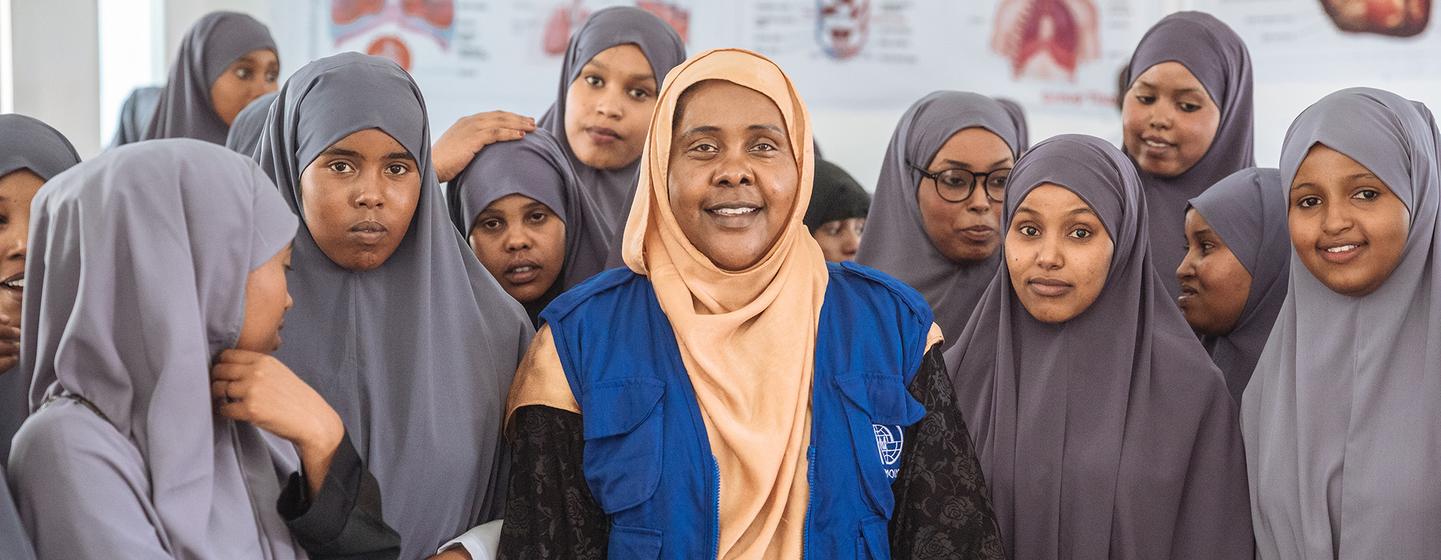
IOM’s health centre in Al-Kufra provides critical care and hope to displaced Sudanese women like NourAlhuda and Arafa. Photo: IOM 2024/Mouaid Tariq Duffani
(UN News)* — Adam Ibrahim was working with the UN humanitarian agency, OCHA, in his home country, Sudan, when conflict between rival armed forces erupted in early 2023 and he became a refugee alongside thousands of others who continue to flee the ongoing violence.
Sudan is one of the world’s largest and most complex humanitarian crises, with more than 30.4 million people – over half the population – urgently needing humanitarian assistance.
Yet the 2025 Sudan humanitarian needs and response plan is severely underfunded, with only 13.3 per cent of the required resources received so far.
UNITED NATIONS, Aug 15 2025 (IPS)* — Asia-Pacific’s midwives are a healthcare lifeline capable of delivering nearly 90 percent of essential maternal and newborn services. Yet the region grapples with severe shortages, underinvestment, and systemic neglect.
Strong health systems start with midwives. Credit: Unsplash
The newly released State of Asia’s Midwifery 2024 Report, released by the United Nations Population Fund (UNFPA), reveals that despite midwives’ lifesaving potential, many countries lack enough workers, face poor training and support systems, and struggle with weak policy backing.
The findings underscore an urgent need to elevate midwives from auxiliary roles to central pillars of health systems across the region.
Armed conflict, climate shocks and economic downturn drive out local experts who take with them the know-how that is essential to reversing the crisis.
So the crisis continues. And the brain drain intensifies.
 .
.



 HUMAN WRONGS WATCH