27/05/2021
There is a 90% likelihood of at least one year between 2021-2025 becoming the warmest on record, which would dislodge 2016 from the top ranking, according to
the Global Annual to Decadal Climate Update, produced by the United Kingdom’s Met Office, the WMO lead centre for such predictions.
read more »
Posted in Africa, Asia, Climate Crisis, Latin America & Caribbean, Market Lords, Middle East, Migrants and Refugees, Mother Earth, Others-USA-Europe-etc., The Peoples |
Leave a Comment »
26/05/2021
By John Scales Avery*
A new freely downloadable book

John Scales Avery
I would like to announce the publication of a book which discusses the duty of scientists and engineers to try to prevent the catastrophes that currently threaten human society and the biosphere.
The book may be freely downloaded and circulated from the following link:
http://eacpe.org/app/wp-content/uploads/2021/05/The-Social-Responsibility-Of-Scientists-by-John-Scales-Avery.pdf
Three major threats to human society
Science and technology have conferred many benefits on human society, but as we start the 21st century, most thoughtful observers believe that our science-driven and information-driven industrial civilization has entered a period of crisis.
All indices are increasing rapidly – population, total wealth, industrial output, rates of scientific discovery, and so on. But it is clear that the total human footprint on the face of nature has become too great.
read more »
Posted in Africa, Asia, Climate Crisis, Latin America & Caribbean, Market Lords, Middle East, Migrants and Refugees, Mother Earth, Others-USA-Europe-etc., The Peoples |
Leave a Comment »
26/05/2021
World set to miss environment-related Sustainable Development Goals – UN report
.

Nairobi (UNEP)* – Despite progress in key environmental areas such as clean water, sanitation, clean energy, forest management and waste, countries are still living unsustainably and are on course to miss the environmental dimensions of the 2030 Agenda for Sustainable Development, according to the Measuring Progress: Environment and the SDGs report.
read more »
Posted in Africa, Asia, Climate Crisis, Latin America & Caribbean, Market Lords, Middle East, Migrants and Refugees, Mother Earth, Others-USA-Europe-etc., The Peoples |
Leave a Comment »
26/05/2021
MONTREAL/VICTORIA, Canada, May 26 2021 (IPS)* – Over the past 75 years, there have been many UN Security Council (UNSC) resolutions acknowledging Israel’s violations of international law, including a Resolution under Chapter VI of the UN Charter, that could have addressed, if implemented, the plight of the Palestinians.

A tower block lies in ruins in Gaza city following an Israeli air strike. The humanitarian community has welcomed the ceasefire agreed in the Occupied Palestinian Territory and Israel but warned that the destruction in Gaza will take years, if not decades, to fix. Credit: UNRWA/Mohamed Hinnawi
read more »
Posted in Asia, Market Lords, Middle East, Migrants and Refugees, Mother Earth, Others-USA-Europe-etc., The Peoples, War Lords |
Leave a Comment »
26/05/2021

Celebrations to mark Timor-Leste’s independence in 2002 were held in the capital Dili. | UN Photo / Sergey Bermeniev
25 May 2021 (United Nations)* — In the UN Charter, a Non-Self-Governing Territory is defined as a Territory “whose people have not yet attained a full measure of self-government.”
In 1946, several UN Member States identified a number of Territories under their administration that were not self-governing and placed them on a UN list.
read more »
Posted in Africa, Asia, Latin America & Caribbean, Market Lords, Middle East, Migrants and Refugees, Mother Earth, Others-USA-Europe-etc., The Peoples, War Lords |
Leave a Comment »
26/05/2021
25 May 2021 — As those individuals aware of it will have observed, presumably with deep regret, the latest ‘International Day for Biological Diversity’ passed on 22 May with the bulk of the human population continuing to act in ways that destroy Earth’s biosphere at an ever-accelerating rate.

Robert J. Burrowes
Unaware that many authors continue to report the ongoing destruction of Earth’s biodiversity, which is under siege on a range of fronts by unchecked human destruction of Earth’s biosphere as well as particular assaults on Earth’s living creatures, responses to this ‘hidden’ path to human extinction continue to waver between non-existent and token.
Consequently, in such circumstances, the destruction of biodiversity might yet become the means by which Homo sapiens is consigned to the fossil record ‘beating’ nuclear war, the climate catastrophe and electromagnetic radiation as the fundamental driver of extinction.
read more »
Posted in Africa, Asia, Climate Crisis, Latin America & Caribbean, Market Lords, Middle East, Migrants and Refugees, Mother Earth, Others-USA-Europe-etc., The Peoples, War Lords |
Leave a Comment »
25/05/2021
Projects to restore seagrass are gathering pace.
25 May 2021 (UNEP)* — From the Gazi Bay, in Kenya, to Maputo Bay, in Mozambique, all the way to Dale Bay in Wales, projects to restore seagrass are gathering pace.
read more »
Posted in Africa, Asia, Climate Crisis, Latin America & Caribbean, Market Lords, Middle East, Migrants and Refugees, Mother Earth, Others-USA-Europe-etc., The Peoples |
Leave a Comment »
25/05/2021
25 May 2021 (FAO)* — “We go to look for oysters in the mangroves to feed our families and for business. This is how I make a living. If I work for two to three days, I can earn money to cover my expenses,” says Fatou Sarr, President of the Women Transformers Group of Diamniadio, a cooperative and producers’ organization that supports small-scale oyster producers.
With backing from FAO and the Coastal Fisheries Initiatives, communities are on a mission to save natural habitats like mangroves to safeguard their local environments. ©FAO/Yacine Cissé
Posted in Africa, Asia, Climate Crisis, Latin America & Caribbean, Market Lords, Middle East, Migrants and Refugees, Mother Earth, Others-USA-Europe-etc., The Peoples |
Leave a Comment »
25/05/2021
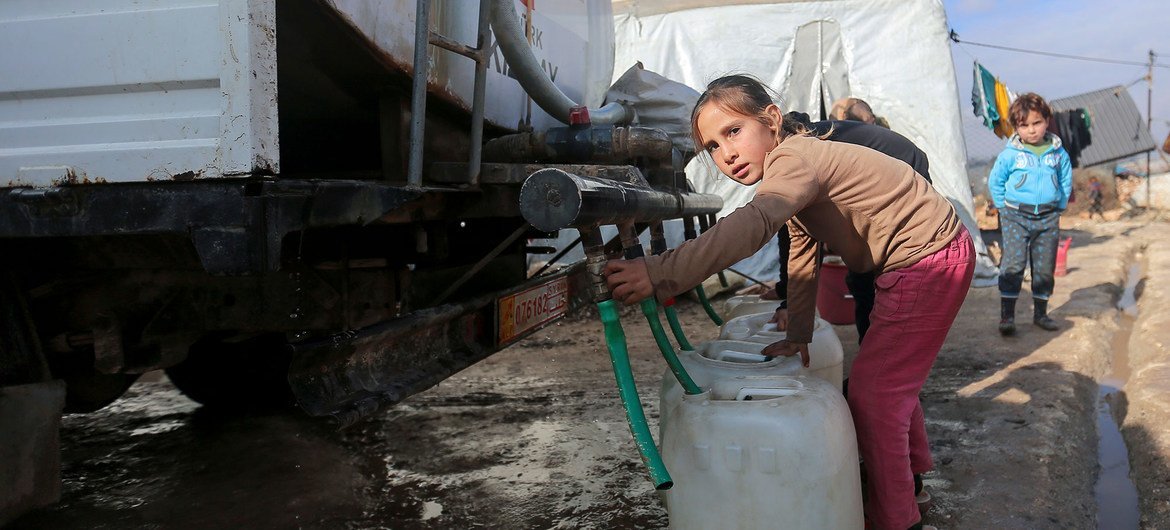
(UN News)* — Attacks on water and sanitation facilities in conflict zones around the world are putting the lives of millions of children around the world in danger, and are a much greater threat than violence itself, warns the UN Children’s agency, UNICEF, in a report released on 25 May 2021.
.
© UNICEF/Khaled Akacha | A young girl collects water from a tanker truck in an IDP camp in northwest Syria.
.
Water Under Fire Volume 3, highlights that children’s access to water has been threatened in nearly every conflict-related emergency where UNICEF is responding.
read more »
Posted in Africa, Asia, Climate Crisis, Latin America & Caribbean, Market Lords, Middle East, Migrants and Refugees, Mother Earth, Others-USA-Europe-etc., The Peoples, War Lords |
Leave a Comment »
23/05/2021
Posted in Africa, Asia, Climate Crisis, Latin America & Caribbean, Market Lords, Middle East, Migrants and Refugees, Mother Earth, Others-USA-Europe-etc., The Peoples, War Lords |
Leave a Comment »



 HUMAN WRONGS WATCH