As the climate warms, a destructive pest is spreading its wings and damaging the livelihoods of fruit growers in southern Africa. The invasive fruit fly, Bactrocera dorsalis, is preventing farmers like Susan Zinoro, a mango farmer from Mutoko, Zimbabwe, from literally and figuratively enjoying the fruits of their labour.
Mango farmers Susan and Batsirai Zinoro from Mutoko District, Zimbabwe are using Integrated Pest Management methods to control a fruit fly pest. Credit: Busani Bafana/IPS
BULAWAYO, Zimbabwe, Feb 23 2021 (IPS)* – Every harvest season, Susan Zinoro, a mango farmer from Mutoko, Zimbabwe, buries half the mangoes she’s grown that season. They have already started rotting either on the tree or have fallen to the ground before harvest. It’s a difficult task for Zinoro because she knows she is throwing away food and income meant for her family.
Implementation of nature-based solutions has been growing. But there is an urgent need to gather more evidence on the outcomes of adaption projects worldwide. As temperatures rise and climate change impacts intensify, nations must urgently step up action to adapt to the new climate reality or face serious costs, damages and losses, the 2020 edition of the UN Environment Programme (UNEP) Adaptation Gap Report finds.*
(UNEP)* — Implementation of nature-based solutions has been growing worldwide for the past two decades. Since 2006, multilateral funds serving the Paris Agreement have backed around 400 adaptation projects in developing countries, half of which started after 2015. The majority focus on agriculture and water, with drought, rainfall variability, flooding and coastal impacts.
23 February 2021 (UN News)* — People living in low-income countries are at least four times more likely to be displaced by extreme weather compared to people in rich countries, despite being the least responsible for climate change, that’s according to the UN’s humanitarian office, OCHA.
.
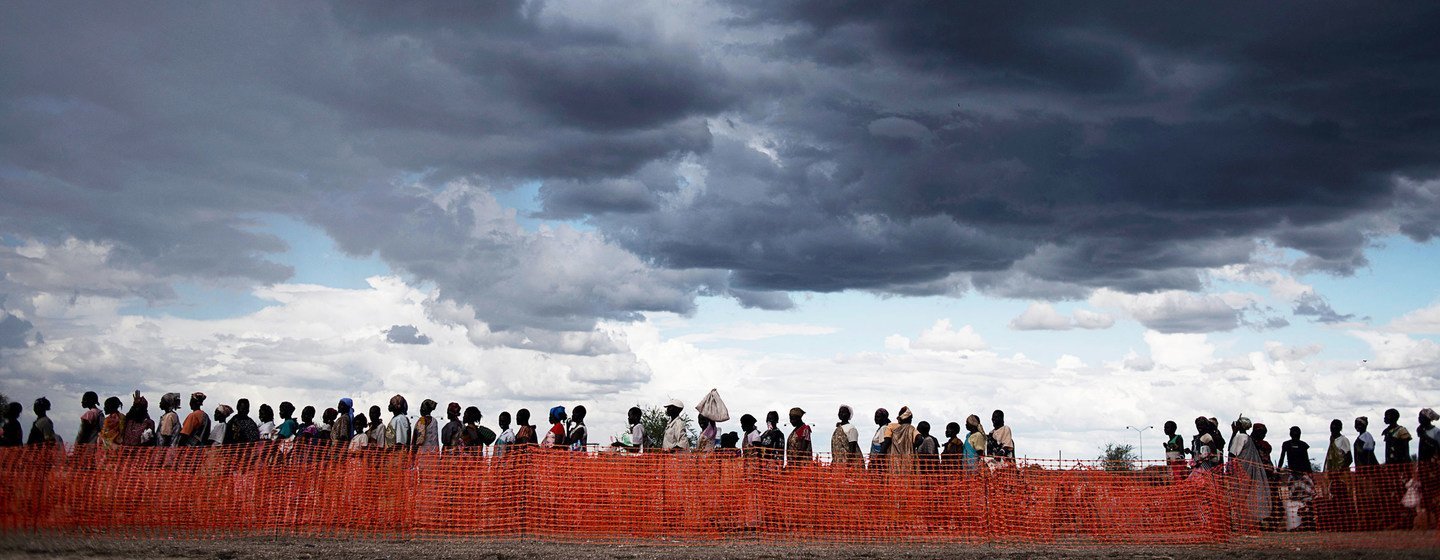
IRIN/Jacob Zocherman | The most vulnerable people in the world, like these displaced persons in South Sudan, are more likely to suffer from the effects of climate change.
.
The UN is warning that much more needs to be done to anticipate, and plan for, the extreme weather events that put millions in need of urgent assistance.
(UN News)* — During this time of “crisis and fragility”, the UN chief told the United Nations Environment Assembly on 22 February 2021 that human well-being and prosperity can be vastly improved by prioritizing nature-based solutions.
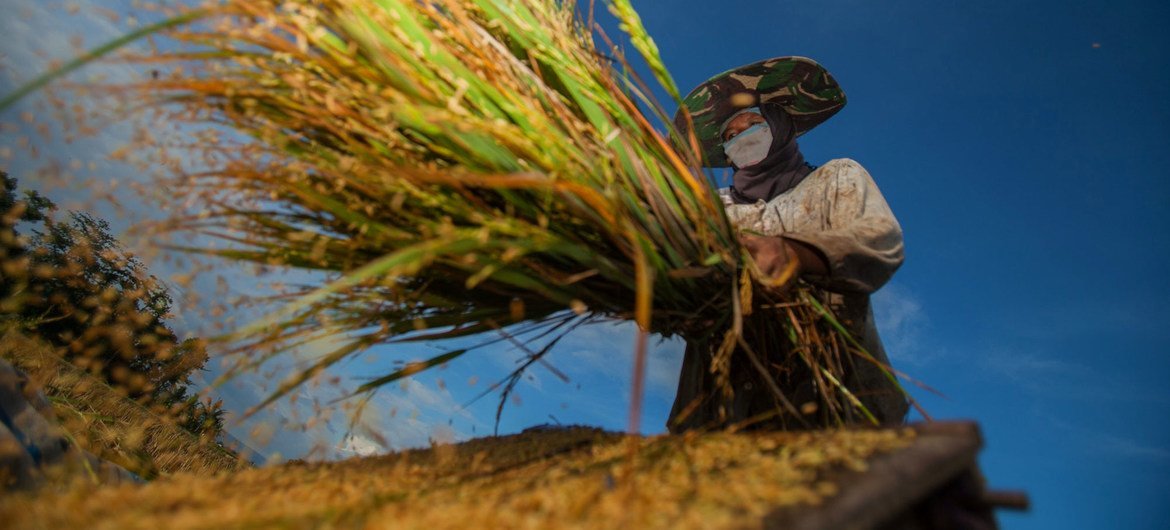
CIFOR/Tri Saputro | A farmer harvests rice in Bantaeng, Indonesia.
Painting a picture of the turmoil wreaked by COVID-19, whereby millions are being pushed into poverty, inequalities are growing among people and countries, and “a triple environmental emergency” of climate disruption, biodiversity decline and a pollution epidemic that is “cutting short some nine million lives a year”, UN Secretary-General António Guterres upheld in his video message that now is “a critical year to reset our relationship with nature.”
I am a child of the Ganga Himalaya , nourished materially and spiritually by Dev Bhoomi, our sacred land. The mountains , forests and Ma Ganga have shaped my imagination, my knowledge ,my science , my life , my activism.
Ankara, 20 February 2021 (IOM)* – Turkey, host to almost four million refugees and migrants, has established a dedicated United Nations Network on Migration (UNNM). The initiative flows from the 2018 Global Compact for Safe, Orderly and Regular Migration (GCM), the first cooperative framework addressing international migration.
.
As GCM convenor, IOM hosted a gathering in the Turkish capital Ankara on 18 February 2021, which brought together United Nations representatives to formally bring the country’s UNNM into being.
The world we live in has been built around an economic system that prioritises never-ending growth over the welfare of people and the planet. This system plunders our planet’s resources while oppressing our most vulnerable. It perpetuates structural inequalities and deepens the climate crisis and fossil fuels are at its core and is known as “Fossil Capital”.
20 February 2021 (UNEP)* — The COVID-19 pandemic is drawing young people around the world into the fight against climate change, as witnessed this week during the Youth Environment Assembly.
Photo: IISD/19 Feb 2021
The gathering, which is being held virtually, as part of the UN Environment Assembly, is the planet’s largest youth-led environmental event. It has zeroed in on climate change, which participants described as a dire threat to the planet.
19 February 2021 (WMO)* — Large swathes of North America have been gripped by cold and heavy snowfall, causing loss of life, major traffic chaos and power outages for millions of people. The prolonged freeze, which saw many new record cold maximum and minimum temperatures, was caused by an Arctic blast of air moving down from Canada all the way into Texas.
More than 100 million people over 1.6 million km² were under winter storm warnings, according to the US National Weather Service. Some 73% of the Continental USA was covered in snow as of midnight February 16, the greatest extent on record in the database, which dates back to 2003.
UNITED NATIONS, Feb 19 2021 (IPS)* – Yemen is heading towards the worst famine the world has seen in decades, the United Nations Security Council was warned in a briefing yesterday [18 February 2021].
Volunteers teach people living in settlements about COVID-19. This photo was taken in Sana’a, Yemen. At a Security Council briefing yesterday UN Under Secretary-General for Humanitarian Affairs and Emergency Relief Coordinator said people in Yemen are more worried about hunger than the COVID-19 pandemic. Credit: Dhia Al-Adimi/UNICEF





 HUMAN WRONGS WATCH