29/11/2020
The body – which is designed to ensure that the
Principles for Responsible Banking remain relevant and that the signatories are accountable to civil society – is the only instance of a sustainable finance initiative having such significant civil society input.
read more »
Posted in Africa, Asia, Climate Crisis, Latin America & Caribbean, Market Lords, Middle East, Migrants and Refugees, Mother Earth, Others-USA-Europe-etc., The Peoples, War Lords |
Leave a Comment »
29/11/2020
Mario Lubetkin is Assistant Director General at the Food and Agriculture Organization of the United Nations (FAO)
ROME, Nov 27 2020 (IPS)* – Overcoming the digital gap to face food insecurity with the use of artificial intelligence practices in agriculture is part of a growing debate that seeks to simultaneously safeguard natural resources and address the difficulties generated by climate change and the implications of the COVID-19 pandemic.
 Digital technologies are changing agriculture and food systems. It is important to bridge the digital gap in this sector so that family farmers in developing countries are not left behind as food security depends on them. Credit: FAO.
read more »
Posted in Africa, Asia, Climate Crisis, Latin America & Caribbean, Market Lords, Middle East, Migrants and Refugees, Mother Earth, Others-USA-Europe-etc., The Peoples |
Leave a Comment »
29/11/2020
International Day of Solidarity with the Palestinian People
Foreword
United Nations* — This study has been prepared by the Division for Palestinian Rights of the United Nations Secretariat for, and under the guidance of, the Committee on the Exercise of the Inalienable Rights of the Palestinian People, in pursuance of General Assembly resolution 32/40 B of 2 December 1977.

UN Photo
The study was published in keeping with the following guiding principles suggested by the Committee:
“The study should place the problem in its historical perspective, emphasizing the national identity and rights of the Palestinian people. It should survey the course of the problem during the period of the League of Nations Mandate and show how it came before the United Nations. It should also cover the period of United Nations involvement in the problem.”
Posted in Africa, Asia, Market Lords, Middle East, Migrants and Refugees, Mother Earth, Others-USA-Europe-etc., The Peoples, War Lords |
Leave a Comment »
29/11/2020
29 November 2020 (UN News)* — Commemorating the International Day of Solidarity with the Palestinian People, UN Secretary-General António Guterres urged Israeli and Palestinian leaders to explore every opening to “restore hope” for a two-State solution.
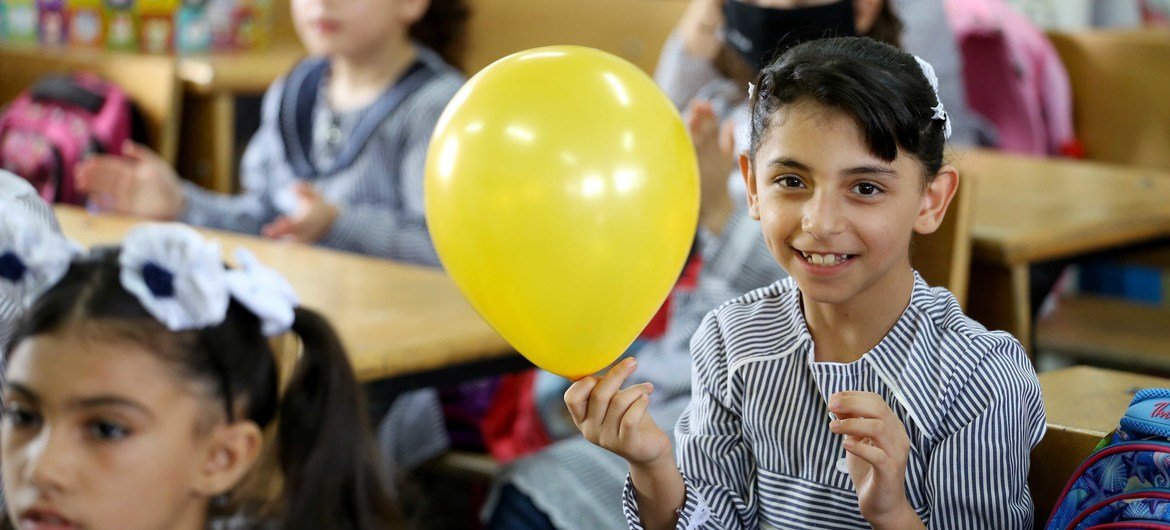
UNRWA/Khalil Adwan | Palestine refugee students in a classroom at an UNRWA elementary co-ed school.
In a message, the UN chief cautioned that prospects for a viable two-State solution are becoming “more distant”.
“A host of factors continue to cause great misery, including: the expansion of illegal settlements, a significant spike in the demolition of Palestinian homes and structures, violence and continued militant activity,” said Mr. Guterres.
read more »
Posted in Africa, Asia, Market Lords, Middle East, Migrants and Refugees, Mother Earth, Others-USA-Europe-etc., The Peoples, War Lords |
Leave a Comment »
28/11/2020
18 November 2020 (UNEP)* — Today, when students file into the lunchroom at Mundika High School in western Kenya, they are greeted by a spread of nutritious local vegetables with exotic-sounding names, like spider plant. But that wasn’t always the case. Just a few years ago, that fare had largely disappeared from Kenyan plates, replaced by cheaper foreign-derived foods, like cabbage and maize meal.
 Photo: Aurillia Manjella / 18 Nov 2020
“The first time we introduced indigenous African leafy vegetables in a school meal programme, we didn’t know how the students would respond,” said Aurillia Manjella, an agricultural consultant who helped Mundika high, and several other schools, integrate traditional foods into their menus.
read more »
Posted in Africa, Asia, Climate Crisis, Latin America & Caribbean, Market Lords, Middle East, Migrants and Refugees, Mother Earth, Others-USA-Europe-etc., The Peoples |
Leave a Comment »
28/11/2020
By Frederica Barclay*
27 November 2020 (IWGIA)* — In Peru, the Bagua Massacre prompted the adoption of the ILO Convention 169 in response to local demands and international pressure. However, far from respecting the communities’ decision, this has led to simulations of consultations that prevent the Indigenous Peoples from exercising their right to autonomy and self-determination. The consultation process, as outlined by the State, has become a threat.
 Prior consultation for lot 192 in 2015. Photo: PUINAMUDTThe obligation of States to conduct processes of free, prior and informed consultation and to obtain the consent of the Indigenous or original peoples is a right established by Convention 169 of the International Labour Organization (ILO) in 1989 and was one of the major vindications enshrined in this global instrument.
read more »
Posted in Africa, Asia, Climate Crisis, Latin America & Caribbean, Market Lords, Middle East, Migrants and Refugees, Mother Earth, Others-USA-Europe-etc., The Peoples, War Lords |
Leave a Comment »
28/11/2020
UNITED NATIONS, Nov 27 2020 (IPS)* – The numbers are staggering— as reflected in the ongoing coronavirus pandemic which has triggered a new round of food shortages, famine and starvation.
 In 2019, Ethiopia experienced the fifth-worst food crisis worldwide. Credit: FAO/IFAD/WFP/Michael Tewelde
According to the Rome-based World Food Programme (WFP) 690 million people do not have enough to eat. while 130 million additional people risk being pushed to the brink of starvation by the end of the year.
“Hunger is an outrage in a world of plenty. An empty stomach is a gaping hole in the heart of a society,” Secretary-General Antonio Guterres said last week pointing out that famine is looming in several countries.
read more »
Posted in Africa, Asia, Climate Crisis, Latin America & Caribbean, Market Lords, Middle East, Migrants and Refugees, Mother Earth, Others-USA-Europe-etc., The Peoples, War Lords |
1 Comment »
28/11/2020
By UNICEF Executive Director Henrietta Fore*
NEW YORK, 25 November 2020 – “UNICEF urges parties to the conflict in Ethiopia to spare children from the impact of hostilities in the Tigray region, now in their third week.
.
“Some 500,000 people live in Mekelle, half of them are children. UNICEF is deeply alarmed that the two parties’ threat of a further escalation in the fighting would put their lives and well-being at immediate risk.
read more »
Posted in Africa, Asia, Latin America & Caribbean, Market Lords, Middle East, Migrants and Refugees, Mother Earth, Others-USA-Europe-etc., The Peoples, War Lords |
Leave a Comment »
27/11/2020
25 November 2020 (Wall Street International)* — The recent meeting of the G20 – scheduled to take place in Riyadh but held virtually due to the Coronavirus pandemic – has been an eloquent example of how the world is drifting, in a crisis of leadership. It was, in a sense, a showcase.
Everybody had to accept the view that the host of the meeting, the ailing King Salman of Saudi Arabia, was accompanied on TV screens by his apparent heir, Prince Mohamed bin Salman, who is clearly the mastermind of the brutal assassination, dismembering and disappearance of the body of dissident Saudi journalist Jamal Khashoggi.
read more »
Posted in Africa, Asia, Climate Crisis, Latin America & Caribbean, Market Lords, Middle East, Migrants and Refugees, Mother Earth, Others-USA-Europe-etc., The Peoples, War Lords |
2 Comments »
27/11/2020
26 November 2020 (UNEP)* — Over the last 30 years, more and more tea, coffee and cocoa farmers have embraced towards climate-smart and sustainable practices by adopting “certification standards” that help to maintain soil quality, increase productivity and reduce costs. The standards also assure buyers of agricultural commodities that the products in their supply chains are environmentally sustainable.
 Photo by Rainforest Alliance / 26 Nov 2020
In July 2020, a milestone was reached when United Nations Environment Programme (UNEP) partner, the Rainforest Alliance, published its new unified standard (certification programme) for production systems that conserve biodiversity and ecosystem services.
The standard applies to over 5 million hectares of tropical farmland, impacting the livelihoods of over 2 million farming families.
read more »
Posted in Africa, Asia, Latin America & Caribbean, Market Lords, Middle East, Migrants and Refugees, Mother Earth, Others-USA-Europe-etc., The Peoples |
Leave a Comment »



 HUMAN WRONGS WATCH