19/09/2020
Closing the coverage gap, worsened by COVID-19, will require additional sources of financing says a new ILO study.
Posted in Africa, Asia, Climate Crisis, Latin America & Caribbean, Market Lords, Middle East, Migrants and Refugees, Mother Earth, Others-USA-Europe-etc., The Peoples, War Lords |
Leave a Comment »
16/09/2020
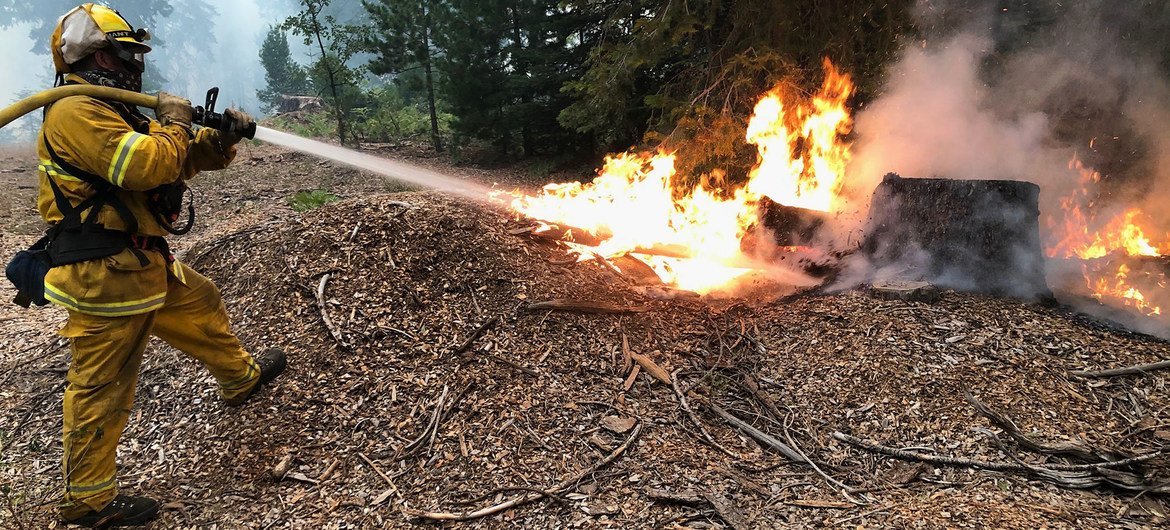
(UN News)* — The northern hemisphere experienced its warmest August ever, the World Meteorological Organization (
WMO) said on Tuesday
[15 September 2020], amid searing conditions that have contributed to devastating wildfires on the west coast of the United States.
.
San Francisco Fire Department | More than 78,000 acres of forest in the Sierra mountains in California has been lost due to wildfires.
“The northern hemisphere just had its hottest summer on record”, said Clare Nullis, WMO spokesperson.
Posted in Climate Crisis, Migrants and Refugees, Mother Earth, Others-USA-Europe-etc., The Peoples |
Leave a Comment »
16/09/2020
We have known for a long time that biodiversity, and the services it provides, have been in decline. It is on this background that ten years ago, the international community adopted the Strategic Plan for Biodiversity 2011-2020. The goal of the plan, and its Aichi Biodiversity Targets, was to halt biodiversity loss and ensure that ecosystems continued to provide essential services.

Photo by Unsplash
Posted in Africa, Asia, Climate Crisis, Latin America & Caribbean, Market Lords, Middle East, Migrants and Refugees, Mother Earth, Others-USA-Europe-etc., The Peoples |
Leave a Comment »
15/09/2020
Lessons for today from the 1960’s
Everyone agrees that the 1960’s were very special. Those of us who lived through that era remember it as a time when the danger of a nuclear war between the United States and the Soviet Union was very real indeed.

John Scales Avery
The world came extremely close to disaster during the Cuban Missile Crisis.
In response to the threat of nuclear destruction, there were massive public protests against nuclear weapons. Millions of people all over the world took to the streets.
Where is that passion and engagement today? When the Cold War supposedly ended with the fall of the Berlin Wall, everyone heaved a sigh of relief, and decided that the threat of global nuclear annihilation had gone away. But it has not gone away. It is still with us, and is perhaps greater today than ever before. Why do we not protest? Where are the millions of protesters that we saw in the 1960’s?
read more »
Posted in Africa, Asia, Climate Crisis, Latin America & Caribbean, Market Lords, Middle East, Migrants and Refugees, Mother Earth, Others-USA-Europe-etc., The Peoples, War Lords |
Leave a Comment »
14/09/2020
By Robert J. Burrowes*
On 16 August 1819, an estimated 60,000 pro-democracy and anti-poverty activists were peacefully protesting the utterly corrupt nature of the Parliament in Westminster and demanding the reform of parliamentary representation (which afforded less than 2% of people the right to vote).

Robert J. Burrowes
The gathering took place in St Peter’s Field, Manchester in England.
The protest was precipitated by the acute economic slump, including chronic unemployment and harvest failure, following the conclusion of the Napoleonic Wars as well as by enforcement of the Corn Laws which kept the price of bread high, by blocking (or imposing tariffs on) the import of cheap grains, at the expense of ordinary people.
read more »
Posted in Africa, Asia, Climate Crisis, Latin America & Caribbean, Market Lords, Middle East, Migrants and Refugees, Mother Earth, Others-USA-Europe-etc., The Peoples, War Lords |
Leave a Comment »
13/09/2020
It is hard to know where things began when we are already in the middle of it all
12 September 2020 (Wall Street International)* — It is hard to know where things began when we are already in the middle of it all. This is especially so as we suffer through today’s difficult, complicated and partially obfuscated time. Perhaps the beginning occurred in 1865 when the American Civil War was officially declared ended, but continued to seethe in less organized ways.
read more »
Posted in Africa, Asia, Climate Crisis, Latin America & Caribbean, Market Lords, Middle East, Migrants and Refugees, Mother Earth, Others-USA-Europe-etc., The Peoples |
Leave a Comment »
13/09/2020
10 September 2020 (UN Environment)* — They say a picture is worth a thousand words, a map could be worth a million. To understand the complex interactions between nature and human society, the United Nations Environment Programme (UNEP) has teamed up with MapX – an online platform for managing geospatial data on natural resources.
 Glacial lakes in Bhutan. Photo: NASA 2016
“Nature’s value is often invisible in the economic choices we make,” said Salman Hussain, Head of Ecosystem Services Economics at UNEP.
“As a result, we have been drawing down our natural capital without accounting for the costs of nature’s ability to provide humanity with essential services.”
Posted in Africa, Asia, Latin America & Caribbean, Market Lords, Middle East, Migrants and Refugees, Mother Earth, Others-USA-Europe-etc., The Peoples |
Leave a Comment »
13/09/2020
 With a narrative label that tells its backstory, Jumla bean sales are up, and business is looking bright for Lalita and her family. ©Organic World and Fair Future Pvt. Ltd.
The Sinja Valley in northwest Nepal is a breathtaking place with a rich history. Plunging mountainsides and rocky caves hide ruins of grand palaces and temples: remains of the capital city of the influential Western Malla kingdom that ruled the area between the 12th and 14th century.
read more »
Posted in Africa, Asia, Latin America & Caribbean, Market Lords, Middle East, Mother Earth, Others-USA-Europe-etc., The Peoples |
Leave a Comment »
12/09/2020
Many farmers feel they have no option but to burn their crop residues to dispose of them, but innovative solutions can turn them into sustainable energy for communities. ©CIAT/Neil Palmer
7 September 2020 (FAO)* — The problem? Burning crop residues. Although it causes a variety of health issues and significantly raises levels of pollution, it is a common practice in India and many other countries around the world. The solution? Turn the crop residues into something useful, such as bioenergy.
read more »
Posted in Africa, Asia, Climate Crisis, Latin America & Caribbean, Market Lords, Middle East, Mother Earth, Others-USA-Europe-etc., The Peoples |
Leave a Comment »


 HUMAN WRONGS WATCH