Instead of buying into the World Economic Forum’s dystopian “Great Reset,” we can build an alternative system with a mandate to serve the people.
This is part two to a May 5, 2022 article called “A Monetary Reset Where the Rich Don’t Own Everything,” the gist of which was that national and global debt levels are unsustainably high. We need a “reset,” but of what sort?
Ellen Brown
The “Great Reset” of the World Economic Forum (WEF) would leave the people as non-owner tenants in a feudalistic technocracy.
The reset of the Eurasian Economic Union would allow participating nations to opt out of the Western capitalist system altogether, but what of the Western countries that are left? That is the question addressed here.
Our Forefathers Had Some Innovative Solutions
Fortunately for the United States, our national debt is in U.S. dollars. As former Federal Reserve Chairman Alan Greenspan once observed, “The United States can pay any debt it has because we can always print money to do that. So there is zero probability of default.”
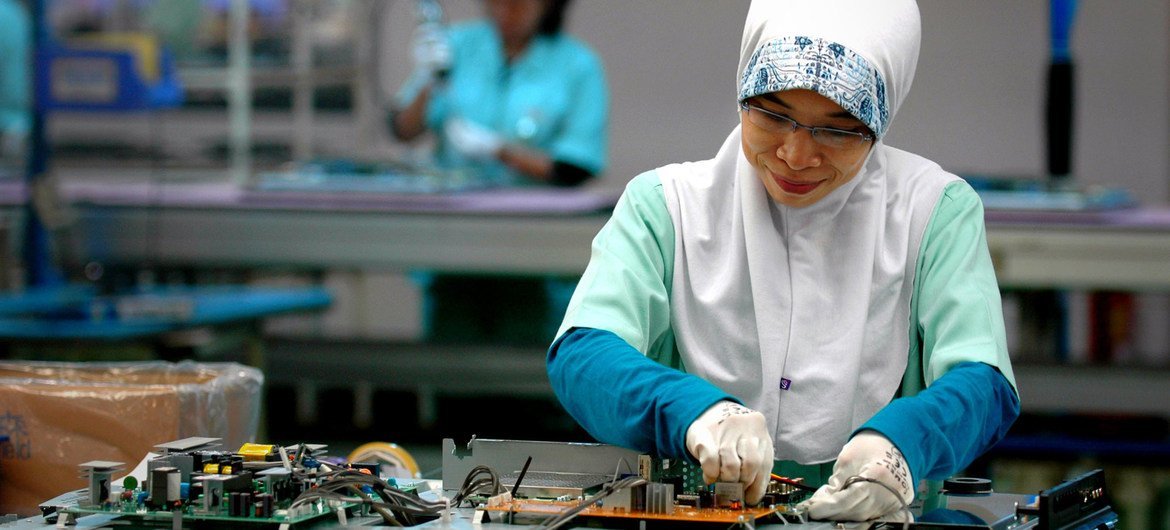
(UN News)* — The recovery of the global jobs market is going into reverse, the UN labour agency, ILO, said on Monday [23 May 2022], blaming COVID-19 and “other multiple crises” that have increased inequalities within and between countries.
In its latest update on the world of work, International Labour Organization Director-General Guy Ryder said that although there had been “tentative signs of recovery in the final months of last year, with global employment returning to higher levels in industrialised nations”, rising food and fuel prices and financial turbulence have destabilised the job market.
(UN News)* — With a scorching summer fast approaching, food prices rising and access to water and electricity limited in many parts of Syria, donors must make good on $4.3 billion in humanitarian pledges committed at last week’s Brussels funding conference, the UN’s senior humanitarian official told the Security Council on Friday [20 May 2022].
Martin Griffiths, Humanitarian Affairs chief and Emergency Relief Coordinator, thanked donors for their contributions – totalling nearly $6.7 billion – which includes $2.4 billion earmarked for 2023 and beyond.
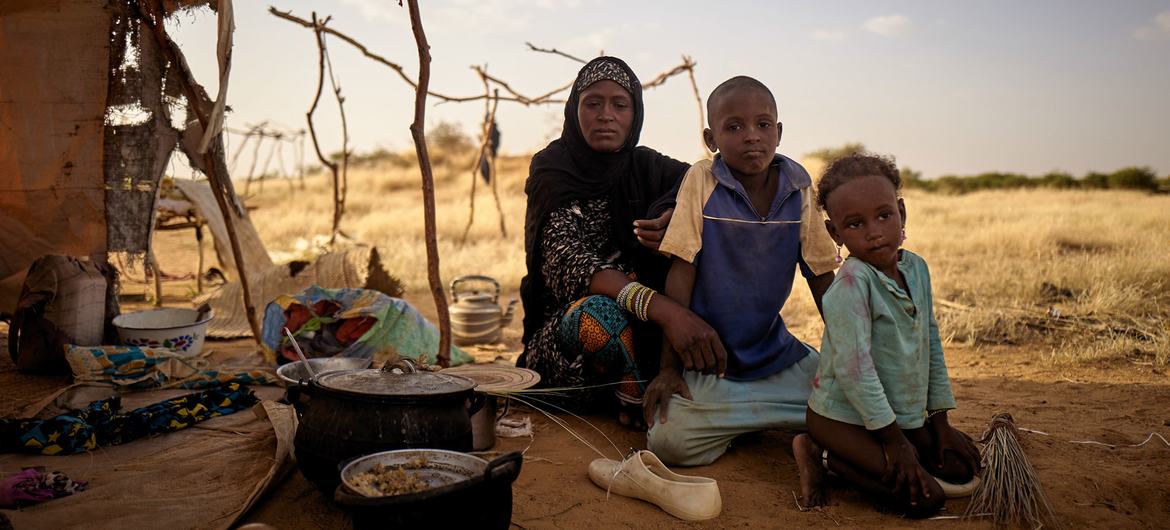
(UN News)*– As 18 million people in Africa’s Sahel region teeter on the edge of severe hunger over the next three months, the UN released on Friday [20 May 2022] an additional $30 million from its emergency humanitarian fund, to boost the humanitarian response across four countries.
Food insecurity is set to reach its highest level since 2014, warned the UN Office for the Coordination of Humanitarian Affairs (OCHA).
“Entire families in the Sahel are on the brink of starvation,” said Martin Griffiths, UN Humanitarian Affairs chief and Emergency Relief Coordinator. “If we don’t act now, people will perish”.
Sobering numbers
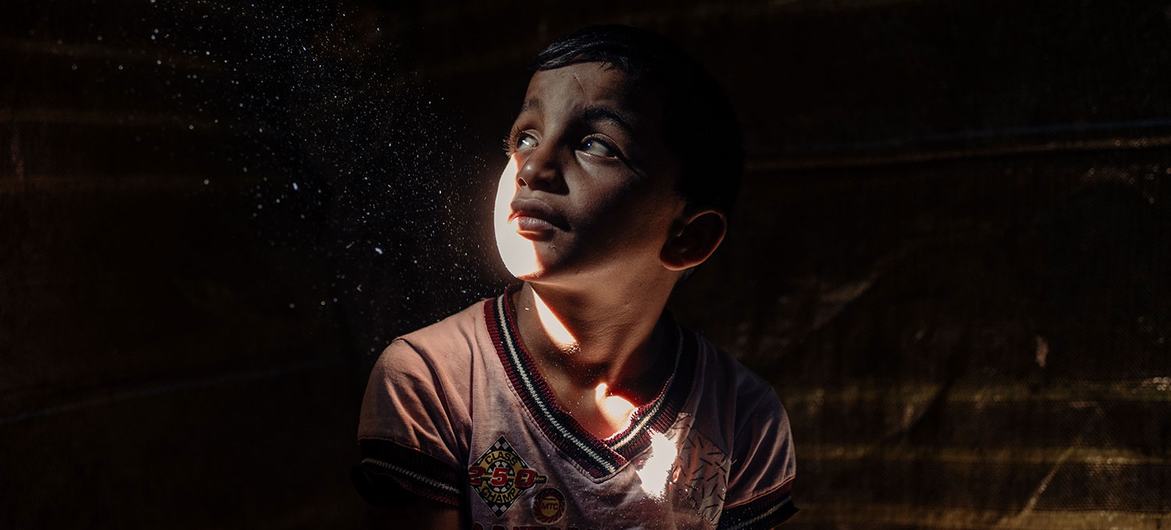
In the Sahel, 7.7 million children under five are expected to suffer from malnutrition, of which 1.8 million are severely malnourished.
And if aid operations are not scaled up, this number could reach 2.4 million by the year’s end.
MADRID, May 20 2022 (IPS)* – It is often said that a pessimistic person is an optimistic but well-informed person. Here, a good number of people may believe that human wit and inventiveness are capable of facing both the current and the looming disasters, like the impact of climate change, for instance.
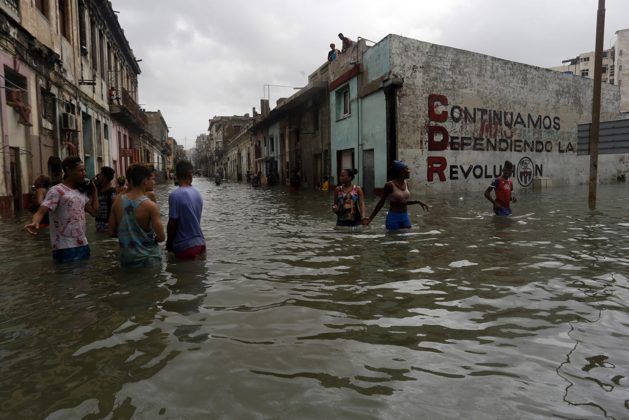
“The good news is that human decisions are the largest contributors to disaster risk, so we have the power to substantially reduce the threats posed to humanity, and especially the most vulnerable among us” Credit: Jorge Luis Baños/IPS
Others, instead, may think that such human ingenuity will once more address the symptoms rather than the causes provoking them. Thus, they would be right to want to be informed and aware of the root causes of such disasters in order to push for eradicating them.
“What are the roots that clutch, what branches grow / Out of this stony rubbish? Son of man, / You cannot say, or guess, for you know only / A heap of broken images, where the sun beats, / And the dead tree gives no shelter, the cricket no relief, / And the dry stone no sound of water. Only / There is shadow under this red rock, / (Come in under the shadow of this red rock), / And I will show you something different from either / Your shadow at morning striding behind you / Or your shadow at evening rising to meet you; / I will show you fear in a handful of dust.”
— T.S. Eliot, The Waste Land: I. The Burial of the Dead, 1922
Pepe Escobar
This glimpse of “fear in a handful of dust” already ranks as one the prime breakthroughs of the young 21st century, presented this week by Chief of Russian Radiation, Chemical, and Biological Protection Force Igor Kirillov.
The provisional results of evidence being collected about the work of U.S. bioweapons in Ukraine are simply astonishing. These are the main takeaways.
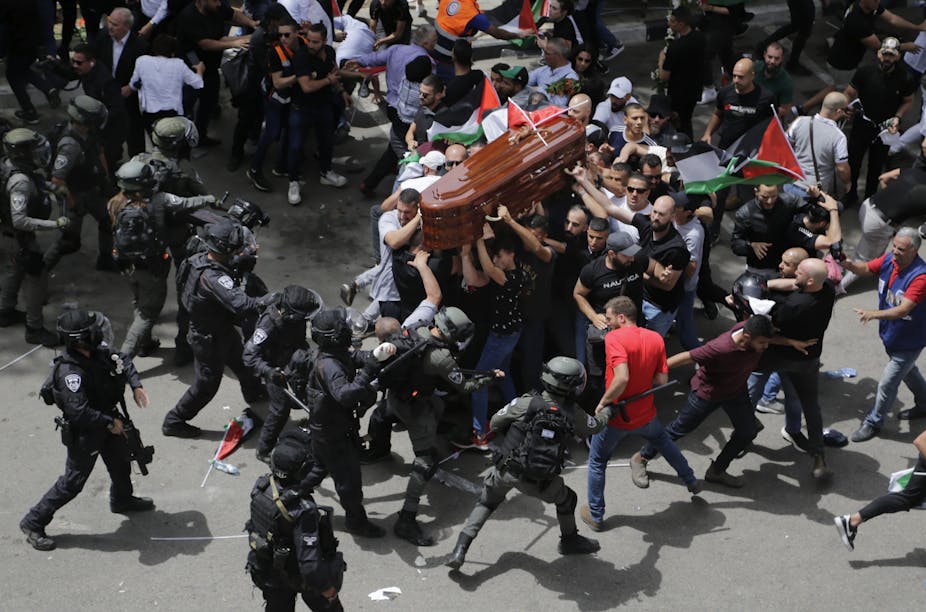
Yet those who skimmed the headlines of initial reports from several U.S. media outlets may have been left with a different impression of what happened.
“Israeli Police Clash with Mourners at Funeral Procession,” read the headline of MSNBC’s online report. The Wall Street Journal had a similar headline on its story: “Israeli Forces, Palestinians Clash in West Bank before Funeral of Journalist.”
MADRID, May 18 2022 (IPS)* – While the attention of mostly Western media and politicians is quasi exclusively hoarded up by the proxy war in Ukraine and its consequences on the energy sector, the world’s big oil business continues to burn Planet Earth with its underreported though highly polluting, wasteful practice of gas flaring.
.
Global gas flaring increased to 144 billion cubic metres (bcm) in 2021 from 142 bcm in 2020. It is estimated that each cubic metre of associated gas flared results in about 2.8 kilograms of CO2-equivalent emissions. Credit: public domain
This is anything but a minor issue: in fact, as much as 144 billion cubic metres of gas was flared at upstream oil and gas facilities in just one year-2021. Such an amount caused the emission of 400 tons of carbon dioxide (CO2) equivalent, according to the World Bank.
A world renowned journalist Shireen AbuAqleh was intentionally murdered by an Israeli sniper in Jenin. Millions of tears were shed for her including ours at the Palestine Institute for Biodiversity and Sustainability (palestinenature.org). We planted ten trees in her honor. The constellation of events and circumstances and her background actually were so amazing that it provided a huge dose of sadness but also a big ray of hope for us.
.
Jenin, where she was murdered, is a center of heroic resistance to occupation (resistance not supported by any government, international or even Palestinian).
She was a journalist and wearing protective blue journalist vest and helmet. Thus she mobilized the media. She was beloved by every Palestinian home for her coverage of their daily miseries inflected by foreign occupiers for decades.
Children working on tobacco farms in Chipangali District in Eastern Province of Zambia. Credit: Brenda Chitindi
“Most major tobacco producing countries use child labour in tobacco growing. Almost no cigarette can be guaranteed to be free from child labour.” – British Medical Journal, 2015.
HONG KONG / LOME, May 17 2022 (IPS)* – Despite World Day Against Child Labour launched in 2002 by the International Labour Organization (ILO), little has changed over the past two decades for the millions of children who remain trapped.




 HUMAN WRONGS WATCH