By Nargiz Shekinskaya in Awaza and Vibhu Mishra in New York.
(UN News)* — Trapped by geography and squeezed by global market forces, the world’s 32 landlocked developing countries remain among the poorest – and most overlooked.
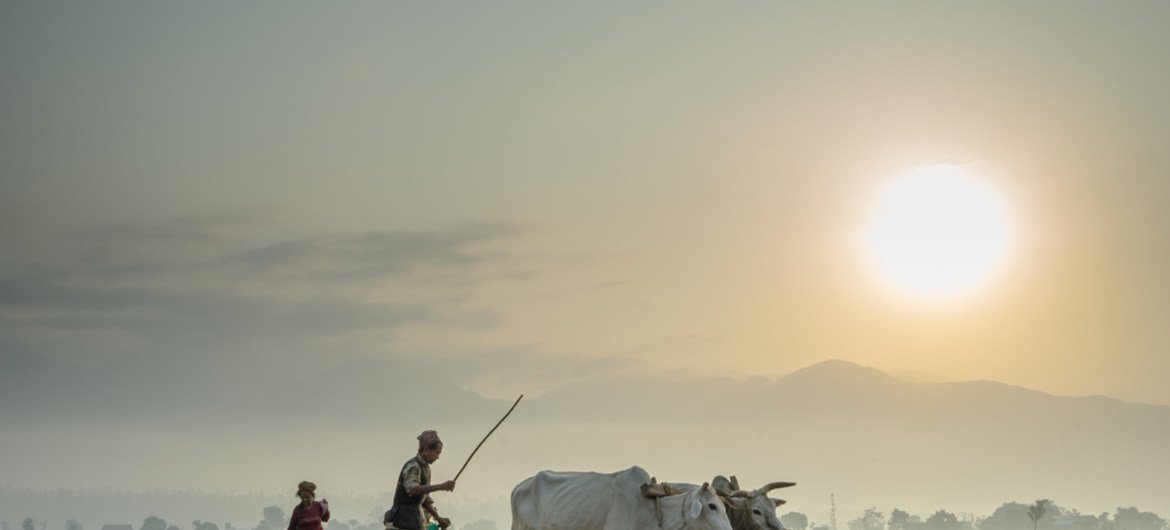
IFAD/Sanjit Das | In landlocked developing countries like Nepal (pictured), a lack of diversified industries and accessible markets limits local livelihoods – driving a growing exodus of young people seeking work abroad and often leaving older generations behind.
At a major UN conference underway this week in Awaza, Turkmenistan, calls are growing to tackle the high trade costs, investment gaps and growing digital divide that continue to hold these countries back.
Despite progress in some areas, landlocked nations – from Bolivia to Bhutan and Burkina Faso – account for just1.2 per cent of global exports, even though they represent over seven per cent of the world’s countries.
AWAZA, Turkmenistan, Aug 6 2025 (IPS)* ––Agriculture is a critical sector in landlocked developing countries, as more than half (55 percent) of the population is employed in the agriculture sector – significantly higher than the global average of 25 per cent.
As such, the deterioration of food security in landlocked developing countries (LLDCs) is an unfolding catastrophe.
A high-level event focused on agriculture at the ongoing Third United Nations Conference on Landlocked Developing Countries. Credit: Joyce Chimbi/IPS
There are 32 LLDCs, with a combined population of nearly 600 million people.
The prevalence of moderate or severe food insecurity rose from an estimated 43 percent in 2015 to 51 percent in 2023, and the rate of undernourishment from approximately 15 percent to 19 percent in the same period.
(UN News)* —At a major UN forum opening in Awaza, Turkmenistan, this week, parliamentarians from around the world are being urged to take decisive action to improve the lives of more than 600 million people living in landlocked developing countries (LLDCs).
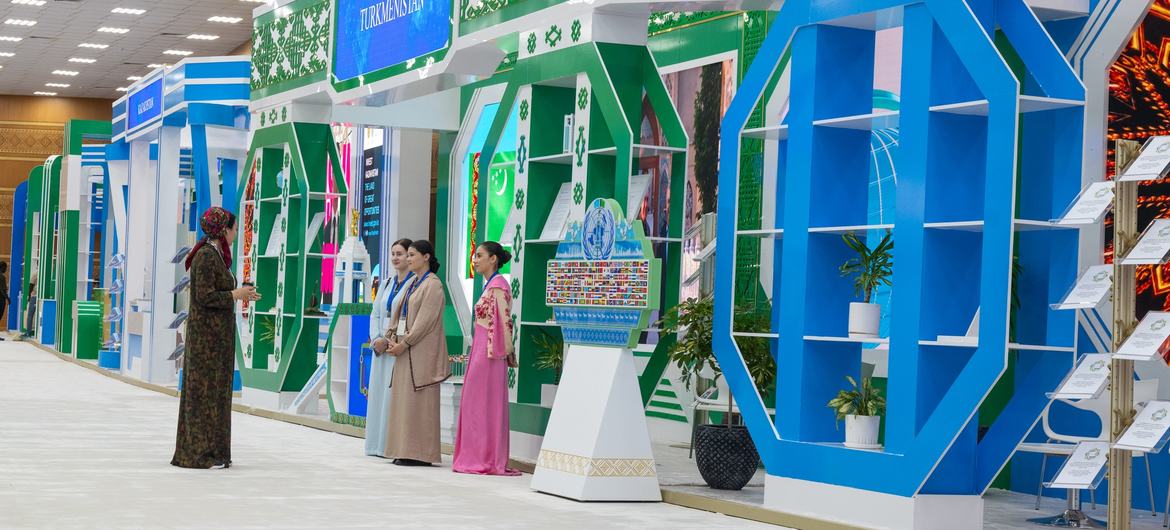
UN Photo/Eskinder Debebe | Final preparations being made at the venue of the LLDC3 conference in Awaza, Turkmenistan.
Speaking at the Parliamentary Forum of the Third UN Conference on LLDCs, senior UN leaders stressed that political will, matched with national legislative action, is essential if a new decade-long development plan is to make a real difference.
There are 32 such countries globally, home to over half a billion people. Many are also among the world’s least developed, hindered by high transport costs, limited access to global markets, and heightened vulnerability to climate impacts.
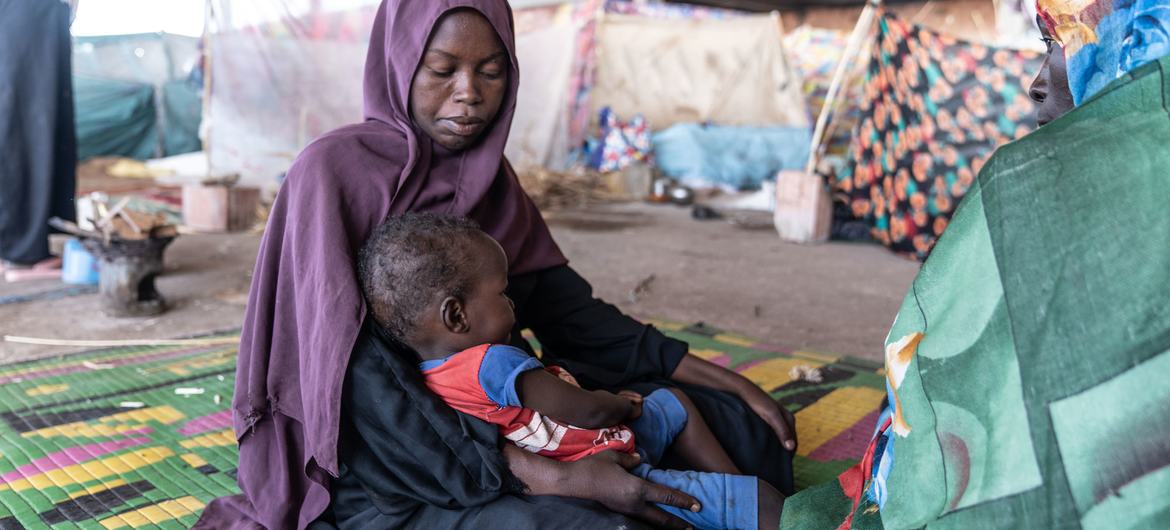
(UN News)* — Famine was declared in the Zamzam camp in North Darfur one year ago. And since then, little has changed – no aid trucks have reached the region, the nearby city of El Fasher is still under siege and food prices are four times higher than other parts of the country.
(UN News)* — Children in Gaza are dying not just from hunger, but from the total collapse of the systems meant to protect them, UN agencies warned on Tuesday [].
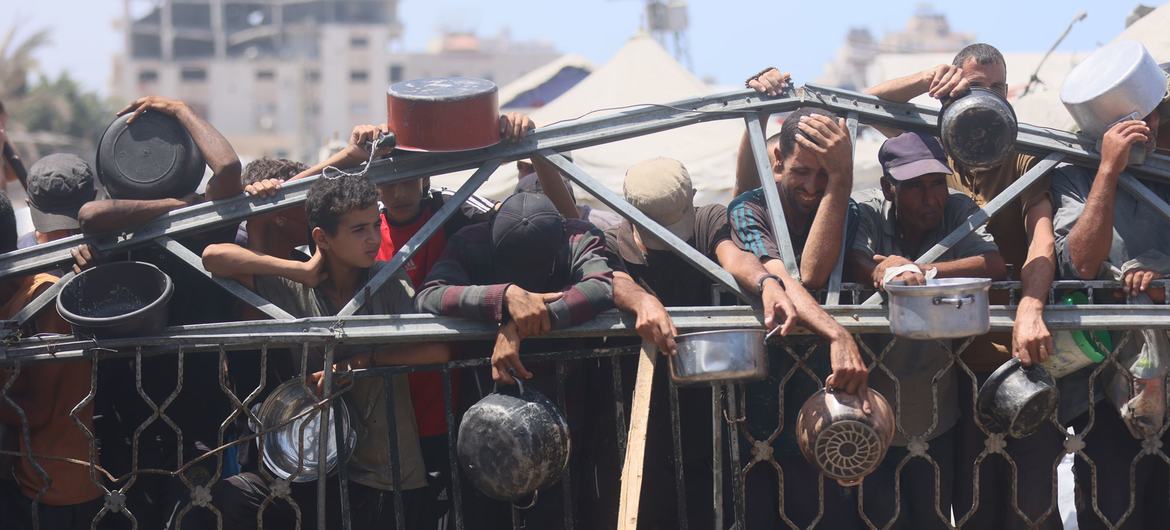
UN News | People wait for food at a community kitchen in western Gaza City.
.
With 96% of households lacking clean water, many malnourished children are not surviving long enough to receive hospital care.
.
James Elder, Spokesperson for the UN Children’s Fund (UNICEF), told a media briefing in Geneva that it would be a mistake to assume that the situation was improving.
.
“There’s a sense through the world’s press that things are improving,” he said. “But unless there is sustained humanitarian aid…there will be horrific results.”
He emphasised the scale of need: “When food comes in which supports 30,000 children, there are still 970,000 children not getting enough. It is a drop in the ocean.”
(United Nations)* — Landlocked Developing Countries (LLDCs) lack territorial access to the sea, leaving them dependent on transit neighbors for a route to world markets.
.
Located more than 500km from the Atlantic coast, Burkina Faso is one of 16 landlocked developing countries in Africa.
PHOTO:UNDP / Aurélia Rusek
This geographic disadvantage drives up transport costs, introduces avoidable delays, and exposes LLDCs to any political or economic instability along those corridors.
The results are stark: Average transport costs are more than twice those of neighboring coastal states.
Export opportunities shrink, foreign direct investment falls, and economic growth slows.
When a transit country is itself a developing economy—often the case—intraregional trade remains modest.
NAIROBI, Kenya / PARIS, France, Aug 5 2025 (IPS)** – One would expect that this year’s wetter than average rainy season in parts of Africa would be viewed with relief, not fear.
Credit: World Organisation for Animal Health
Yet many areas in the region sits at a knife’s edge—still recovering from years of drought and a historic famine, too much rain leads to flooding and water-borne diseases.
LONDON, Aug 4 2025 (IPS)** ––Rice queues – something once unthinkable – began appearing around May. As the country’s staple food hit record prices, frustrated shoppers found themselves breaking a cultural taboo by switching to rice from South Korea.
It was a symbol of how far Japan’s economic certainties had crumbled, creating fertile ground for a political shift.
Credit: Kim Kyung-Hoon/Reuters via Gallo Images
That came on 20 July, when Japan joined the ranks of countries where far-right parties are gaining ground.
The Sanseitō party took 15.7 per cent of the vote in the election for parliament’s upper house, while the ruling two-party coalition of the Liberal Democratic Party (LDP) and Kōmeitō lost its majority.
The result spells trouble for Japan’s civil society.
(Jerusalem) – Israeli forces at the sites of a new US-backed aid distribution system in Gaza have routinely opened fire on starving Palestinian civilians in acts that amount to serious violations of international law and war crimes, Human Rights Watch said on 1 August 2025.
Mass casualty incidents have taken place on a near-daily basis at or near the four sites operated by the Gaza Humanitarian Foundation (GHF), which operates in coordination with the Israeli military.
30 July 2025 — After surviving 17 months of bombing and displacement in Gaza, Palestine, Emad, an MSF nurse supervisor, was medically evacuated with his family to France in March 2025.
In this short documentary, he recounts what they endured during the war — from the destruction of their home, and repeated displacement, to the limited access to healthcare for his daughter, Sila, who was born with a congenital heart condition.
Currently at least 12,000 patients, including thousands of children like Sila, need to be evacuated urgently from Gaza to access vital medical care.





 HUMAN WRONGS WATCH