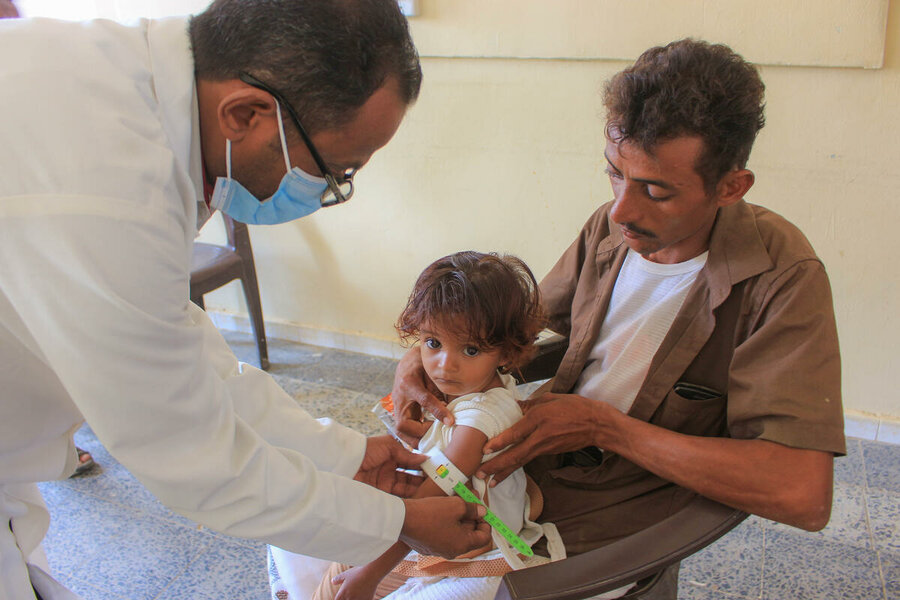
16 June 2021 (WFP)* — Famine — driven by conflict and fueled by climate shocks and the economic downturn caused by the COVID-19 pandemic — could soon become a reality for millions of people. Below, the World Food Programme’s acting director of nutrition, Allison Oman Lawi, explains what famine is — and spells out the urgent need for action to avert it.
Yemen: A child at a WFP-supported clinic in Hajjah is diagnosed with moderate acute malnutrition. Photo: WFP/Issa Al-Ragh
15 June 2021 (IFAD)* — Every year, on 16 June, the International Day of Family Remittances (IDFR) is observed to raise further awareness on the abnegation and sacrifice of migrant workers, who support their families and communities of origin through the money they send back home, particularly in these times of crisis.
This year, the IDFR lauds the human spirit and resilience of over 200 million migrants who defied predictions of the pandemic and continued to send money home to their countries of origin.
16 June 2021 (United Nations)* — The International Day of Family Remittances (IDFR) was adopted by the United Nations General Assembly and is observed on 16 June. The IDFR recognizes more than 200 million migrant workers, women and men, who send money home to over 800 million family members.
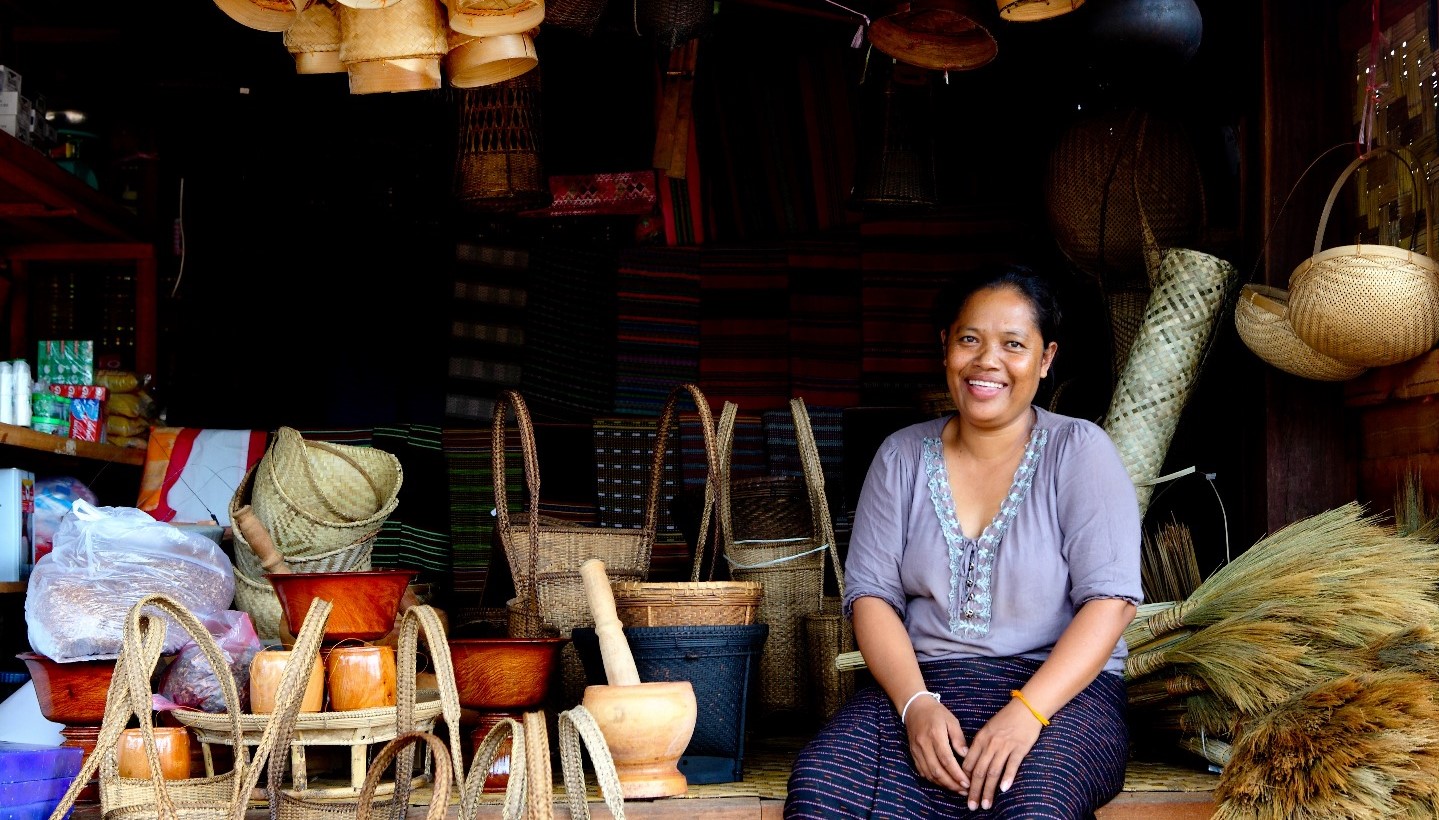
Left: A market vendor sells produce at Victoria Market in Port Victoria, Seychelles. Right: 64 years old, Christine Banlog, has been a market woman for 22 years. She is widowed, and raising her three grandchildren in Nyalla, Cameroon. PHOTO:UN Women/Ryan Brown
.
(United Nations)* — Although all age groups are at risk of contracting COVID-19, older persons are at a significantly higher risk of mortality and severe disease following infection, with those over 80 years old dying at five times the average rate.
.
An estimated 66% of people aged 70 and over have at least one underlying condition, placing them at increased risk of severe impact from COVID-19.
(FAO)* — Cotton is one of the most common fabrics in the world, from its origins in ancient India to the modern garments many of us wear today. This durable, versatile and naturally organic fabric is made from the white, fluffy fibres around the seeds of cotton plants.
However, the backstory of cotton is more complicated. Its production is heavily dependent on natural resources and labour; and unfortunately, child labour is often a part of this.
The International Labour Organization and UNICEF warn nine million additional children at risk as a result of COVID-19 pandemic.
GENEVA, 12 June 2021 (ILO)* – The number of children in child labour has risen to 160 million worldwide – an increase of 8.4 million children in the last four years – with millions more at risk due to the impacts of COVID-19, according to a new report by the International Labour Organization (ILO) and UNICEF.
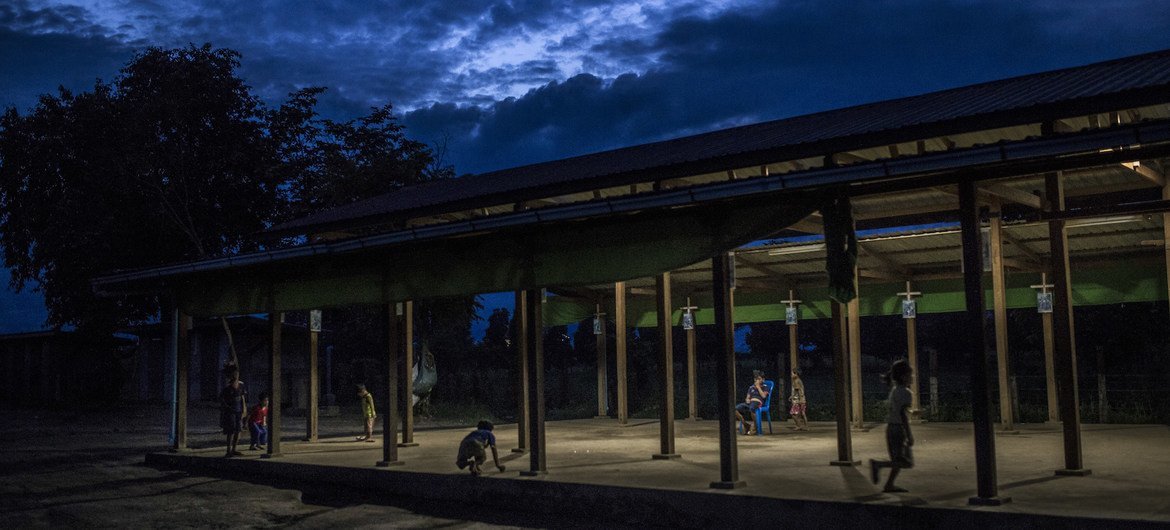
(UN News)* – Escalating violence across Myanmar including attacks on civilians must be halted to prevent even greater loss of life and a deepening humanitarian emergency, UN rights chief Michelle Bachelet on 11 June 2021said.
.
Ms. Bachelet’s appeal follows reports of a continuing military build-up in various parts of the country including Kayah State in the east – where more than 108,000 people have fled their homes in the last three weeks – and in Chin State in the west.
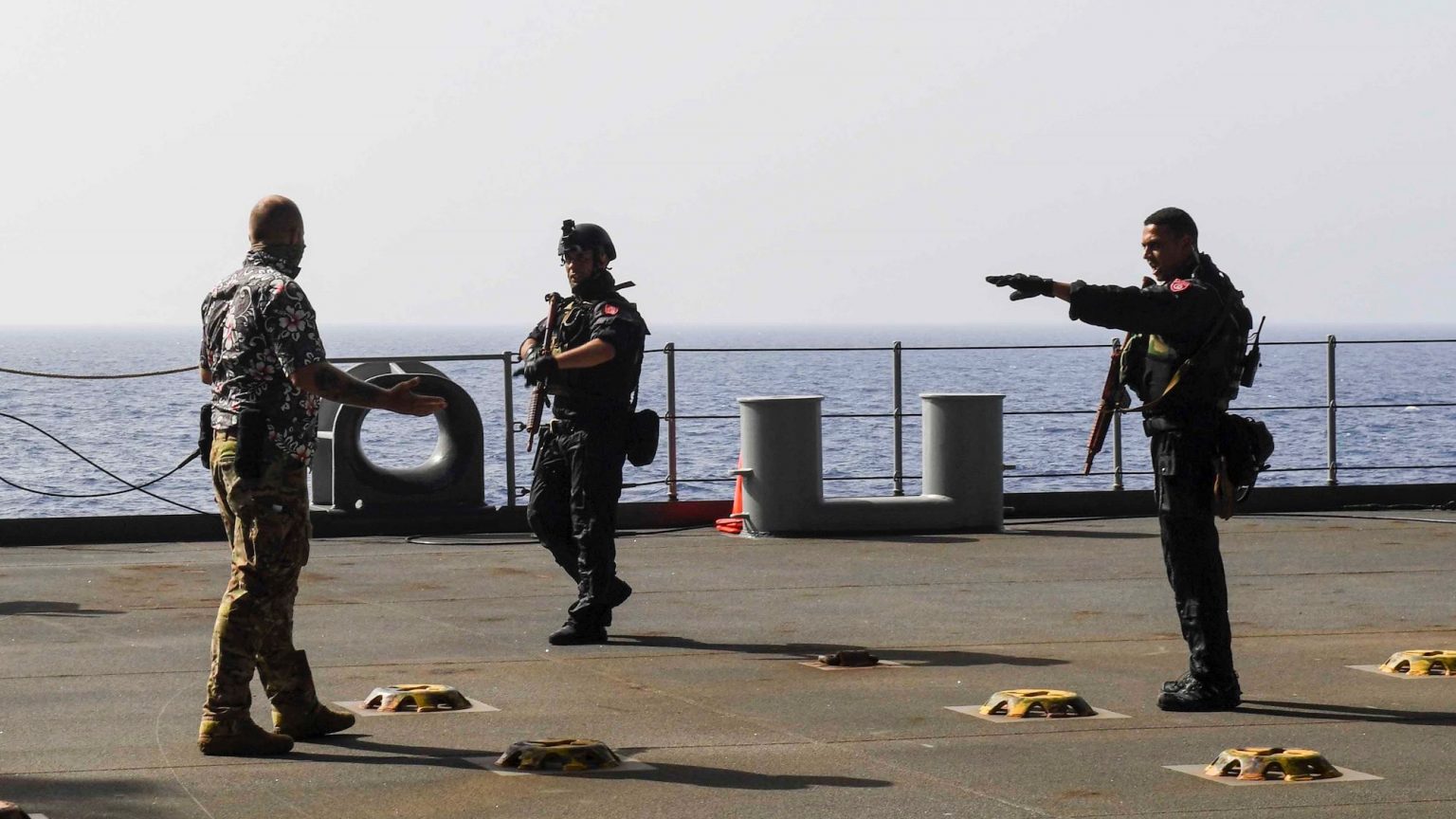
Phoenix Express 2021, the AFRICOM-sponsored military exercise involving 13 countries in the Mediterranean Sea region, concluded last week. While its stated aim was to combat “irregular migration” and trafficking, the US record in the region indicates more nefarious interests.
Tunisian navy personnels aboard USS Hershel “Woody” Williams (ESB 4) on May 23 when the Phoenix Express 2021 was underway. Photo : AFRICOM
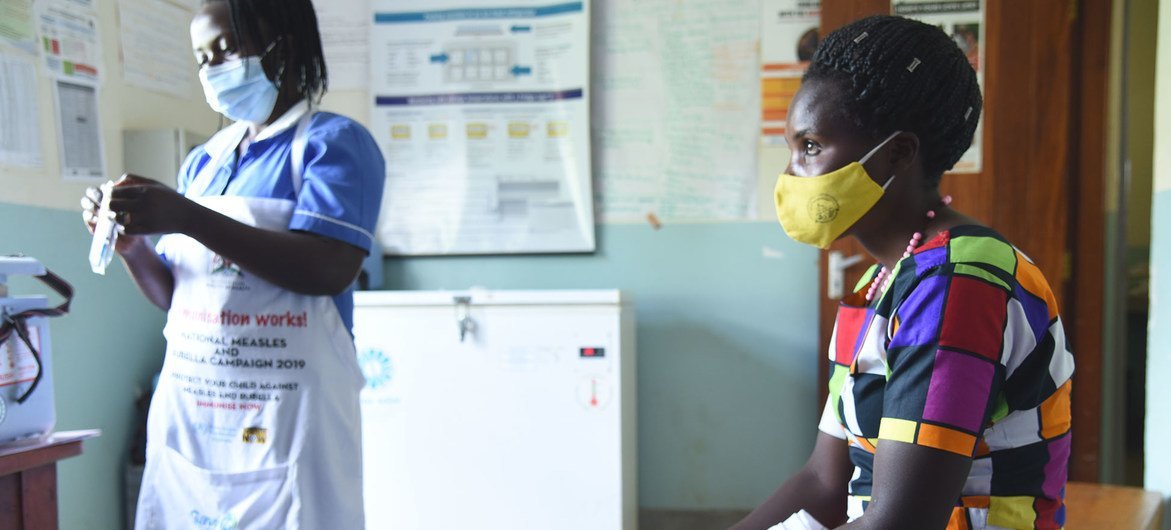
(UN News)* — Nine in 10 African nations look set to miss the September target of vaccinating 10 per cent of their populations against COVID-19, the World Health Organization (WHO), on 10 June 2021said.
$72.6 billion is how much nine nuclear armed countries spent on their nuclear weapons as the pandemic spread in 2020 and a global treaty banning nuclear weapons took full effect.
The report “Complicit: 2020 Global Nuclear Weapons Spending” details the spending of these nine countries on their arsenals, the companies that profited, and the lobbyists hired to keep nuclear weapons in business.
This amounts to $137,666 every minute, and (after adjusting for inflation) represents an increase of $1.4 billion from last year.
The U.S. spent three times more than the next in line- a whopping $37.4 billion.
China was the only other country crossing the ten billion mark, spending $10.1 billion.
Russia had the third highest spending at $8 billion, though the U.K.’s $6.2 billion and the French $5.7 billion weren’t so far behind.
India, Israel, Pakistan also each spent over a billion on their arsenals, while North Korea spent $667 million.



 HUMAN WRONGS WATCH