Black women are mobilising to win seats at the table in this month’s municipal elections – amid death threats and COVID-19 restrictions. Português. Español.
Taina Rosa (left) and Lauana Nara, candidates in this week’s municipal elections, want more Black women in office. | Credit: Dokttor Bhu Bhu and Allan Calisto
13 November 2020 (openDemocracy)* — “When she was murdered, the Black women’s movement dealt with this collective trauma by turning it into institutional political action,” says Ana Carolina Lourenço, co-founder of Mulheres Negras Decidem (Black Women Decide).
On 14 July 2020, Ruksana Begum fetches water near the raised homestead where her family has been living since floodwaters submerged their house in Amtola Char in Chilmari Upazila, Kurigram, Bangladesh. UN Water
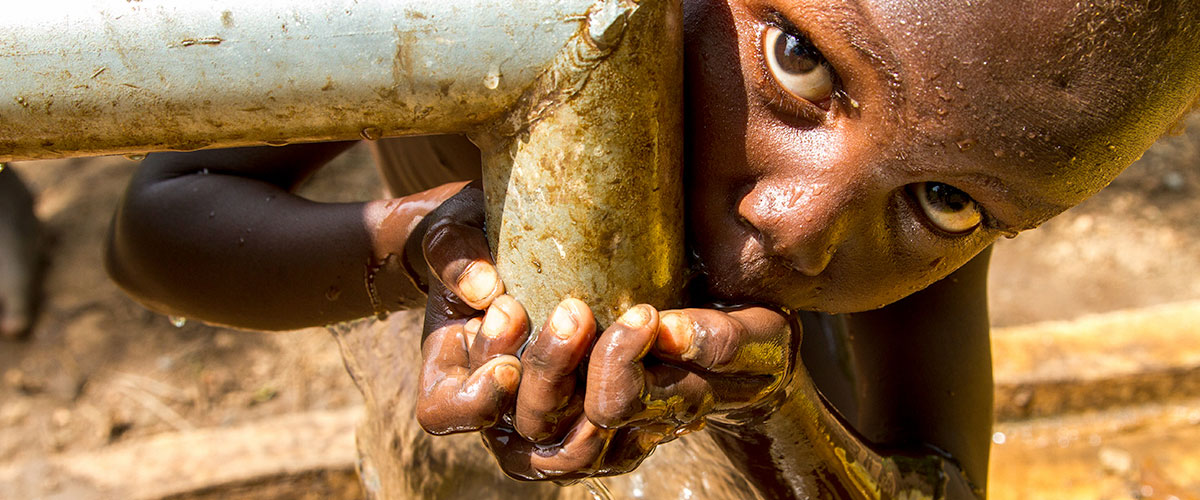
(United Nations)* — Over half of the global population or 4.2 billion people lack safe sanitation and around 297,000 children under five – more than 800 every day – die annually from diarrhoeal diseases due to poor hygiene, poor sanitation or unsafe drinking water.
Without safely managed, sustainable sanitation, people often have no choice but to use unreliable, inadequate toilets or practise open defecation.
Eriam Sheikh,7 year old comes out after using the toilet on stilts or floating toilet built over a drain passing by Rafiq Nagar in Mumbai. PHOTO:UN Water
16 November 2020 (United Nations)* — World Toilet Day celebrates toilets and raises awareness of the 4.2 billion people living without access to safely managed sanitation. It is about taking action to tackle the global sanitation crisis and achieve Sustainable Development Goal 6: water and sanitation for all by 2030.
(United Nations)* — Access to water and sanitation is a precondition to life and a declared human right. Water is vitally important to sustainable development – from health and nutrition, to gender equity and economics.
Over the coming years, our water-related challenges will become more urgent. The increasing demands of a growing population and rapidly developing global economy, combined with the effects of climate change, will exacerbate lack of access to water and sanitation for domestic uses.
“What is tolerance? It is the prerogative of humanity. We are all full of weakness and errors; let us mutually pardon each other our follies – it is the first law of nature.” -Voltaire
Fostering mutual understanding among cultures and peoples
The United Nations is committed to strengthening tolerance by fostering mutual understanding among cultures and peoples.
International Day for Tolerance – 16 November 2020
15 November 2020 (UNESCO)* — “Tolerance is respect, acceptance and appreciation of the rich diversity of our world’s cultures, our forms of expression and ways of being human.” UNESCO’s 1995 Declaration of Principles on Tolerance.
In 1996, the UN General Assembly adopted Resolution 51/95(link is external) proclaiming 16 November as International Day for Tolerance. This action followed the adoption of a Declaration of Principles on Tolerance by UNESCO’s Member States on 16 November 1995. Among other things, the Declaration affirms that tolerance is neither indulgence nor indifference.
Civil war broke out in Ethiopia, the French government doubled down on Islamophobia and Tanzania returned to ‘de-facto one party rule,’ say openDemocracy editors around the world.
Emmanuel Macron with Donald Trump in 2018 | The White House, Public Domain,
13 November 2020 (openDemocracy)* — People across the globe have been mesmerised by the US elections, horrified by Trump’s failure to concede, and entertained by a certain landscape gardening business. I asked my colleagues what we’d all missed in the rest of the world.
14 November 2020 (UN News)* — If just two per cent of the Ocean were to be sustainably farmed, the world could easily be fed, according to experts. In the first story of a two-part series looking at the opportunities and challenges facing Ocean farming, we take a look at the huge potential role of seaweed in mitigating climate change, cutting marine pollution, and achieving the UN goal of Zero Hunger.
.
Unsplash/Shane Stagner | Kelp, a type of seaweed, can be fed to animals and could help to reduce greenhouse gas emissions.
‘We are still hunter-gatherers’
“When it comes to the ocean, we are still hunter-gatherers”, says Vincent Doumeizel, a senior advisor on ocean-based solutions at the UN Global Compact, and an evangelist for seaweed.
Last September, European Union President Ursula Von der Leyen announced that by 2030, she wants Europe carbon-neutral, to reduce its greenhouse gas emissions (GHGs) by 55%, and to spearhead a digital revolution. In the U.S. that same month, California’s Governor Gavin Newsom announced that the state will reduce its GHGs by prohibiting sales of new gas-powered vehicles beginning in 2035.
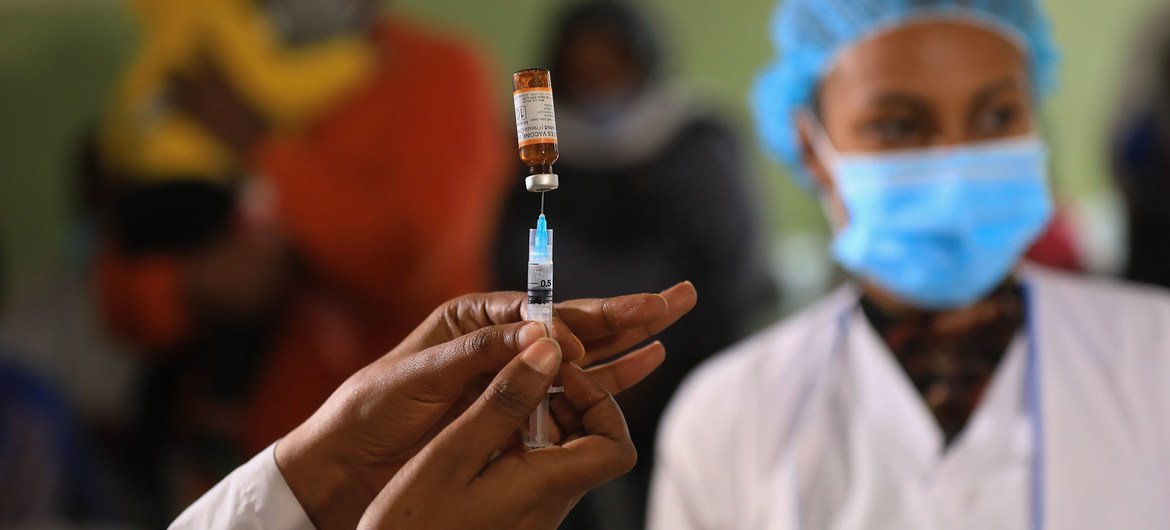
(UN News)* — Measles killed an estimated 207,500 people last year after a decade-long failure to reach optimal vaccination coverage, resulting in the highest number of cases for 23 years, the World Health Organization (WHO) and US Centers for Disease Control (CDC) said in a joint report on Thursday [12 November 2020].
UNICEF/Nahom Tesfaye | In June 2020, a measles vaccination campaign targeting 14 million children was launched in Ethiopia.
The death toll in 2019 was 50 per cent higher than a historic low reached in 2016, and all WHO regions saw an increase in cases, adding up to a global total of 869,770.




 HUMAN WRONGS WATCH