8 November 2020 (UN News)* — Some 13 million people in the central Sahel region of north Africa require urgent humanitarian assistance, due to violence, insecurity and extreme weather events. Behind these stark figures lie personal stories of tragedy, resilience and hope.
.
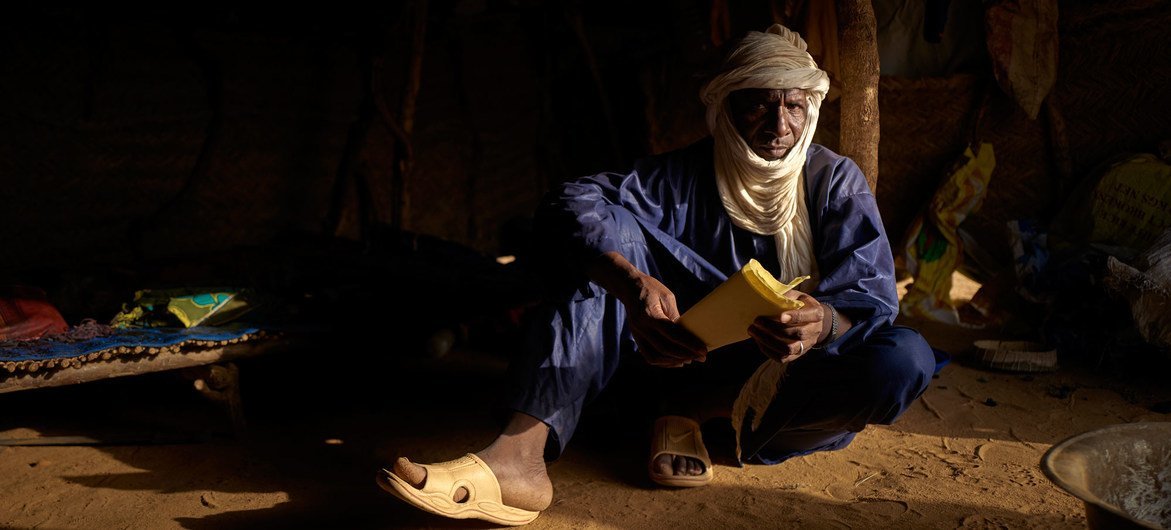
UNOCHA/Michele Cattini | Abdou Salam Djibril, a displaced man from Tessit, in his tent at an informal camp near Gao in Mali.
“We fled because of the ongoing conflict. A lot of people have been wounded. Five of my family members, including my nephew, were killed. We were afraid of reprisals, so we came here”.
9 November 2020 (UNEP)*— Vast jet-black plumes of smoke curling upwards into the sky, blocking out the sun. Crude oil flowing through the streets. These were some of the environmental footprints left by ISIL/Da’esh (Islamic State of Iraq and the Levant) in northern and western Iraq.
Oil wells and mineral stockpiles were torched, particularly during the Mosul offensive in the spring of 2016. Water barrages were blown up. So thick were the clouds of smoke that for the inhabitants day became night.
In his 1995 book The Demon-Haunted World Carl Sagan lamented as follows:
I have a foreboding of [a] time when… awesome technological powers are in the hands of a very few, and no one representing the public interest can even grasp the issues; when the people have lost the ability to set their own agendas or knowledgeably question those in authority; when, clutching our crystals and nervously consulting our horoscopes, our critical faculties in decline, unable to distinguish between what feels good and what’s true, we slide, almost without noticing, back into superstition and darkness.
The dumbing down… is most evident in the slow decay of substantive content in the enormously influential media… but especially a kind of celebration of ignorance…. The plain lesson is that study and learning – not just of science, but of anything – are avoidable, even undesirable.
SYDNEY and KUALA LUMPUR, Nov 2 2020 (IPS)* – US third quarter GDP numbers released two weeks ago delighted stock markets and President Trump. Output had picked up by 7.4%, annualised as 33.1%, the largest quarterly economic growth on record, almost double the old record of 3.9% (annualised as 16.7%) in the first quarter of 1950, seven decades ago.
Anis Chowdhury
Spinning numbers
This news could not have come at a better time for Trump, who is struggling for re-election, as his Council of Economic Advisers (CEA) declared that this affirmed Trump’s claim, “we’re coming back, and we’re coming back strong”.
The CEA spun the White House press release headline accordingly, “The Great American Recovery: Third Quarter GDP Blows Past Expectations”.
6 November 2020 (Human Rights Watch) — The US elections took place amid a recession, record unemployment, and rising poverty. The economy was the top issue for voters in the election; one in two voters said that economic inequality was very important in their decision about who to support in the presidential election. But decisions that affect poverty and inequality are not only taken at the federal level.
The coronavirus pandemic has swept across a world that was already profoundly unequal. The failure to tackle inequality has left the majority of countries far more vulnerable and unprepared for both the health and economic impacts of the disease.
In the Central African Republic, the Covid-19 represents a health crisis which is added to an already alarming humanitarian crisis. One in two people in need of humanitarian assistance, and about 70% of health services are provided by humanitarian organizations. Photo: Aurelie Godet/Oxfam
Millions of people have died or been pushed into hunger and poverty because governments have not invested in public healthcare, protected workers’ rights, or provided safety nets for people who can’t work.
She lives in a settlement for displaced people outside Kabul, Afghanistan’s capital city. Fifteen people share her makeshift two-room home, including Shayista’s daughter and her children.
UN food agencies warn of rising levels of acute hunger with potential risk of famine in four hotspots – Burkina Faso, northeastern Nigeria, South Sudan and Yemen cause for concern but acute hunger on the rise across the globe.
A group of men prepare food in a village near Tanout in Niger.
ROME, 6 November 2020 (FAO)* – The world has been put on a heightened famine alert with a new report by two United Nations agencies that contains a stark warning; four countries contain areas that could soon slip into famine if conditions there undergo “any further deterioration over the coming months”.
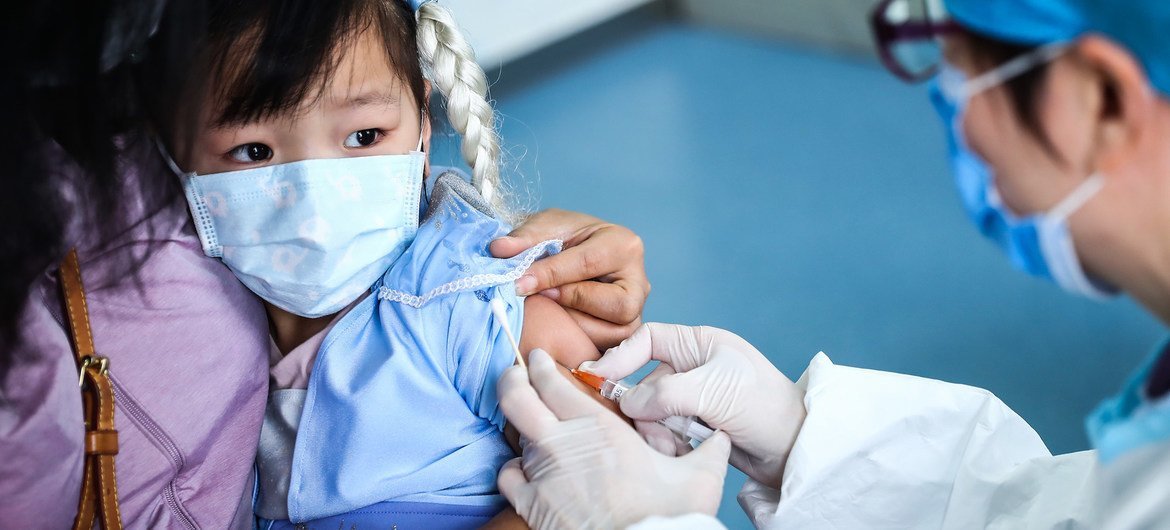
6 November 2020 (UN News)* — Globally, millions of children are at a heightened risk of polio and measles – dangerous but preventable diseases – amid disruptions to vital immunization programmes due to the coronavirus pandemic, UN Children’s Fund (UNICEF) and World Health Organization (WHO) have said.
.
UNICEF/Yuwei | A 3-year-old girl receives a vaccine shot at a community health centre in Beijing, China.
.
According to the two UN agencies, immunization rates in some countries have fallen by as much as 50 per cent, with people unable to access health services because of lockdown and transport disruptions, or unwillingness due to fear of contracting COVID-19.
UNITED NATIONS, Nov 5 2020 (IPS)* – When the United Nations was struggling to cope with a cash crisis back in April 1996, one of the many drastic measures it undertook was to cut down on its staff.
Work and reforms of the UN ‘at risk’, Antonio Guterres warned Member States, amidst ‘record-level’ cash crisis, October 2020. Credit: UN Photo/Rick Bajornas. The UN Secretariat building in New York
So, it took the path of corporate America, and ironically, for a cash-strapped institution, it offered a “golden handshake”—a severance pay of about $80,000 dollars each — to those who would voluntarily leave the near-bankrupt Organization.




 HUMAN WRONGS WATCH