Let us begin by recognizing the brilliant contributions that Jewish intellectuals have given to the world.
Of the three great monotheistic Abrahamic religions, Judaism, Christianity and Islam, Judaism was the first. Thus the religious traditions of much of the world have their roots in Jewish culture.
We should also acknowledge the remarkable intellectual achievements of thinkers such as Albert Einstein, Sigmund Freud, Niels Bohr, Hanna Adler, Emmy Noether, Noam Chomsky, and many, many more. Interested readers can look at a more complete list HERE.
By Don Murray in Bambari, the Central African Republic*
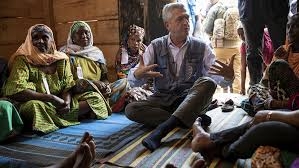
UN High Commissioner for Refugees Filippo Grandi listens to internally displaced people in Bambari and calls for a redoubled effort to help them go home. | عربي
4 December 2019 (UNHCR)* — The Élevage and Alternatif settlements in the city of Bambari seem, at first glance, normal. But the lives of the residents here have been hollowed out.
4 December 2019 (UN News)* — A record 168 million people worldwide will need help and protection in crises spanning more than 50 countries in 2020, the UN’s emergency relief chief has said, in an appeal for nearly $29 billion in humanitarian aid from donors.
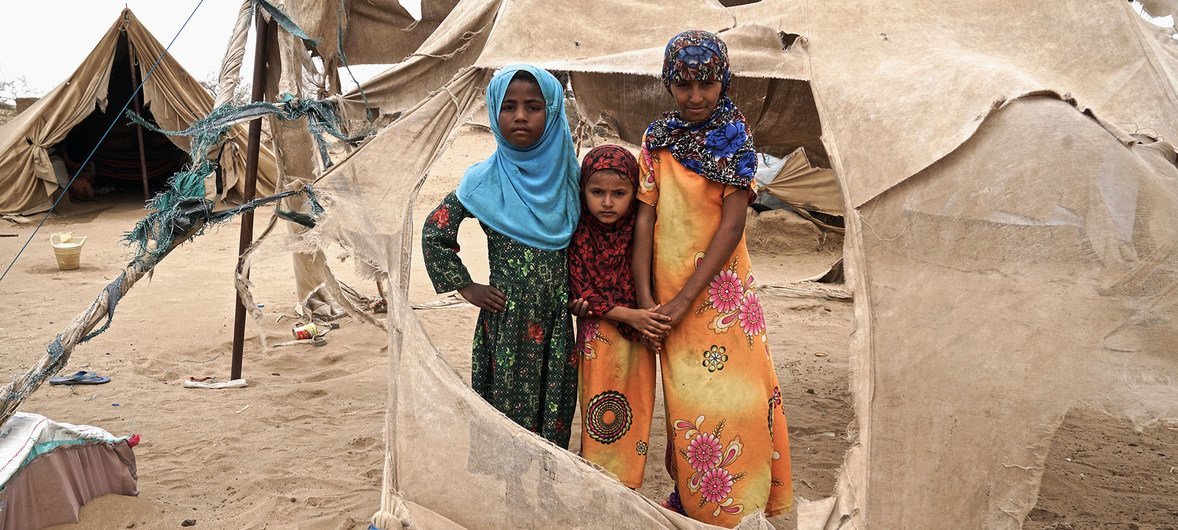
OCHA/Giles Clarke | Displaced children stand in the shredded remains of tents in Abs settlement, Yemen, for internally displaced persons. Located just 40 km from the frontlines, the settlement is regularly damaged by passing sandstorms.
Protecting people’s health from climate change dangers such as heat stress, storms and tsunamis has never been more important, yet most countries are doing too little about it, the World Health Organization (WHO) said on Tuesday [3 December 2019]. (*).
In its first global review of more than 100 countries, the UN agency found that while around half of them have developed a strategy on the issue, fewer than one in five is spending enough to implement all of their commitments.
We give our children loving care, but it makes no sense to do so unless we do everything in our power to give them a future world in which they can survive. We also have a duty to our grandchildren, and to all future generations.
One of the most concerning sights of the pre-trial hearings in Julian Assange’s extradition case has been his documents.
The WikiLeaks founder shuffled into the video conferencing room at Belmarsh high security prison, in southeast London, on October 11th, carrying a cardboard box full of paper files.
When he appeared in person at Westminster Magistrates Court, ten days later, he was carrying a folder full of papers as he took his seat behind a screen separating him from the judge.
Incredible as it may seem, these dog-eared sheaves of paper constitute the notes for his defence against an extradition request from the US on espionage charges, which could, if upheld, see him sentenced to 175 years’ prison, with no possibility of parole. In one of multiple violations of his rights as a remand prisoner, he is operating under restrictions meaning that he has no access to a laptop computer.
28 November 2019 (UNHCR)* — Filippo Grandi bears witness to conditions at the Moria centre on Lesvos and calls on European states to help Greece address situation | Français
The Ordovician-Silurian Extinction, which occurred about 439 million years ago, wiped out 86% of life on Earth at the time. Most scientists believe that this mass extinction was precipitated by glaciation and falling sea levels (possibly a result of the Appalachian mountain range forming), catastrophically impacting animal life which lived largely in the ocean at the time.
2. The Late Devonian Extinction happened about 364 million years ago and destroyed 75% of species on Earth. Possibly spread over hundreds of thousands of years, a sequence of events that depleted the oceans of oxygen and volcanic ash that cooled the Earth’s surface are believed to have driven the extinctions. It was to be 10 million years before vertebrates again appeared on land. ‘If the late Devonian extinction had not occurred, humans might not exist today.’
The Emissions Gap could also be called the “Commitment Gap”. It measures the gap between what we need to do and what we are actually doing to tackle climate change.
The number of international migrants in 2019 is now estimated at 270 million and the top destination remains the United States, at nearly 51 million, the UN migration agency said on Wednesday [27 November 2019].(*)
In its latest global report, IOM noted that the overall figure represents just a tiny fraction of the world’s population, although it is a 0.1 per cent increase on the level indicated in its last report, published two years ago.
“This figure remains a very small percentage of the world’s population (at 3.5 per cent), meaning that the vast majority of people globally (96.5 per cent) are estimated to be residing in the country in which they were born,” IOM’s Global Migration Report 2020 said.



 HUMAN WRONGS WATCH