Ian Gough’s latest book is required reading for anyone who wants to understand the enormity of the task at hand, writes Katherine Trebeck.
17 July 2019 (openDemocracy)* — This is a long overdue review of a book that could not be more important. I read Gough’s Heat, Greed and Human Need: Climate Change, Capitalism and Sustainable Wellbeing soon after it was published, and I have taken my time to digest and reflect on its messages.
10 July 20193 (Norwegian Refugee Council)* — Proposed U.S. cuts in aid for poor Central Americans will only exacerbate the crises and force more people to flee, warns the Norwegian Refugee Council (NRC), which assists victims of violence in the region.
“Elena” was displaced by violence in Honduras. With a little humanitarian assistance she managed to start her own business. (Her name has been changed for security reasons). Photo: Ana Karina Delgado
“This cruel removal of aid to vulnerable communities will not make the so-called border crisis go away, it will only fuel the impulse to escape misery and seek a better future across the U.S. border, said Jan Egeland, Secretary General of NRC.
21 July 2019 (Pressenza)* — On a recent podcast entitled “How Only 3.5% of a Population Can Change Society, ” Sonali Kolhatkar interviewed Erica Chenoweth, co-author of the book Why Civil Resistance Works: The Strategic Logic of Nonviolent Conflict. The book describes a study of worldwide mass campaigns of nonviolent resistance against tyranny and colonialism from 1900 to 2006.
No Muslim Ban 2, Washington, DC USA (Image by tedeytan CC)The authors find that the nonviolence struggles were more than twice as effective as their violent counterparts in achieving their stated goals.
21 July 2019 (Wall Street International)* – The rivalry between the great powers is best appreciated by examining them based on their respective power and in relation to how their political or moral actions are evaluated at the international level.
What is considered good, ethical or morally acceptable may be so for some, but not necessarily for others, and this is influenced by diverse factors, including cultural ones, in the way of conceiving societies as well as the international order.
A UNHCR survey finds that half of Venezuelans who have fled are particularly vulnerable due to their age, health issues, or the choices they had to make to survive. | Español
19 July 2019 (UNHCR)* — Recurring blackouts in the Venezuelan city of Maracaibo took a terrible toll on the whole population. But they were particularly rough on Adrianna,* a 24-year-old woman with a cognitive impairment that stopped her intellectual development at around age six.
Without power, her mother Carolina* could no longer play Adrianna the music or TV shows she had long relied on to soothe her.
After 80 days of intensifying attacks, many on health facilities, “the carnage must stop” in northwest Syria, said the UN relief chief on Thursday [18 July 2019], noting that more than 70 civilians had been killed this month alone across the last rebel-held enclave of the country.
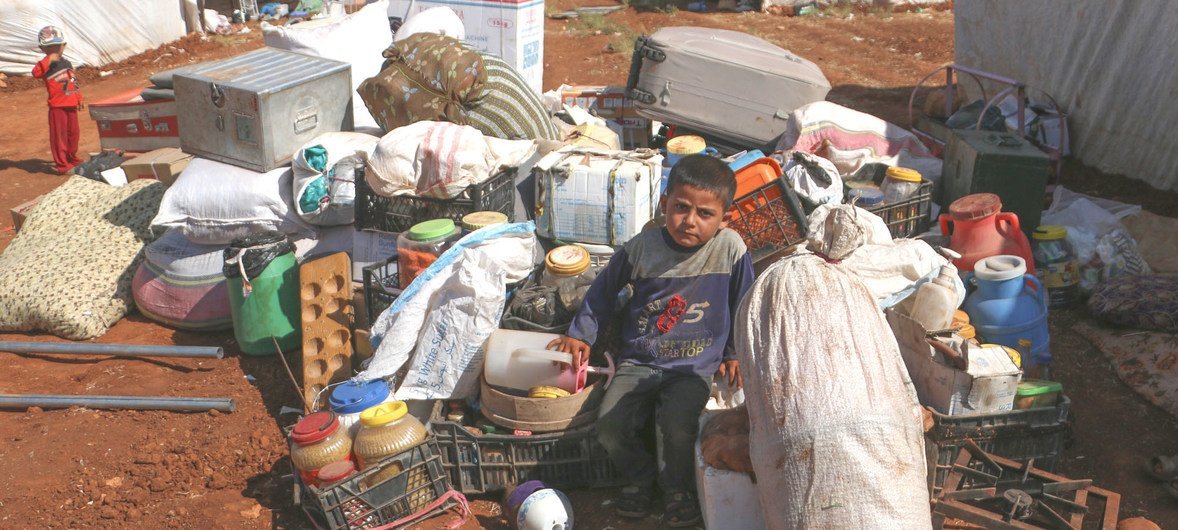
UNICEF/Aaref Watad | Families take shelter in a makeshift camp, 50 kilometers north of Idlib, in Syria. Since the beginning of September 2018, thousands of people have been displaced, following an escalation of hostilities in the country’s northwest.
“People around the world have watched in horror as war planes and artillery shelling kill and injure civilians and destroy civilian infrastructure.
19 July 2019 (UN)* — Human trafficking is a crime that exploits women, children and men for numerous purposes including forced labour and sex.
Artwork from the Global Report on Trafficking in Persons 2018, UNODC.
Since 2003 the UN Office on Drugs and Crime (UNODC) has collected information on about 225,000 victims of trafficking detected worldwide.
Globally countries are detecting and reporting more victims, and are convicting more traffickers. This can be the result of increased capacity to identify victims and/or an increased number of trafficked victims.
15 July 20193 (Norwegian Refugee Council)* — Half way into the year, humanitarian organisations have received only 27 per cent of the money needed to provide relief to people affected by crises worldwide.
Adjana Mohamed is one of many people who have fled from the clutches of Boko Haram and found safety north in Cameroon. Photo: NRC/Tiril Skarstein
“The current lack of funding is alarming. Despite increasing needs, substantially less money is available for humanitarian assistance compared to the same period last year. We are deeply concerned for those people already feeling the hard consequences of cuts,” said Jan Egeland, Secretary General of the Norwegian Refugee Council (NRC).
Washington, D.C. 17 July 2019 (UN Environment)* — With the world’s population expected to reach nearly 10 billion by 2050, a major new report shows the global food system must undergo urgent change to ensure there is adequate food for everyone without destroying the planet.





 HUMAN WRONGS WATCH