31/05/2019
By Finian Cunningham*
30 May 2019 (RT)* —
US Secretary of State Mike Pompeo doubled down on vilification of Сhinese telecoms giant Huawei as “an instrument of government” suggesting that the company was a national security threat by acting as an agent for Beijing.
Posted in Africa, Asia, Latin America & Caribbean, Market Lords, Middle East, Migrants and Refugees, Others-USA-Europe-etc., The Peoples, War Lords |
Leave a Comment »
31/05/2019
31 May 2019 (UN Environment)* — According to the World Health Organization, every year, around 7 million people die prematurely from disease caused by air pollution. That is 800 people every hour, or 13 every minute, dying because of the dirty air they breathe. Approximately, 4 million of these deaths occur in the Asia-Pacific region.
.

.
Posted in Africa, Asia, Latin America & Caribbean, Market Lords, Middle East, Migrants and Refugees, Mother Earth, Others-USA-Europe-etc., The Peoples, War Lords |
Leave a Comment »
30/05/2019
KUALA LUMPUR and PENANG, May 28 2019 (IPS) – Over recent decades, the scope, size, concentration, power and even the purpose and role of finance have changed so significantly that a new term, financialization, was coined to name this phenomenon.

Financialization refers to a process that has not only transformed finance itself, but also, the real economy and society.
The transformation goes beyond the quantitative to involve qualitative change as finance becomes dominant, instead of serving the needs of the real economy.
Financialization involves the growth and transformation of finance such that with its hugely expanded size, scope and concentration, finance now overshadows, dominates and destabilizes the productive economy.
The role and purpose of finance has been qualitatively transformed. Finance used to profit from serving production and trade. Traditionally, financing production involved providing funds for manufacturers to finance production, and for traders to buy and sell.
read more »
Posted in Africa, Asia, Latin America & Caribbean, Market Lords, Middle East, Migrants and Refugees, Mother Earth, Others-USA-Europe-etc., The Peoples, War Lords |
Leave a Comment »
29/05/2019
UNITED NATIONS, May 29 2019 (IPS)* – When the UN Security Council met last week to discuss the deaths and devastation caused to civilians in ongoing military conflicts and civil wars, the killings in Yemen and the air attacks on hospitals, schools, mosques, and market places—whether deliberate or otherwise– were singled out as the worst ever.

Children walk through a damaged part of downtown Craiter in Aden, Yemen. The area was badly damaged by airstrikes in 2015 as the Houthi’s were driven out of the city by coalition forces. Credit: UN OCHA/Giles Clarke
read more »
Posted in Africa, Asia, Market Lords, Middle East, Migrants and Refugees, Others-USA-Europe-etc., The Peoples, War Lords |
1 Comment »
29/05/2019

A local Tibetan woman talks to Greenpeace, she has five children and runs a busy guest house in the village of Zhang Zong. © John Novis / Greenpeace
read more »
Posted in Africa, Asia, Latin America & Caribbean, Market Lords, Middle East, Migrants and Refugees, Mother Earth, Others-USA-Europe-etc., The Peoples, War Lords |
2 Comments »
29/05/2019
“The culture of peace is universal. It is shared by people and nations Worldwide. Today’s “culture of war” is a US hegemonic project predicated on the creation of conflict and divisions within and between countries. It is this (unilateral) project of global warfare which is intent upon destroying civilization.”
— Prof. Michel Chossudovsky, “Towards a Culture of World Peace”
Warmongering Is Anti-Human Impulse

Dr. Mahboob A. Khawaja
The draconian ferocity of aggressive wars continues as we watch the unwarranted aggressive events unfolding against Iran in the Persian Gulf Region. One sees a contrast between a real issue and an imaginative problem.
The motivating factor signals one thing that American ruling elite thinks: “we are the most powerful nation on earth” and nobody else should challenge our supremacy – the naïve malignity mindset of the American current leadership.
.
read more »
Posted in Africa, Asia, Latin America & Caribbean, Market Lords, Middle East, Migrants and Refugees, Mother Earth, Others-USA-Europe-etc., The Peoples, War Lords |
Leave a Comment »
29/05/2019
28 May 2019 (UN Environment)* — As a global movement to tackle air pollution gathers pace, innovators are rising to the challenge, unveiling products and technologies that remove some of the dangerous toxins that are seeping into our lungs and accelerating climate change.

According to the World Health Organization (WHO), every year around 7 million premature deaths are caused by air pollution. That’s 800 people dying every hour. But the good news is that there is a growing public understanding that action must be taken.
Here are four innovative businesses and their cutting-edge technologies to beat air pollution:
read more »
Posted in Africa, Asia, Latin America & Caribbean, Market Lords, Middle East, Migrants and Refugees, Mother Earth, Others-USA-Europe-etc., The Peoples, War Lords |
Leave a Comment »
29/05/2019
The UN Children’s Fund (UNICEF) said on 28 May 2019 that much greater protection for educational facilities was needed across Afghanistan where attacks against schools have increased three-fold in just one year. The call coincides with the third International Conference on Safe Schools, taking place this week in Mallorca, Spain.
© UNICEF/UN0212108/Mohammadi | Afghanistan’s education system has been devastated by more than three decades of sustained conflict. For many of the country’s children, completing primary school remains a distant dream. Here, 10-year-old Fatima is on the board to solve a math question, at the ALC in Baghe Mellat, Herat.
If you are a pupil in Afghanistan, then you were three times more likely to be affected by an attack in 2018 than you were the previous year. Attacks on schools in the country surged from 68 in 2017 to 192 in 2018, according to UNICEF. This is the first time that the number of school attacks has increased, since 2015.
read more »
Posted in Asia, Market Lords, Others-USA-Europe-etc., The Peoples, War Lords |
Leave a Comment »
29/05/2019
Bribery is the main way people in North Korea get food, healthcare, shelter and work, a new UN human rights office report said on Tuesday [28 May 2019].
UNICEF/Simon Nazer | Children in a newly built clinic in Musan County, Democratic People’s Republic of Korea (DPRK), are checked for malnutrition and given vaccines, Vitamin A and deworming tablets.
Based on more than 200 first-hand accounts of escapees from the country, officially known as the Democratic People’s Republic of Korea (DPRK), the report asserts that the State-run public distribution system collapsed in the mid-1990s, forcing people to work in informal markets, where they have no choice but to bribe officials to avoid arrest.
read more »
Posted in Asia, Others-USA-Europe-etc., The Peoples, War Lords |
Leave a Comment »
28/05/2019
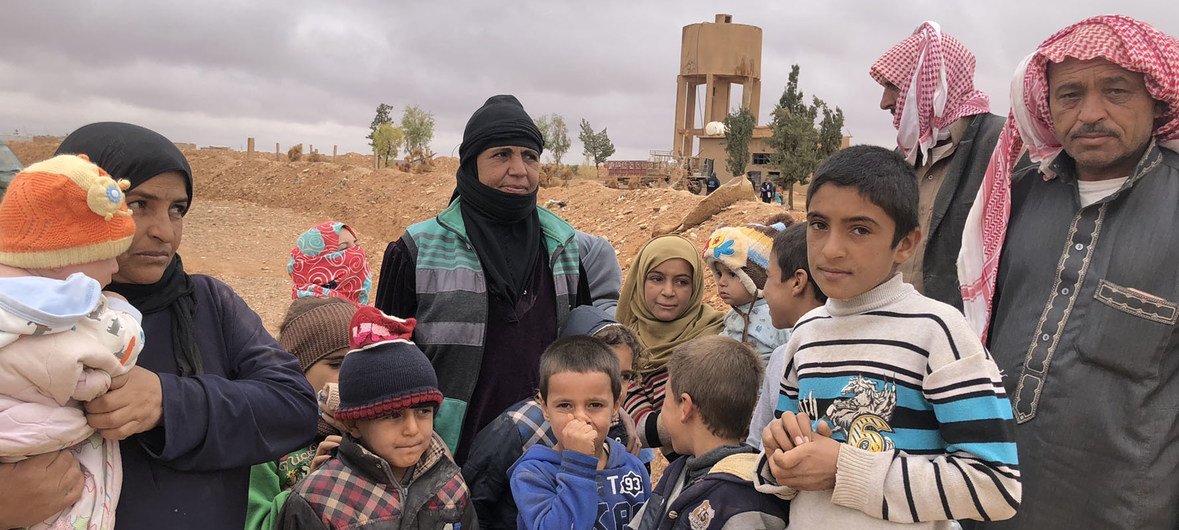
After eight years of deadly air strikes and terrorist attacks that have left hundreds of thousands of Syrians dead and millions of others injured, United Nations Deputy Emergency Relief Coordinator Ursula Mueller asked the Security Council on Tuesday [28 May 2019], the hard-hitting question: “Can’t this Council take any concrete action when attacks on schools and hospitals have become a war tactic that no longer sparks outrage”?
.
UN Syria/Fadwa Baroud AbedRabou | The UN Office for the Coordination of Humanitarian Affairs (OCHA) visits Rukban, the arid remote area of Syria close to the Jordan and Iraq borders, which became a refugee camp in 2014.
Posted in Asia, Market Lords, Middle East, Migrants and Refugees, Others-USA-Europe-etc., The Peoples, War Lords |
1 Comment »



 HUMAN WRONGS WATCH