07/05/2022
MADRID, May 6 2022 (IPS)* – The world’s leading health and children specialised organisations have once again sounded the alarm bell about what they classify as “shocking, insidious, exploitative, aggressive, misleading and pervasive” marketing tricks used by the baby formula milk business with the sole aim of increasing, even more, their already high profits.

The global formula milk industry, valued at some 55 billion US dollars, is targeting new mothers with personalised social media content that is often not recognisable as advertising. Photo by Lucy Wolski on Unsplash
Continue reading →
Posted in Africa, Asia, Latin America & Caribbean, Market Lords, Middle East, Others-USA-Europe-etc., The Peoples |
Leave a Comment »
05/05/2022
The international community calls for a shift towards better prevention, anticipation, and targeting to address the root causes of food crises.
.

Conflict remains the main driver of acute food insecurity. ©FAO/Sonia Nguyen
Rome (FAO)* – The number of people facing acute food insecurity and requiring urgent life-saving food assistance and livelihood support continues to grow at an alarming rate.
This makes it more urgent than ever to tackle the root causes of food crises rather than just responding after they occur.
Continue reading →
Posted in Africa, Asia, Climate Crisis, Latin America & Caribbean, Market Lords, Middle East, Migrants and Refugees, Mother Earth, Others-USA-Europe-etc., The Peoples, War Lords |
Leave a Comment »
03/05/2022
The UN will be commemorating World Press Freedom Day on May 3. The following article is part of a series of IPS features and opinion pieces focused on media freedom globally.

Credit: United Nations
LONDON, Apr 28 2022 (IPS)* – Women journalists around the world are experiencing an exponential increase in misogynistic online abuse, which poses a grave risk to women’s media participation in the digital age.
This is a grievous form of censorship that seeks to silence women, stifle free expression, and close down critical journalism by undermining their ability to engage freely in public debate, report on issues, and address discrimination.
Continue reading →
Posted in Africa, Asia, Latin America & Caribbean, Market Lords, Middle East, Others-USA-Europe-etc., The Peoples, War Lords |
1 Comment »
03/05/2022
(New York) – Indian authorities are increasingly targeting journalists and online critics for their criticism of government policies and practices, including by prosecuting them under counterterrorism and sedition laws, ten human rights organizations said on 3 May 2022 on World Press Freedom Day.
Continue reading →
Posted in Asia, Market Lords, The Peoples |
1 Comment »
03/05/2022
(Stockholm) Total global military expenditure increased by 0.7 per cent in real terms in 2021, to reach $2113 billion. The five largest spenders in 2021 were the United States, China, India, the United Kingdom and Russia, together accounting for 62 per cent of expenditure, according to new data on global military spending published on 25 April 2022 by the Stockholm International Peace Research Institute (SIPRI).
.
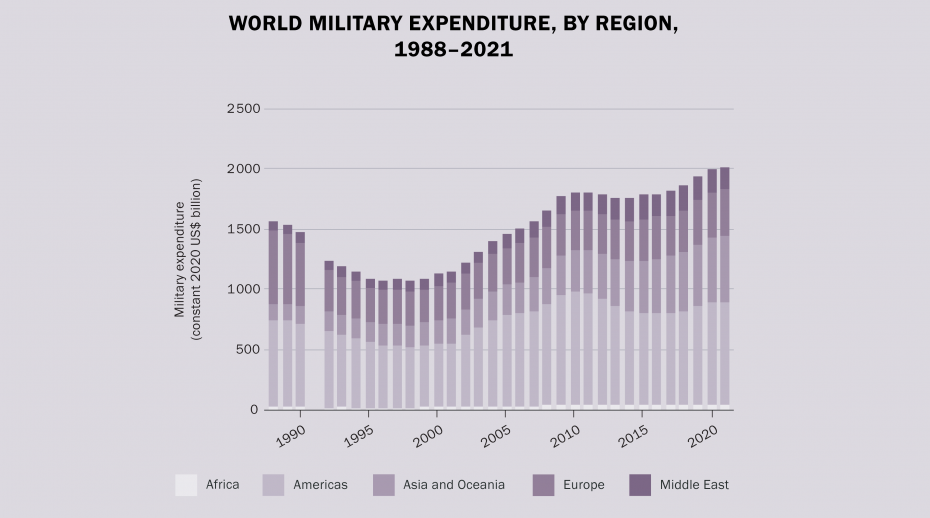
World military expenditure, by region, 1988–2021
Posted in Africa, Asia, Latin America & Caribbean, Market Lords, Middle East, Others-USA-Europe-etc., The Peoples, War Lords |
Leave a Comment »
03/05/2022
(UN News)* — Journalists and media workers are facing “increasing politicization” of their work and threats to their freedom to simply do their jobs, that are “growing by the day”, said the UN chief, marking World Press Freedom Day on Tuesday [3 May 2022].
Unsplash/Jovaughn Stephens | A video journalist covers a news event.
The day shines a spotlight on the essential work they do, bringing those in power to account, with transparency, “often at great person risk”, said Secretary-General António Guterres, in a video message.
Continue reading →
Posted in Africa, Asia, Latin America & Caribbean, Market Lords, Middle East, Others-USA-Europe-etc., The Peoples, War Lords |
Leave a Comment »
01/05/2022
(UN News)* — With extreme heat gripping large parts of India and Pakistan, the two countries are working to roll out life-saving health action plans to combat the heatwave, the World Meteorological Organization (WMO) said on Friday [29 April 2022].
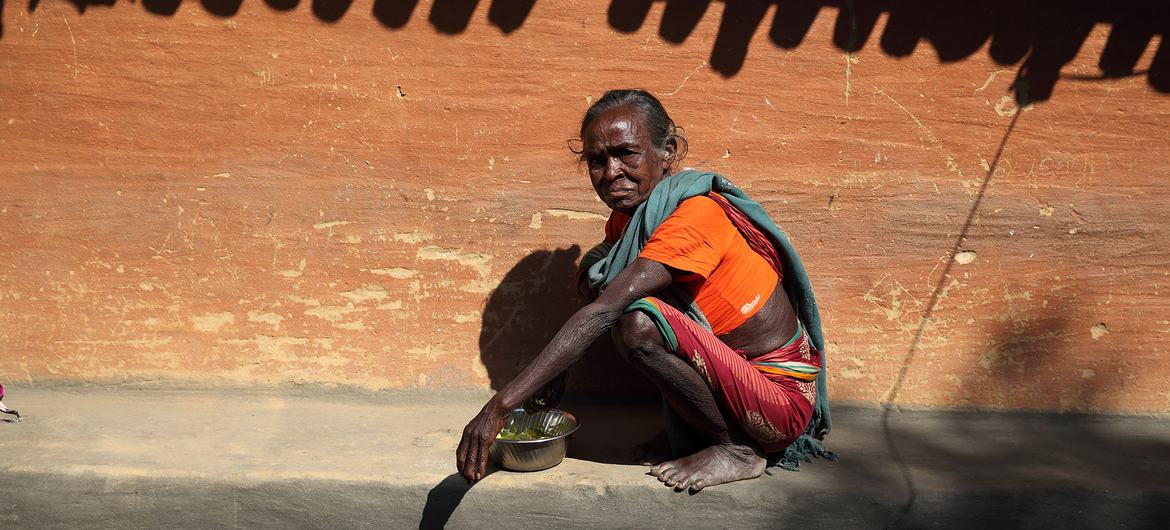
© UNICEF/Soumi Das | An elderly woman has her lunch in the sun at Adibasi Sahi, India. The extreme heat is impacting hundreds of millions of people in the country.
The extreme heat is impacting hundreds of millions of people in one of the most densely populated parts of the world, threatening to damage whole ecosystems.
Continue reading →
Posted in Asia, Climate Crisis, Market Lords, Migrants and Refugees, Mother Earth, Others-USA-Europe-etc., The Peoples |
Leave a Comment »
01/05/2022
(UN News)* — More than 3,000 people died or went missing while attempting to cross the Mediterranean and the Atlantic last year, hoping to reach Europe, the UN refugee agency, UNHCR, said on Friday [29 April 2022], appealing for $163.5 million to assist and protect thousands of refugees and asylum seekers.
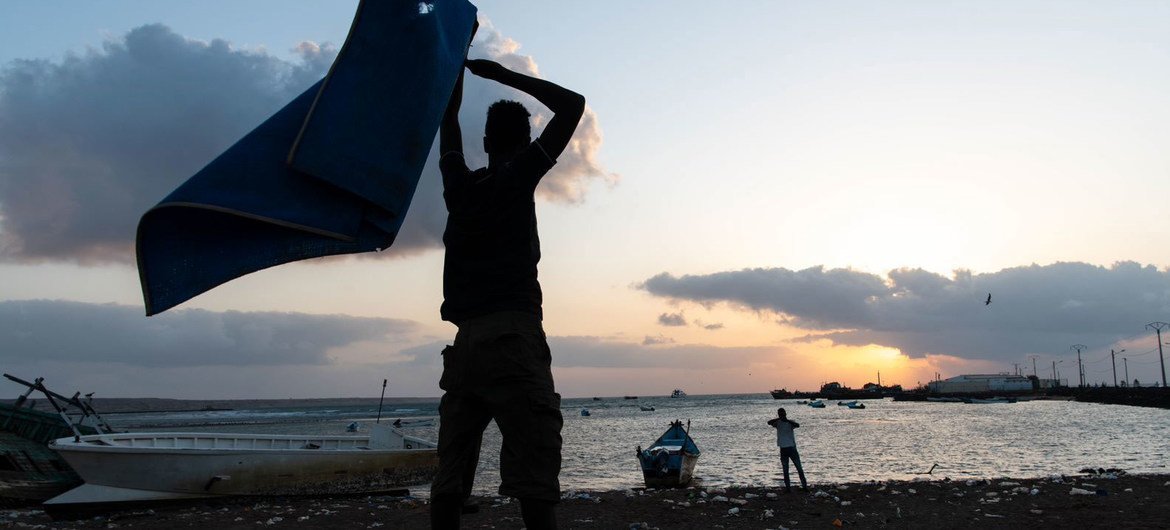
© IOM 2020/Alexander Bee | The crimes of trafficking and aggravated smuggling of persons are of great concern to UNHCR.
Posted in Africa, Asia, Climate Crisis, Latin America & Caribbean, Market Lords, Middle East, Migrants and Refugees, Mother Earth, Others-USA-Europe-etc., The Peoples, War Lords |
Leave a Comment »
01/05/2022
(UN News)* — The UN’s Humanitarian Country Team in Yemen on Saturday [30 April 2022] released its Response Plan (HRP) for this year, seeking nearly $4.3 billion to reverse a steady deterioration across the country, the grinding war there continues, despite a current pause in fighting.
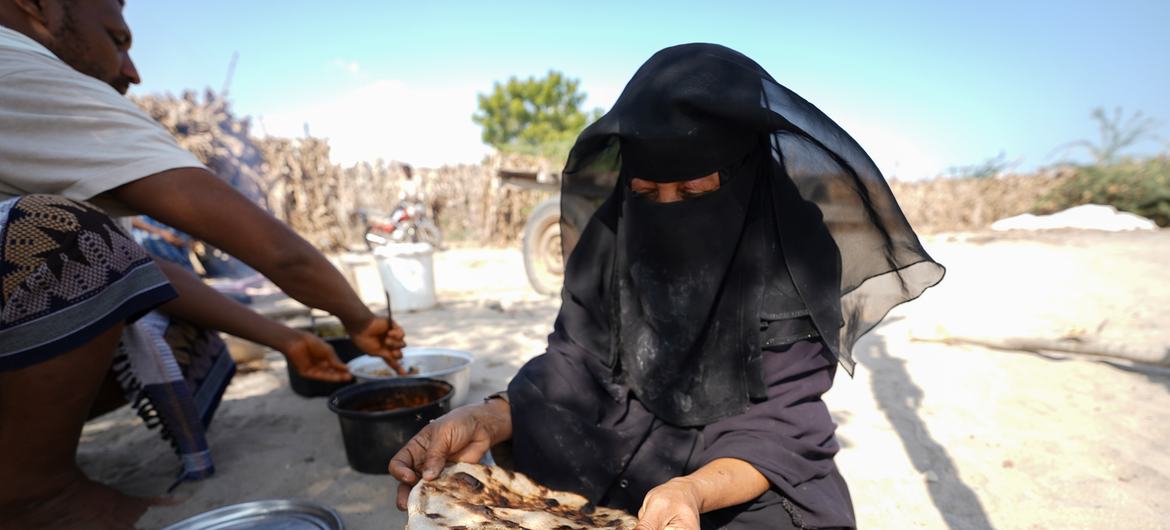
© WFP/ Saleh Hayyan | A woman baking bread at her shelter in Khanfar District, Yemen.
The plan targets 17.3 million out of the staggering 23.4 million people in need of lifesaving humanitarian assistance and protection services across the war-ravaged Arab nation, as the first nationwide truce in six years, coinciding with the Muslim holy month of Ramadan, continues to broadly hold.
The UN-led truce between the Saudi-led coalition forces supporting the internationally recognized Government, and Houthi rebels (formally known as Ansar Allah) who hold much of the country including the capital, Sa’ana, began on 2 April, and is due to continue through May.
Continue reading →
Posted in Asia, Market Lords, Middle East, Migrants and Refugees, Mother Earth, Others-USA-Europe-etc., The Peoples, War Lords |
1 Comment »
29/04/2022
MADRID, Apr 29 2022 (IPS)* – Every now and then, experts remind that the Indigenous Peoples are the best (and last?) custodians of the essential web of life: biodiversity.

Brazilian Indigenous people during one of their regular protests in Rio de Janeiro demanding the demarcation of their lands and to be taken into account in environmental and climate measures. Credit: Mario Osava / IPS
There are more than 370 million self-identified peoples in some 70 countries around the world. In Latin America alone there are over 400 groups, each with a distinct language and culture, though the biggest concentration is in Asia and the Pacific– with an estimated 70 per cent.
And their traditional lands guard over 80% of the planet’s biodiversity. Continue reading →
Posted in Africa, Asia, Climate Crisis, Latin America & Caribbean, Market Lords, Middle East, Migrants and Refugees, Mother Earth, Others-USA-Europe-etc., The Peoples |
1 Comment »


 HUMAN WRONGS WATCH